‘Gone Girl’ Is the Best Thriller of the 21st Century. Here’s How It Gets Inside Your Head.
The 50 Best Thrillers of the 21st Century
A.O. Scott dissects the first page of Gillian Flynn’s story of murderous marital dysfunction.
Share full article
0
20th Century Fox
By A.O. Scott
Aug. 4, 2026
Gillian Flynn’s “Gone Girl” was voted the best thriller of the 21st century in our recent poll. If you haven’t read it yet, you can start right here: We’re going to be looking at only the first three paragraphs, without giving away any secrets. And if you have read the book, it’s worth marveling at how Flynn grabs your attention and gives you the willies.
Not by revealing very much. A chapter heading states that the narrator is someone named Nick Dunne. We don’t know who this Nick is or what he’s like, and he’s not in a hurry to tell us. Here’s how he introduces himself in the opening passage:
When I think of my wife, I always think of her head. The shape of it, to begin with. The very first time I saw her, it was the back of the head I saw, and there was something lovely about it, the angles of it. Like a shiny, hard corn kernel or a riverbed fossil. She had what the Victorians would call a finely shaped head. You could imagine the skull quite easily.
I’d know her head anywhere.
And what’s inside it. I think of that too: her mind. Her brain, all those coils, and her thoughts shuttling through those coils like fast, frantic centipedes. Like a child, I picture opening her skull, unspooling her brain and sifting through it, trying to catch and pin down her thoughts. What are you thinking, Amy? The question I’ve asked most often during our marriage, if not out loud, if not to the person who could answer. I suppose these questions stormcloud over every marriage: What are you thinking? How are you feeling? Who are you? What have we done to each other? What will we do?
Right away, we’re knocked off balance. Is this guy a doting husband or a psychopath?
The doubt creeps in with the very first sentence.
There’s something a little off about a man rhapsodizing about his wife’s head.
He’s not talking about her eyes, her face or her smile, but about a part of her he compares to a dried-out seed and a petrified piece of long-extinct biomatter.
His rather chilly aesthetic appreciation of its shape and appearance leads him (and you, before you even know her) to picture her as a skeleton.
This is an image with a history.
“The skull beneath the skin” is a phrase from the first stanza of T.S. Eliot’s poem “Whispers of Immortality,” which cites the 17th-century English dramatist John Webster, notorious for his bloody tragedies of violence and vengeance.
The great mystery writer P.D. James took Eliot’s words for the title of one of her elegant novels of murder.
Nick, who turns out to be a failed writer, may have those references in mind.
His next sentence — a confession? an observation? a joke? — slides ever so subtly into grislier territory.
To say that you’d know your own wife anywhere (he still hasn’t told us her name, by the way) is to say nothing at all. Who wouldn’t?
But to say you’d recognize her head is to perform a rhetorical decapitation. You’d know it was hers even if it were detached from the rest of her.
Less than 100 words into the book, we’re already thinking about death and dismemberment, picturing a severed head and a skull stripped of flesh. But nothing alarming has happened. Any violence is implicit, which is to say that it’s in our heads, or maybe Nick’s.
The next thing we know he’s fantasizing about opening up his wife’s skull and examining its contents.
But that’s just a figure of speech, right? He’s talking about his perfectly innocent husbandly curiosity.
Not about splattering her brains all over the floor, but about finding out what’s on her mind, which is a normal part of marriage.
Really, it’s what being married is all about: wondering what the other person is thinking and coming up with relevant questions. Any couples therapist will tell you: The key to a relationship is communication.
But why does that feel so sinister, so threatening?
Before we know anything about this couple, Nick and Amy, we know their marriage is in trouble.
By now, millions of readers know exactly what kind of trouble.
When you think of your favorite thriller, you always think of the beginning.
Some writers plunge you right into the middle of the action, peppering you with names, places and vivid details.
Here’s Dan Brown, kicking off “Angels & Demons”: “Physicist Leonardo Vetra smelled burning flesh, and he knew it was his own.”
And here’s the beginning of Attica Locke’s “The Cutting Season”: “It was during the Thompson-Delacroix wedding, Caren’s first week on the job, that a cottonmouth, measuring the length of a Cadillac, fell some 20 feet from a live oak on the front lawn, landing like a coil of rope in the lap of the bride’s future mother-in-law.”
But other, equally masterly thrillers ensnare you in a butterfly net of indirection and innuendo, creating a mood of uneasy suspense without supplying much concrete information. That’s Flynn’s M.O.
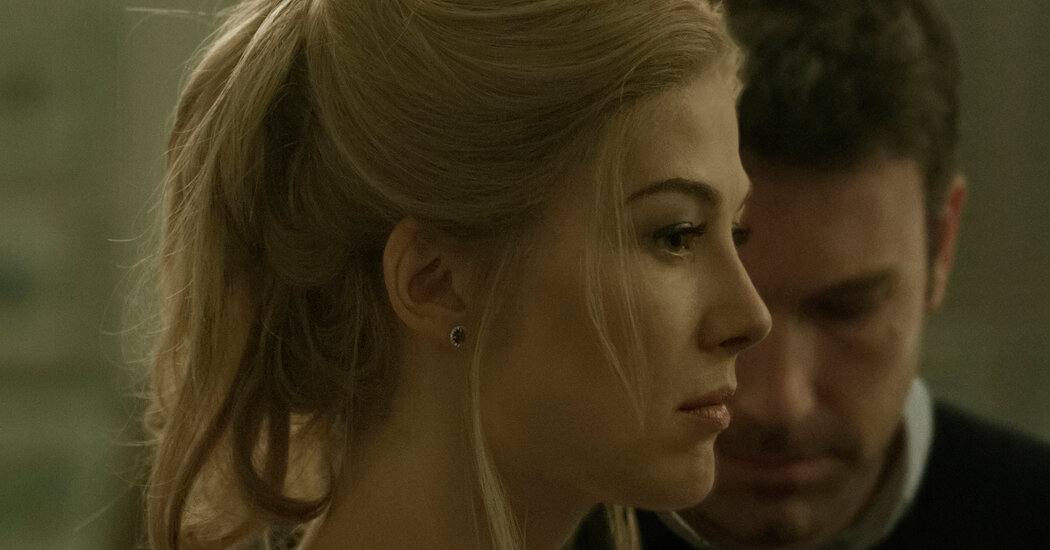
It works in movies too, though not exactly the same way. In her screenplay for the 2014 film adaptation of “Gone Girl,” directed by David Fincher, Flynn condensed the opening lines and emphasized the violence of Nick’s thoughts. In Ben Affleck’s tobacco-rasped baritone, he says he pictures “cracking her lovely skull” while the camera gazes upon Rosamund Pike’s blond, unblemished cranium. We’re not so much in his mind as in their bed.
20th Century Fox
Movies, even psychological thrillers as deft and atmospheric as “Gone Girl,” take place in literal, visual space. Fincher’s opening shots supply important facts about the characters and the setting, a stressed-out industrial town in the middle of the Great Recession. True to its source, the movie is full of twists and surprises. It’s cold, scary and sometimes appallingly funny.
The novel shares those qualities, but it also operates in a more intimate, human register. The story is anchored in the consciousness of its characters; we see it all through the fog of their desires, dreams and delusions. They’re smart people who make dubious, sometimes disastrous choices.
We start out with Nick’s version of things. Later, we’ll hear from Amy, gaining the kind of access to her mind that her husband can only fantasize about. The maelstrom of their marriage, once the stormclouds burst, is a classic and convoluted he said/she said story.
Tony Cenicola/The New York Times
The key to the novel’s power lies less in what they say than in how they say it — as if they are confiding in us, telling deeply held secrets, trusting us to be on their side, or at least to hear them out.
In those first pages, you can almost feel Nick’s hand on your shoulder as he muses on the mysteries of his wife’s skull. In real life, you might be plotting your escape, nodding politely and stepping away. “Gone Girl” reverses that magnetism. What should repel you draws you nearer. The book gets into your head, and under your skin.
The 50 Best Thrillers of the 21st Century
See the full list, as voted on by 291 experts
Find out how your favorite writers voted
Want to weigh in? Play our game.
Take a closer look at the top pick
Let Us Help You Find Your Next Thriller
The Best Thrillers of 2025
Three of Summer’s Best Thrillers
The 100 Best Books of the 21st Century
The 100 Best Movies of the 21st Century
Share full article
0
……Read full article on The New York Times-Arts
Other

One-stop lifestyle app dedicated to making life in Singapore a breeze!




 English
 简体中文
简体中文
Comments
Leave a comment in Nestia App