‘If we can’t have a good marriage, at least have a good divorce’: S’pore man on amicable split
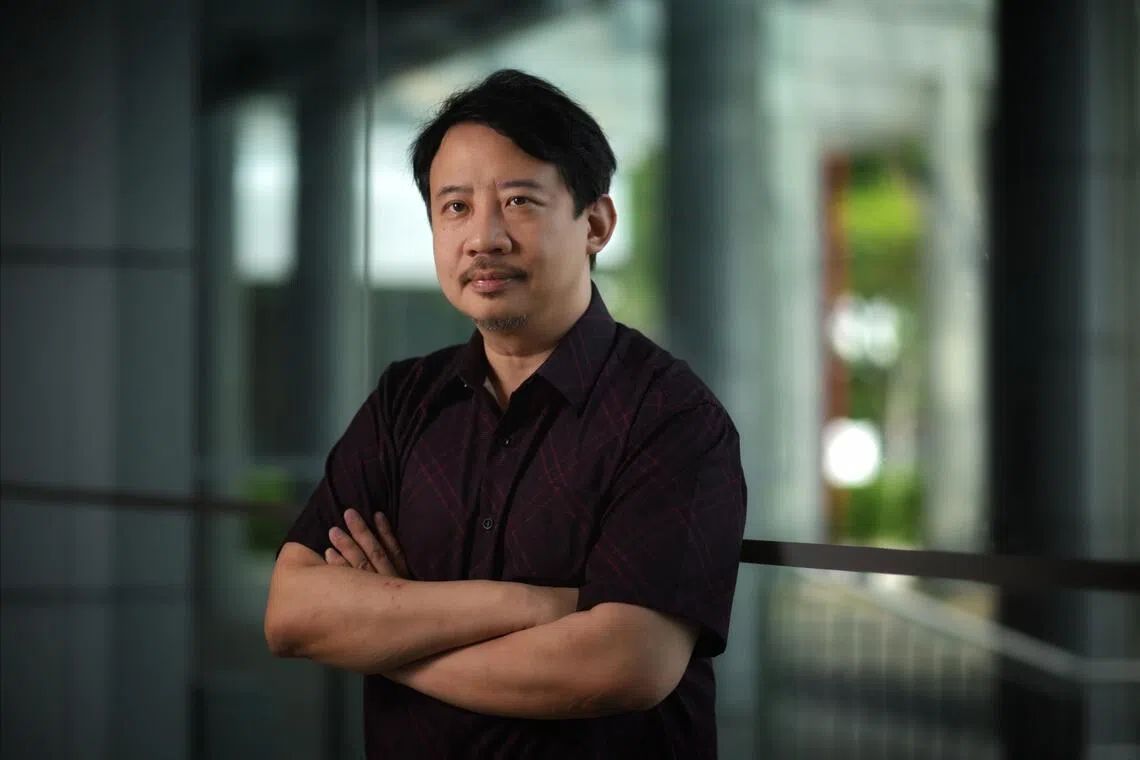
Don Shiau and his wife split on good terms and they decided to choose the new legal reason for divorce, called divorce by mutual agreement.
SINGAPORE - Writer Don Shiau, 45, and his then wife waited nearly three years before filing for divorce – holding out for a new legal option for them to part ways without blaming each other.
They used divorce by mutual agreement, which kicked in on July 1, 2024, as it did not feel truthful or fair to cite unreasonable behaviour as the reason for their marriage ending.
“It was not the kind of divorce (where you think) ‘You are so unreasonable that I cannot live with you anymore’,” said Shiau.
“We felt we conducted ourselves well in the marriage. So to go on record to say (there was) unreasonable behaviour, it didn’t feel emotionally right.”
The childless couple separated amicably.
There was no major deal breaker like adultery or abuse, said Shiau, who obtained his former wife’s blessing for this interview.
He added that their marriage counsellor had said their main issue was the way they handled conflict.
“We had very different approaches to resolving conflict, and it ended up taking a toll on both of us,” he said.
“We ended up feeling unhappy and resentful, and it felt (like the marriage) couldn’t work anymore.”
Their divorce was finalised about four months after they filed. The process was smooth, said Shiau.
Like him and his former wife, almost one in five civil, or non-Muslim, couples in 2025 cited this new legal fact, according to the 2025 marriage and divorce statistics released by the Department of Statistics on July 10.
A fact is one of six ways recognised under the Women’s Charter to prove a marriage has broken down irretriveably.
Divorce by mutual agreement was the third-most common reason cited for civil divorces, after unreasonable behaviour and living apart or separated for three years or more.
Lawyers say the new option reduces acrimony in the divorce process, as it allows couples to jointly acknowledge that the marriage has broken down without requiring either spouse to be cast as the wrongdoer.
Gloria James-Civetta, head lawyer of Gloria James-Civetta & Co, said that if a spouse cites a fault-based fact, such as unreasonable behaviour or adultery, he or she has to set out their charges of such behaviour. And the other party may deny or counter those allegations.
She said: “This can place parties in the roles of accuser and the accused, and require them to revisit painful events in the marriage to establish or resist blame.
“Such allegations may heighten feelings of anger, humiliation and resentment, making it more difficult for the parties to communicate respectfully.”
Jessica Chow, PKWA Law Practice’s associate director of family law and probate department, said focusing on problem-solving instead of fault-finding also benefits children.
Chow said: “When parents are able to avoid an adversarial contest over blame, they are generally better able to communicate and work together on decisions affecting their children.”
In Singapore, the only legal ground for civil divorces is that the marriage has broken down irretrievably.
Divorce by mutual agreement is one of six facts that can be relied on to prove this.
There are three fault-based facts – adultery, desertion and unreasonable behaviour.
Besides that, there are also two non-fault-based facts, where a couple must have been separated for at least three years with consent to divorce or separated for at least four years if there is no consent.
But citing divorce by mutual agreement is not an easy way out, said Rajan Chettiar, managing director of Rajan Chettiar LLC.
Couples have to tell the Family Justice Courts in detail why their marriage broke down, what they did to try to save it and why it still cannot be salvaged, he said.
He added that divorce by mutual agreement is the only fact where the couple must show the attempts they have taken to mend their marriage.
Chow said that this includes attending marriage counselling or mediation, seeking advice from family, friends or religious leaders, or discussing their differences and making other efforts to improve their relationship.
She added: “If the Family Justice Courts is not satisfied that the parties have genuinely explored reconciliation and that those efforts have failed, or if it considers there remains a real prospect of reconciliation, it may delay or decline to grant the divorce.”
Previously, there were concerns that allowing for divorces by mutual agreement would make divorce easier and lead to more couples ending their marriages.
The latest figures suggest that this has not happened, and lawyers note that couples do not decide on divorce lightly.
There were 5,288 civil divorces in 2025, down from 5,638 in 2024 and 5,649 in 2023.
Director of Integro Law Chambers Angelina Hing said: “It would never be the case where a party learns that it is easier to get a divorce and decides to get one.”
For Shiau, ending his marriage of four years was a difficult decision, given all the good times he and his former wife shared.
They had tried their best to make the marriage work, having attended 25 sessions of marriage counselling.
They also attended five sessions of discernment counselling – an option for couples on the brink of divorce – to help them decide whether to stay or end their marriage.
He said the discernment counselling helped him conclude that even after trying their best, further efforts to repair their relationship was futile.
Shiau said divorce by mutual agreement was a “humane” option, as it did not involve revisiting the faults and grievances in the marriage. Today, he and his former wife are still “cordial”.
He said: “The way I see it, if we can’t have a good marriage, at least have a good divorce.”
……Read full article on The Straits Times - Singapore
Singapore

One-stop lifestyle app dedicated to making life in Singapore a breeze!




 English
 简体中文
简体中文
Comments
Leave a comment in Nestia App