481 firms lauded for doing good in 2026; businesses donated nearly $384 million over past three years
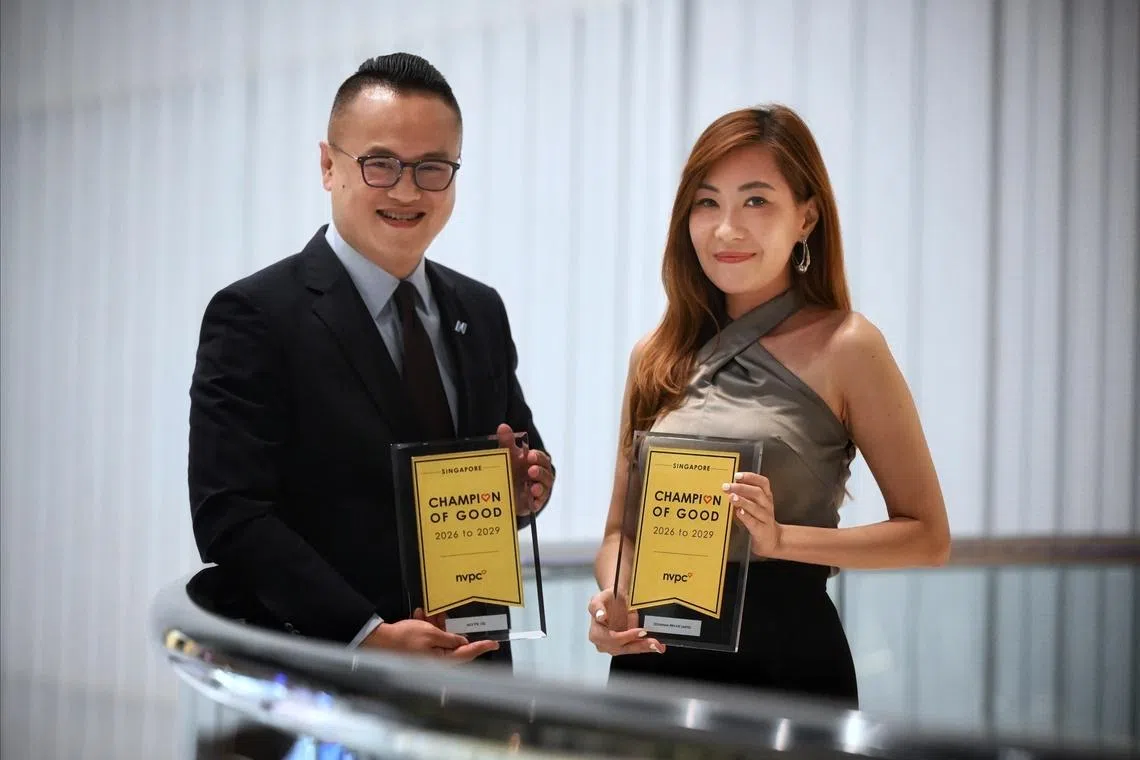
NCS CEO Sam Liew (left) and Go!Mama CEO Vivian Lee at the Company Of Good Conference and Conferment on July 20.
SINGAPORE – More than 480 companies here have been lauded for doing good and creating a positive impact in Singapore through activities like volunteering or donating so far in 2026.
Collectively, a total of 1,046 businesses have been recognised as Companies of Good by the National Volunteer and Philanthropy Centre (NVPC) over the past three years. Together, they have given nearly $384 million in donations, more than $85 million in donations in kind, and contributed more than 1.1 million volunteer hours.
Small and medium-sized enterprises formed the majority of companies in the 2026 cohort, numbering 376, up from 363 in 2025. The Company of Good movement, which recognises businesses that contribute meaningfully to society, marks its 10th anniversary in 2026.
The 2026 numbers were published in an impact report by NVPC on July 20, released at the Company of Good Conference and Conferment at Fairmont Singapore, where close to 700 business leaders gathered.
In a speech at the event, Deputy Prime Minister and Minister for Trade and Industry Gan Kim Yong said that in a volatile world, expectations of companies are changing, and people are increasingly looking not only at what organisations achieve, but also at how they achieve it.
This includes how they hire, how they treat workers, how they operate and how they give back, he said.
The Company of Good movement has evolved from encouraging corporate giving to a broader movement of organisations committed to creating positive impact, he added.
“The next step is to deepen this in practice – and do good by our workers, for our communities and for society at large.”
To do good by workers, Gan said businesses should ensure that transformation amid a changing environment and disruptive technologies is done with workers, not simply to them.
“This means communicating with employees honestly, involving them in job redesign, investing in training and creating credible pathways into new roles,” he said.
“A business that invests in its employees builds a more capable and engaged workforce.”
NVPC’s awards are given in four tiers, with Champion of Good being the highest. Of the 481 companies lauded in 2026, 63 were recognised as Champions of Good.
These include NCS, an artificial intelligence-led tech services company. It previously received the Company of Good – Three Hearts award in 2025 and progressed to Champion of Good in 2026.
Over the past year, NCS increased its donations and more than doubled its volunteer hours, from almost 4,700 to 9,800. One initiative equips children from disadvantaged backgrounds with digital skills through workshops in generative AI, programming and digital design.
Gan said NCS is a good example of doing good for communities in Singapore, where companies can help ensure that progress does not leave the vulnerable and less privileged behind.
“When businesses support the communities around them, they build trust with customers, partners and the public, and strengthen their own long-term resilience,” he said.
Challenges like workforce disruption, inequality and food insecurity cannot be solved by one organisation acting alone, Gan said. Company of Good provides a trusted ecosystem where organisations can collaborate and create positive impact together.
One example is Go!Mama, a local social enterprise that aims to improve access for nursing mothers to breastfeed and express milk in public. It was conferred the Champion of Good award. It currently operates more than 100 lactation pods across Singapore and facilitates more than 80,000 nursing and pumping sessions each year.
It also works closely with government agencies, community organisations and corporates to bring different sectors together and create more family-friendly public spaces and workplaces.
The founder of the start-up, Vivian Lee, told The Straits Times the company intentionally keeps its doors open to women from underserved backgrounds when creating new roles or filling existing ones. About 30 per cent to 50 per cent of its team is made up of women who are single mothers or from disadvantaged communities.
“This has been a deliberate hiring practice rather than a target,” she said. “We believe many women do not lack the ability, they simply have not had the opportunity or support to re-enter the workforce.”
MangaChat, a wellness platform that uses digital experiences to help children develop social-emotional skills and express their emotions better, was named a Company of Good – Two Hearts at the event.
The company also hosts emotional wellness workshops in the community and collaborates with charities to co-create programmes that help children and youth. It has reached more than 150,000 children to date.
MangaChat co-founder Renee Chong told ST that being recognised as a Company of Good is a reminder that technology should always serve people.
Many parents today have achieved success in their own careers but are increasingly uncertain about what advice to give their children in a rapidly changing world, said Chong.
“Instead of preparing children for one specific future, we should equip them with the resilience, emotional regulation and adaptability to navigate any future. That is the impact we hope to create.”
She said MangaChat will continue working to make emotional well-being support more accessible, while developing responsible AI that empowers, not replaces, the relationships between children and the adults who care for them.
……Read full article on The Straits Times - Singapore
Singapore

One-stop lifestyle app dedicated to making life in Singapore a breeze!




 English
 简体中文
简体中文
Comments
Leave a comment in Nestia App