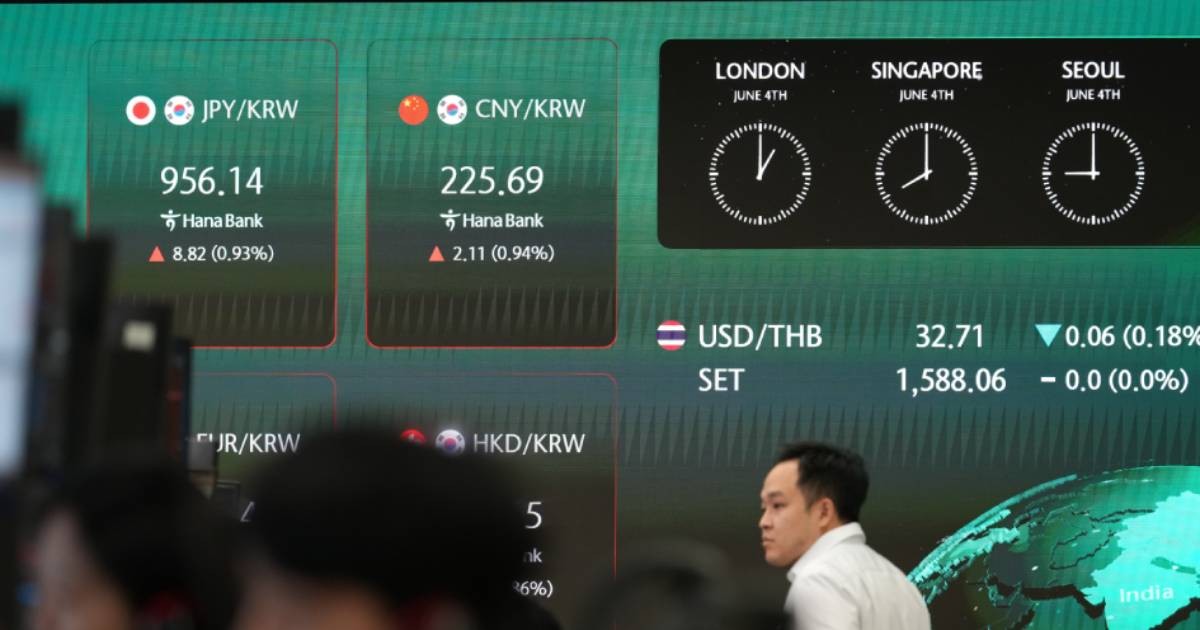
Asian shares retreat as US stocks halt their record-breaking rally, while oil prices fall back
Asian shares retreated on Thursday (June 4) following declines on Wall Street that snapped a nine-day winning streak for the S&P 500.
Oil prices fell back after surging Wednesday as renewed fighting threatened the US-Iran ceasefire.
Early Thursday in Asia, Brent crude was US$1.17 (S$1.50) lower at $96.64 per barrel, while benchmark US crude oil shed $1.08 to $94.94 per barrel. Oil prices had climbed a day earlier after both the United States and Iran said they launched retaliations for earlier attacks or attempted ones.
In share trading, Japan's Nikkei 225 shed 1.9 per cent to 67,101.83 as traders sold technology stocks to lock in gains. Energy and technology giant SoftBank Group slumped 10.4 per cent, while Shin-Etsu Chemical dropped 3.8 per cent.
Hong Kong's Hang Seng lost 1.3 per cent to 25,299.29, and the Shanghai Composite index fell 0.4 per cent to 4,067.46.
In South Korea, the Kospi sank 1.7 per cent to 8,651.87, while Australia's S&P/ASX 200 declined 1.5 per cent to 8,657.40.
On Wednesday, the S&P 500 fell 0.7 per cent from its all-time high for its first drop in 10 days, closing at 7,553.68. The Dow Jones Industrial Average dropped 1.2 per cent to 50,687.07, while the Nasdaq composite sank 0.9 per cent to 26,853.98.
Palo Alto Networks helped drag the market lower, and it fell 5.6 per cent even though it reported profit for the latest quarter that topped analysts' expectations.
Stocks also felt pressure from higher yields in the bond market, which climbed with the price of oil. The yield on the 10-year Treasury rose to 4.49 per cent from 4.46 per cent late Tuesday and from just 3.97 per cent before the war began.
High yields worldwide are threatening to slow economies and undercut prices for stocks and all kinds of other investments. They have already forced the average long-term US mortgage rate to its most expensive level in nine months, and they could curtail companies' borrowing to build the artificial-intelligence data centres that have supported the US economy's growth recently.
More expensive loans can hurt smaller companies in particular because many need to borrow to grow. The Russell 2000 index of the smallest US stocks fell 1.3 per cent, more than the rest of the market.
Reports released Wednesday on the US economy came in mixed. One from the Institute for Supply Management said growth accelerated more last month for US construction, agricultural and other services businesses than economists expected.
The survey also showed businesses are feeling the pinch of higher prices caused by tariffs and more expensive oil.
Still, stocks remain near their records, even with all the pressure on the global economy created by higher inflation.
Oil prices remain below their peaks from earlier in the war with Iran, and hope seems to be remaining on Wall Street that the United States and Iran will ultimately agree to reopen the Strait of Hormuz to oil tankers. That would improve the global flow of crude and hopefully lower its price.
GameStop rose 6 per cent after the video-game retailer said its revenue in the latest quarter grew 14 per cent from a year earlier. It also announced a programme to send up to $2 billion to its investors by buying back its own stock.
Macy's added 0.6 per cent after swinging between gains and losses through the day. The retailer reported profit for the latest quarter that blew past analysts' forecasts, while saying an overhaul of its merchandise and better customer service is resonating with customers.
In other dealings early Thursday, the US dollar fell to 159.90 Japanese yen from 160.08 yen late Wednesday. The euro rose to $1.1610 from $1.1600.
[[nid:737278]]
……Other

One-stop lifestyle app dedicated to making life in Singapore a breeze!




 English
 简体中文
简体中文
Comments
Leave a comment in Nestia App