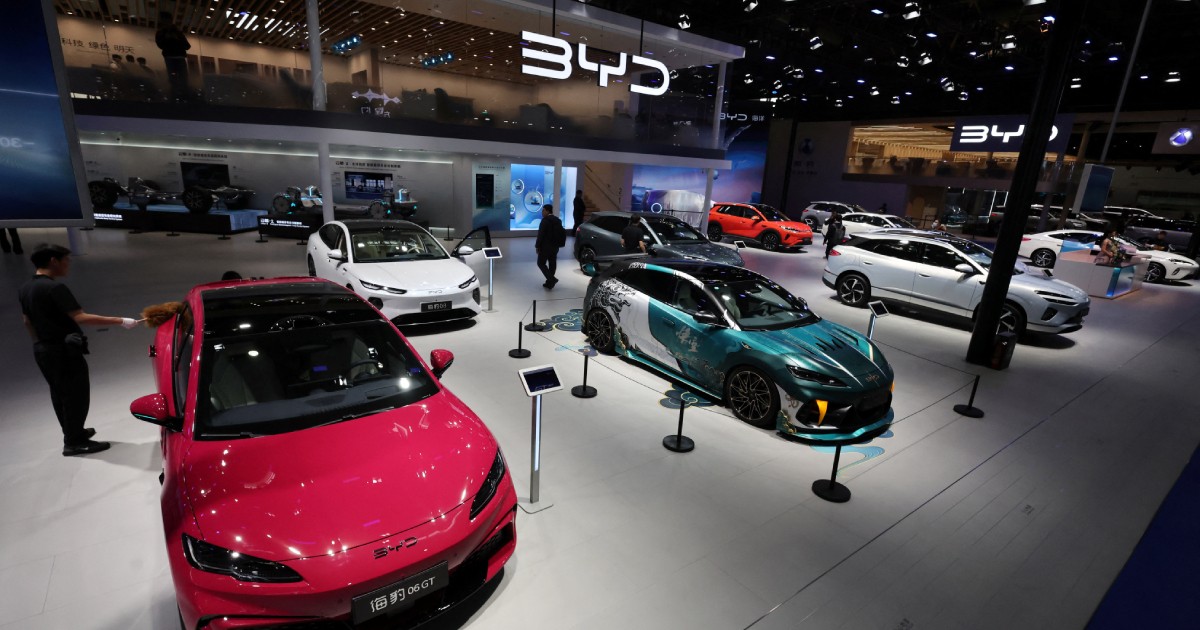
BYD doubles down on fast charging to target China's EV holdouts
BEIJING - China's BYD is pushing super-fast charging to attract drivers still loyal to petrol cars and sharpen its edge in the world's largest auto market, the company's No. 2 executive said on Friday (April 24).
After a meteoric rise to become the world's biggest EV maker, BYD has seen domestic sales fall for seven straight months amid a bruising price war and intensifying competition from local rivals.
The company is now rolling out more models equipped with super-fast "flash" charging as it looks to win over drivers who have avoided EVs due to range anxiety and concerns about long charging times, executive vice president Stella Li told Reuters on the sidelines of the Beijing Auto Show.
"Flash charging is so important for BYD because this solves the last barrier for EV adoption," Li said. "This means we now can compete with the gas market."
BYD says its second-generation batteries can charge from 20 per cent to 97 per cent in under 12 minutes, even at minus 20 degrees Celsius (minus four degrees Fahrenheit) and deliver a driving range of 777 kilometres.
The technology could help BYD build a strong defensive moat against competitors, Li said. As part of that push, the automaker plans to build about 20,000 flash-charging stations in China and 6,000 overseas over the next 12 months.
BYD's recent slowdown at home - where it once appeared unassailable - underscores the ferocity of competition in China's car market.
Sales surged more than tenfold to 4.6 million vehicles in 2025 from 420,000 in 2020, making BYD the world's No. 5 automaker by volume.
BYD, which makes fully electric cars and plug-in hybrids, overtook Volkswagen as China's top carmaker in 2024, ending the German group's 25-year run as market leader. Last year, it surpassed Tesla as the world's top EV maker.
But since peaking in late May last year, BYD shares have fallen 25 per cent, and the company last month posted its first annual profit decline in four years.
Domestic sales have been squeezed by rivals including Geely and Leapmotor, prompting BYD to roll out its first major battery upgrade in six years.
"It's not that BYD is necessarily doing badly," said Gartner analyst Pedro Pacheco. "But they were growing so fast, where they are now seems bad."
Geely topped new-car sales in China in January and February, briefly pushing BYD down to fourth place. A company source said Geely aims to become China's No. 1 automaker on a sustainable basis within 12 to 18 months.
"It's not that they are misjudging consumers in China," said automotive analyst Felipe Munoz. "BYD knows very well what consumers want, but there is just more competition."
While sales have slowed at home, BYD is expanding aggressively overseas. Sales rose 270 per cent in Europe in 2025 and were up 156 per cent in the first quarter.
The company told analysts in March it was "highly confident" of meeting its 2026 overseas sales target of 1.5 million vehicles or more, after sales outside China hit one million vehicles in 2025.
By 2030, BYD aims for half of new-car sales to come from overseas markets.
……Other

One-stop lifestyle app dedicated to making life in Singapore a breeze!




 English
 简体中文
简体中文
Comments
Leave a comment in Nestia App