Building domestic capabilities through investments
THE success of investments should be measured not merely by the amount of capital they bring, but by their contribution to building lasting domestic capabilities, strengthening technology transfer and innovation-sharing, and integrating domestic firms into global value chains.
Achieving this requires a continued focus on quality investments through strategic policy and sustained investor confidence, alongside targeted public investment.
In particular, public investment in core infrastructure such as power grids, roads and utilities remains essential in emerging areas with strong potential for future economic activity.
Public and private investment should play complementary roles in sustaining investment activity and generating broad-based economic benefits.
While private investment remains an important driver of capital formation, job creation, technology adoption and supply-chain integration, public investment can act as a catalyst in key industrial areas and help de-risk new growth drivers.
The implementation of the New Incentive Framework in 2026 marks a strategic shift towards a selective, outcome-based regime designed to maximise long-term national economic returns.
Moving beyond conventional capital metrics, the framework prioritises high-growth, high-value (HGHV) creation by measuring GDP contribution for every ringgit invested.
This targeted approach is intended to ensure that incentives generate tangible structural benefits, including stronger domestic supply-chain integration and faster technology transfer across key growth sectors.
The framework also places greater emphasis on sustainability and human capital development.
Incentives are structured to give greater weight to environmental, social and governance performance and decarbonisation targets, while encouraging the creation of high-skilled jobs and a more resilient, future-ready workforce.
This would help ensure that investment supports not only near-term economic activity but also longer-term productivity and capability building.
At the same time, sustaining the country’s private investment momentum will require a more aggressive approach by investment promotion agencies.
Close engagement with relevant authorities and utilities providers can help expedite project execution and resolve regulatory bottlenecks. Streamlined approval processes, clearer reporting lines and better data synergies across agencies would further support timely project implementation and ensure that committed investments translate into actual economic output.
This is particularly important given the persistent gap between approved investment and its physical realisation. A 10% increase in approved investment is estimated to increase private investment by 5.2%, with the effect expected to materialise within six to 18 months.
The finding highlights the importance of sustained monitoring and effective project facilitation in converting investment commitments into actual projects and economic activity.
The broader economic impact of private investment also depends on how effectively capital is deployed.
A 10% increase in real private investment is associated with an estimated 0.49% increase in real GDP, while private investment’s share of GDP has risen from 15.3% in 2022 to 17.2% in 2025.
Initial capital spending can generate demand across the domestic economy through construction, machinery procurement, local suppliers and technical services, while technology-driven investment can create longer-term productivity and capability gains.
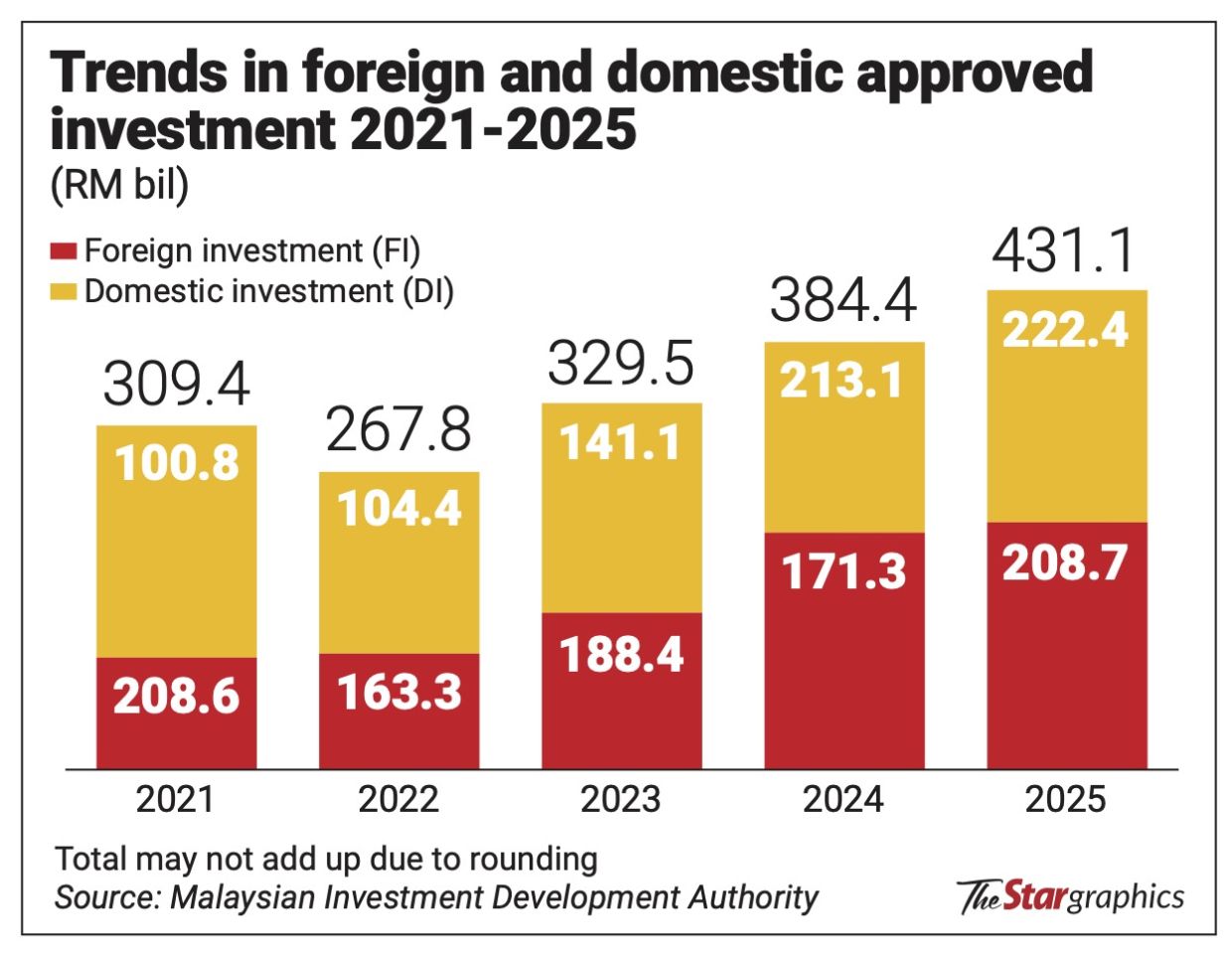
Malaysia’s relatively balanced mix of domestic and foreign investment provides a further foundation for this strategy.
Domestic investment accounted for 51.6% of total approved investments in 2025, while foreign investment remained an important source of technology transfer and access to global markets. Moving forward, economic success will depend not only on the volume of investment secured, but also on how effectively the nation transforms investment into resilient growth and greater socio-economic development.
……Read full article on The Star Online - Business
Entertainment Malaysia

One-stop lifestyle app dedicated to making life in Singapore a breeze!




 English
 简体中文
简体中文
Comments
Leave a comment in Nestia App