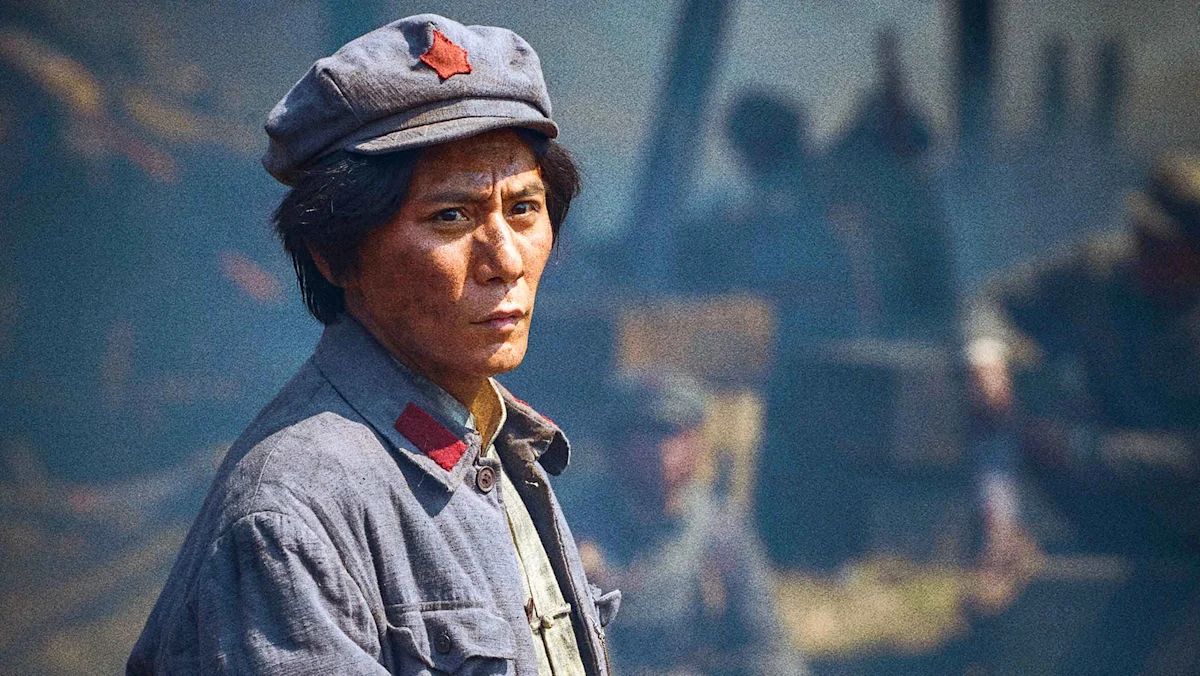
Crossing Review: What's Infernal Affairs Director Andrew Lau Producing A Mao Zedong War Epic?
Crossing (NC16)
Starring Liu Ye, Yu Shi, Wang Lei, Wang Zhifei, Wang Yaoqing
Directed by Xu Zhanxiong
After the heartwarming Dear You, here comes more serious chest-beating.
For folks of a certain vintage, heritage and acreage. Mainly mainland. Ideally a historian, patriot or flag-waver. If you're none of these, well ..... Oh Dear, You. As you try to keep track of the whirlwind of numerous actual figures thrown right at you.
So serious here it's about China's Red Army fighting desperately for survival in an internecine war of heavily outnumbered communists being encircled by much-better-armed nationalists — 30,000 vs 400,000 — circa 1934 before World War II. The former group builds bridges with bare hands. The latter bombs them to smithereens with warplanes.
With a young, rule-breaking Mao Zedong (Lan Yu's Liu Ye) portrayed as a brooding genius. Understanding the value of tactical retreat, he stages mobile, unpredictable guerilla warfare against his methodical, tradition-stifled counterpart, Chiang Kai-shek (Taiwanese actor Wang Yaoqing), in a your-move-against-mine grand, bloody chess match.
Kinda like The Lord Of The Rings with terrain maps spread out. But in drabber outfits.
The humanising small picture here focuses on Zhou Defa (Yu Shi, aka Yosh Yu, from Creation of the Gods series), progressing from seemingly uncaring foot soldier to prototype-commando whose determination grows as his buddies die. In formulaic fashion, a resourceful, unyielding orphan boy, Ajin (Xia Zixuan), embodying the future of China, tags along with him.
Now, director Xu Zhanxiong (The Pioneer), working with co-producer and Infernal Affairs trilogy co-director Andrew Lau, tries not to lionise Mao too much by making him seem somewhat unsure, but there's no escaping the main man's distinct aura. “Remarkable achievements can only be achieved by outstanding figures,” goes the adulation.
Crossing the Chishui River flowing along Sichuan and Guizhou four unexpected times to lure and trick the enemy, the highly motivated brown-clad Reds attack the too-conventional blue-uniformed Kuomintang in victoriously fluid ways. Including scaling a treacherous cliff, suicidal Spiderman-style, to surprise them from behind.
Gotta admit. I thought the Long March was just a very, very long march. I've never heard of this river.
FYI. This pic was reportedly made to commemorate China's 90th anniversary of that historic trek (that’s June 26). So there's no propaganda dispute, à la Dear You, here. This most definitely is straight-up political fare.
Mercurial Mao, not yet installed as Chairman, is seen moping, chain-smoking and thinking deep thoughts in frontline tents and huddled meetings, 1921 (the founding-of-the-CCP film, which included the late Eric Dane in the cast) style, as a moody outsider-dreamer among seasoned military commanders.
Those early-day founders of modern China — calm patrician Zhou Enlai (Wang Lei), battle-hardened charger Zhu De (Wang Zhifei) — are proven leaders trained overseas. While Mao, looking like a rock star with wavy centre-parting hair, is labelled as a village school teacher who derives his strategic ideas from book classics such as Romance of the Three Kingdoms. There are great democratic scenes here where maverick boldness trumps traditionalism as senior socialist people are outvoted for Mao to eventually take over.
Out of instinct and his reading of the psychological nature of the enemy, the iconoclast throws away all previous wisdom to turn the tables on a far superior force that's riddled by opulent overconfidence and corrupt warlords.
While Chiang's nationalists dine in finery, Mao's forces scrape by on small pickings as they repay the simple villagers they encounter with kindness. Removing wooden doors and windows to build the bridges, the Red Army pays the supportive commoners with proletarian money.
Now, the battle scenes seem, to me, to try not to be too graphically brutal. Soldiers get killed, yes. But there's less of the full-on hatred, blood-and-gore frenzy seen in, say, The Battle at Lake Changjin flicks, where Americans were the foes. Could be because this is, after all, Chinese battling Chinese.
Director Xu tries to make this reverent movie more appealing to modern audiences by contemporising its shots, angles and vibes of the final boss here.
Liu Ye's Mao Zedong is a modernist enactment of the Great Helmsman in full temperamental mode.
A fascinating portrait of the artist as a young helmsman. (3/5 stars) in cinemas now
Photo: Shaw Organisation
……Other

One-stop lifestyle app dedicated to making life in Singapore a breeze!




 English
 简体中文
简体中文
Comments
Leave a comment in Nestia App