Dad got healthy, gave up bad habits to donate liver to son with rare condition
Medical Mysteries
Medical Mysteries is a series that spotlights rare diseases or unusual conditions.
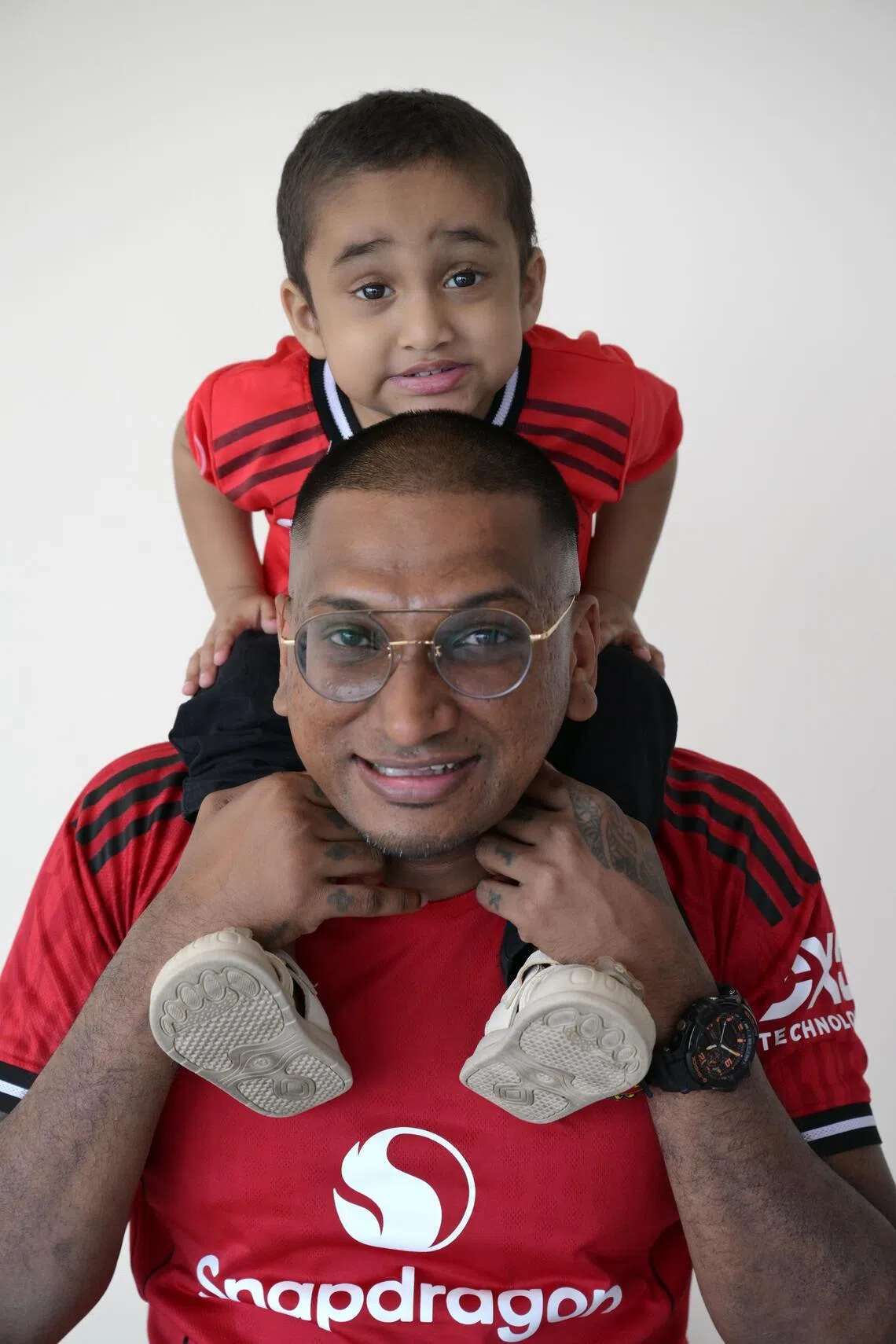
Noel Joshua Selvanathan with his son, Isaiah Luiz Noel, who was diagnosed with a rare genetic disorder called Alagille syndrome.
SINGAPORE – When service staff Noel Joshua Selvanathan, 36, first learnt that his son, Isaiah, was diagnosed with a rare genetic condition and needed a liver transplant to survive, he feared there was little he could do to help.
“I was incarcerated then and having struggled with substance and alcohol abuse in the past, I was just not the right fit. I also suffered from hepatitis C and fatty liver disease, so all I could do was pray,” he told The Straits Times.
Isaiah, now three, was born with Alagille syndrome, a rare genetic disorder characterised by abnormal bile ducts that cause bile to accumulate inside the liver, making it hard for it to get rid of waste which accumulates in the blood. This also damages the liver.
Estimated to affect about one in 70,000 people, it is usually discovered either when patients are still infants or during early childhood. Liver transplantation is the only effective long-term treatment for the disease.
Isaiah was diagnosed at KK Women’s and Children’s Hospital but was later referred to the National University Hospital (NUH) as it is the only public hospital in Singapore authorised to perform paediatric liver transplants.
These complex procedures for children up to 18 years old are managed by the National University Centre for Organ Transplantation (NUCOT) and the Khoo Teck Puat – National University Children’s Medical Institute (KTP-NUCMI).
S. Venkatesh Karthik, a senior consultant with the Division of Paediatric Gastroenterology, Nutrition, Hepatology and Liver Transplantation in the Department of Paediatrics at the Khoo Teck Puat – National University Children’s Medical Institute, said when he first saw Isaiah at two years old, he was very weak.
“What struck me when I first saw him was how jaundiced he was. Also, his appetite was very bad and his energy was very low. He was unable to play as a child of his age should be playing,” Karthik said.
Jaundice, the yellow cast to the skin and eyes, is a hallmark of liver problems.
“Even when his (older) sister, Alexandria, was trying to stimulate him to play, he just did not have the energy to do so. He used to lie down and smile,” he added.
That was when it hit home that the boy was in urgent need of a transplant.
“We got the nutritionist on board immediately to advise on his dietary plan as it was important for the child to be at optimal health from the nutritional point of view since liver transplant is a major undertaking,” he said.
The boy was admitted for a battery of tests and scans before he was listed for a transplant. In such situations, the child is put on the national waiting list or the team looks to the National Organ Transplant Unit for an altruistic anonymous living donor.
The average waiting time on the national list for a deceased donor liver in Singapore is about 12 to 22 months, but because donor organs are scarce, waiting periods can extend significantly depending on blood type, medical urgency and the severity of the patient’s condition.
Many patients opt for a living donor liver transplant – where a healthy family member or compatible living person donates a portion of his or her liver, reducing the wait time to about two months.
Noel said: “It was after my release and after I met with the doctors that I realised how serious the condition was. Isaiah’s doctors had determined that a liver transplant was his best chance at a healthy future.”
Since he could not donate part of his liver, his wife, Melissa Orchard, volunteered.
Unfortunately, during one of the scans, Orchard was found to have lesions and a growth in her spleen.
The 39-year-old housewife said: “The doctors had to eventually remove my spleen and because of that, I could no longer give part of my liver to Isaiah. The only way for Isaiah was to wait for a cadaveric (deceased) donor.”
When Noel found out that his wife’s donation was out of the question, he set out on what would be the most important mission of his life.
“I had to totally change my lifestyle and give up bad habits and alcohol to become a viable organ donor for Isaiah,” he said.
At the time, he was having supper and drinking almost every day, usually with friends after work.
“Isaiah was diagnosed with worsening liver failure and if we were to wait for a deceased liver donor, his own liver would have failed him already. When I found out that I was a match for him, I was extremely grateful to God and to the doctors,” he said.
To be considered as a living liver donor, Noel’s liver had to be completely free of disease.
The doctors said that while hepatitis C and fatty liver disease disqualified him automatically, they are highly treatable.
Once the hepatitis C virus is eradicated with medication and his fatty liver disease reversed through weight loss, diet adjustments and regular exercise, he can become a donor. Noel would also need to abstain from alcohol.
Noel started going to the gym regularly.
“I even managed to reduce my fatty liver by eating healthily. That surprised even myself,” he said.
It took a few months before the doctors gave him the green light to donate part of his liver to his son.
On March 26, father and son underwent a complex 12-hour liver transplant at NUH, led by Vidyadhar Mali, surgical director of the Paediatric Kidney and Liver Transplantation Programmes at the National University Centre for Organ Transplantation.
Transplant surgeon Pang Ning Qi from the Adult Liver Transplantation Programme operated on Noel to remove part of his liver, while Karthik and two other paediatric transplant surgeons, Dale Loh and Vidyadhar, carried out the transplant in Isaiah.
“These two theatres are connected by a common corridor so that the two teams could communicate, telling each other the stages we were at,” Loh said.
The surgery was a success.
“The eureka moment for the teams was when Isaiah’s liver turned a nice reddish brown and it was soft,” Loh added. This meant the organ was starting to work.
To ensure that the new liver was working, Loh said the team used the Doppler ultrasound so that they could hear the pulsation of the portal vein, the major blood vessel that carries nutrient-rich and toxin-laden blood from the gastrointestinal tract, gallbladder, pancreas and spleen directly to the liver for processing.
“That was when we knew it was good,” he added.
Today, Isaiah, who was once frail, yellow and devoid of energy, is an active toddler who loves life and is as curious as any other child his age.
Because the first year after the transplant is the most challenging, as this is typically when rejection happens, Isaiah continues to be closely monitored by the NUH team.
Orchard said: “He is so active, I have to focus my attention on him all the time.”
The journey has also transformed Noel as a father and a person.
He now exercises regularly, has cut red meats from his diet and no longer drinks alcohol.
“I remain healthy for not only myself but for my family. We are forever deeply grateful to the NUH team, who took us through one of the most difficult periods of our lives,” he said.
……Read full article on The Straits Times - Singapore
Singapore

One-stop lifestyle app dedicated to making life in Singapore a breeze!




 English
 简体中文
简体中文
Comments
Leave a comment in Nestia App