Does ‘All Men Are Created Equal’ Include Women?
By Parul Sehgal
Parul Sehgal is a Times critic who writes about literature, language and ideas.
June 8, 2026
Share full article
0
On Nov. 5, 1872, in Rochester, N.Y., 15 American women left their homes to commit a crime. Their leader, a woman in her 50s, with a famously cool, unwavering gaze, was arrested later that month. She denied nothing, and in a statement to the judge at her trial the following year, exhorted other women to join her: “Do precisely as I have done, rebel against your man-made, unjust, unconstitutional forms of law.”
The arrest of Susan B. Anthony for casting a ballot worked precisely as she and her fellow suffragists had intended, generating publicity and a test case for their movement. Anthony went on a speaking tour before the trial, declaring that the time for patience was over. She quoted from the 14th Amendment, enjoining her listeners to scrutinize its language and its logic. And then she put things quite simply.
Susan B. Anthony
Speech, 1873
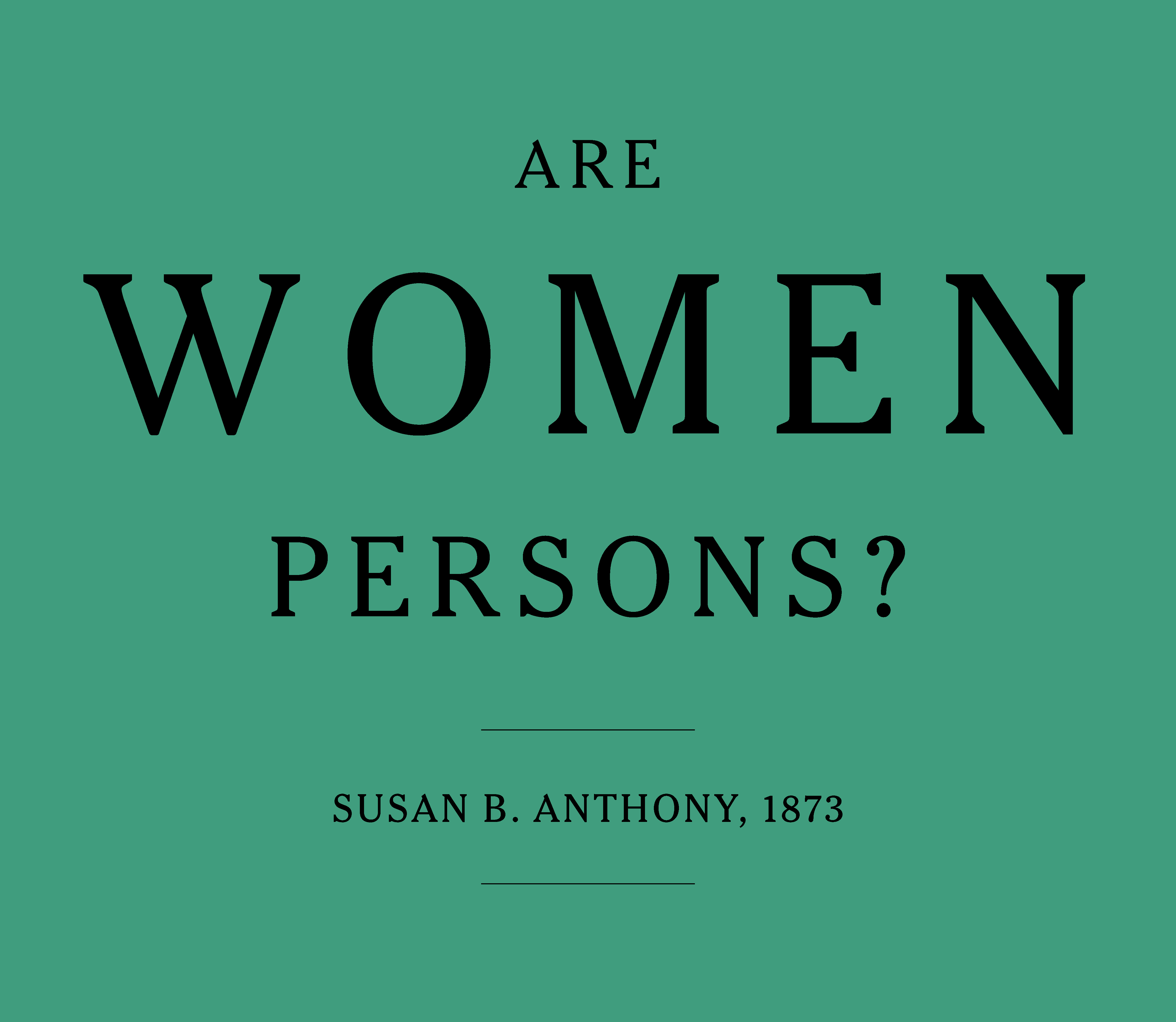
The only question left to be settled , now , is : Are women persons ?
This is blunt and bracing. The last word, especially, catches the ear. Anthony says “persons” rather than “people” because she’s using the precise terms of the Constitution: “All persons born or naturalized in the United States, and subject to the jurisdiction thereof, are citizens of the United States and of the State wherein they reside. No State shall make or enforce any law which shall abridge the privileges or immunities of citizens of the United States.”
If women like Anthony were persons, then they were also citizens. And if they were citizens, then no state laws, such as New York’s, should abridge their privileges or immunities, such as the right to vote.
This was a crucial point in the case Anthony was making, but it had much broader ramifications.
The fight for women’s suffrage was one of the longest and toughest in American history. It met ferocious opposition from liquor lobbyists who feared that newly enfranchised women would vote for prohibition, from industrialists who believed that they would argue for child-labor laws, and from anti-suffrage women themselves — a large and mighty constituency.
Are women persons? The judge in Anthony’s case acknowledged that they were citizens, but he ruled that voting was not one of the privileges or immunities of U.S. citizenship. He directed the jury to find her guilty.
Even so, the ruling hardly settled the question.
Suffragists attacked it from various angles. In the early 20th century, the novelist Alice Duer Miller published a satirical suffrage column, and a book, called “Are Women People?”
From the cover of Alice Duer Miller’s 1915 collection, “Are Women People? A Book of Rhymes for Suffrage Times.” George H. Doran Company
In a famous speech from 1851, Sojourner Truth spoke out: “I have plowed and reaped and husked and chopped and mowed, and can any man do more than that? I have heard much about the sexes being equal; I can carry as much as any man, and can eat as much too.”
Sojourner Truth, circa 1864. MPI/Getty Images
The suffrage movement played out in the streets, through public protests and hunger strikes, but also through the shrewd close-reading of America’s founding documents. Suffragists became experts on how language holds and reveals social hypocrisies.
In the speeches Anthony gave before her trial, she pointed out that the federal Enforcement Act of 1870, which she had so proudly violated, exclusively used masculine pronouns, as did the printed forms pertaining to her case. The record of her conviction would have to be amended by hand: an “s” jotted beside “he” to make it into “she,” and so on.
National Archives Foundation
She said, “I insist if government officials may thus manipulate the pronouns to tax, fine, imprison and hang women, women may take the same liberty with them to secure to themselves their right to a voice in the government.”
She invoked New York tax laws that referred only to “he,” “him” and “his” — and yet weren’t taxes collected from women? The suffrage movement appropriated the great credo of the American Revolution — “no taxation without representation” — and pointed out that American women had continued to pay taxes without any say in the laws that governed their lives.
Perhaps the most famous example of this kind of rereading occurred on July 19, 1848, when a group gathered to discuss “the social, civil and religious condition of Woman” at what became known as the Seneca Falls Convention. Elizabeth Cady Stanton and others drafted a Declaration of Sentiments, which rewrote the central argument of the Declaration of Independence: “All men and women are created equal.”
Suffragists were keenly conscious of making history in the moment. Anthony and Stanton kept extensive archives — Anthony’s own collection threatened to collapse the attic of her home — and they produced a contemporaneous account of their tactics and triumphs in what grew to be the six-volume “History of Woman Suffrage,” published between 1881 and 1922.
Elizabeth Cady Stanton and Susan B. Anthony, circa 1870. National Portrait Gallery, Smithsonian Institution
In the century since, scholars have shown how much that official narrative omitted and obscured. It neglected the contributions of rival feminist factions, and of Black suffragists, and it ignored how a movement that grew out of abolitionism tipped into racism, as Stanton railed against Black men getting the vote before white women.
A larger, more expansive story can be told. Rather than holding Seneca Falls as our starting point, we might recognize other, earlier milestones: for instance, when Maria W. Stewart, a Black activist, became one of the first American women to speak about politics and women’s rights to mixed audiences, at her public lectures in the 1830s. We must acknowledge that the ratification of the 19th Amendment, in 1920, mainly enfranchised white women. Many Black, Indigenous and immigrant women would be denied for years or decades. For them, the Voting Rights Act of 1965 was the more meaningful legislation.
A wider aperture allows us to see not only concealed divisions but also profound continuities. The suffrage movement had powerful bonds with other social causes, even global ones. It nurtured three generations of activists. One of Anthony’s most popular speeches in the 1870s was “Woman Wants Bread, Not the Ballot” — her case for appealing to women as a laboring class. They lobbied for married women to inherit property, to petition for divorce, to have custody of their children, to speak in public. The mark of personhood, for Anthony and others, was not granted by the vote, but exercised through it: the freedom and ability to make meaningful choices.
Advertising a lecture by Anthony. Ken Florey Suffrage Collection/Gado, via Getty Images
Suffragists reread the story of American independence, pored over our founding documents and litigated the assumptions lodged in words as simple as “person.” Historians continue their work, conducting their own scrupulous critique of the documents and narratives passed down. For this young country, the obligation and opportunity to revise has been our steadiest inheritance, a bequest of the Constitution itself, with its famous invocation of “a more perfect union” — reminding us that we are ever a work in progress, ever-evolving.
By A.O. Scott
By Parul Sehgal
By Jia Lynn Yang
By Peter Baker
By Wesley Morris
By A.O. Scott
Share full article
0
……Read full article on The New York Times-Arts
Other

One-stop lifestyle app dedicated to making life in Singapore a breeze!




 English
 简体中文
简体中文
Comments
Leave a comment in Nestia App