Expert backs Nepal’s climate compensation demand as a matter of "Climate Justice"
KUALA LUMPUR: Nepal’s demand for climate compensation from the world’s biggest greenhouse gas emitters is an ethical issue of “climate justice”, says Prof Dr Rozita Hod.
The head of the Department of Public Health at Universiti Kebangsaan Malaysia’s (UKM) Faculty of Medicine said Nepal's stance was sound: countries that contribute little to global carbon emissions are bearing a disproportionate share of the impacts.
“From an ethical point of view, like just now, justice, equality, climate justice is what is being talked about, right? It’s true,” Dr Rozita said after delivering her inaugural lecture on “Climate Change and Its Impact on Human Health: Transmission of Communicable and Non-Communicable Diseases” at UKM on Friday (Sept 4).
She pointed to global emissions data showing that the bulk of carbon dioxide (CO2) comes from fossil fuel use in highly industrialised economies, naming the United States, China and Europe as the main contributors.
“Because they build many industries, they have to use fossil fuel. Solar exists, but the majority is still fossil fuel,” she said, adding that smaller nations like Malaysia and Nepal contribute “a little” to global CO2 but suffer heavily from climate-driven disasters.
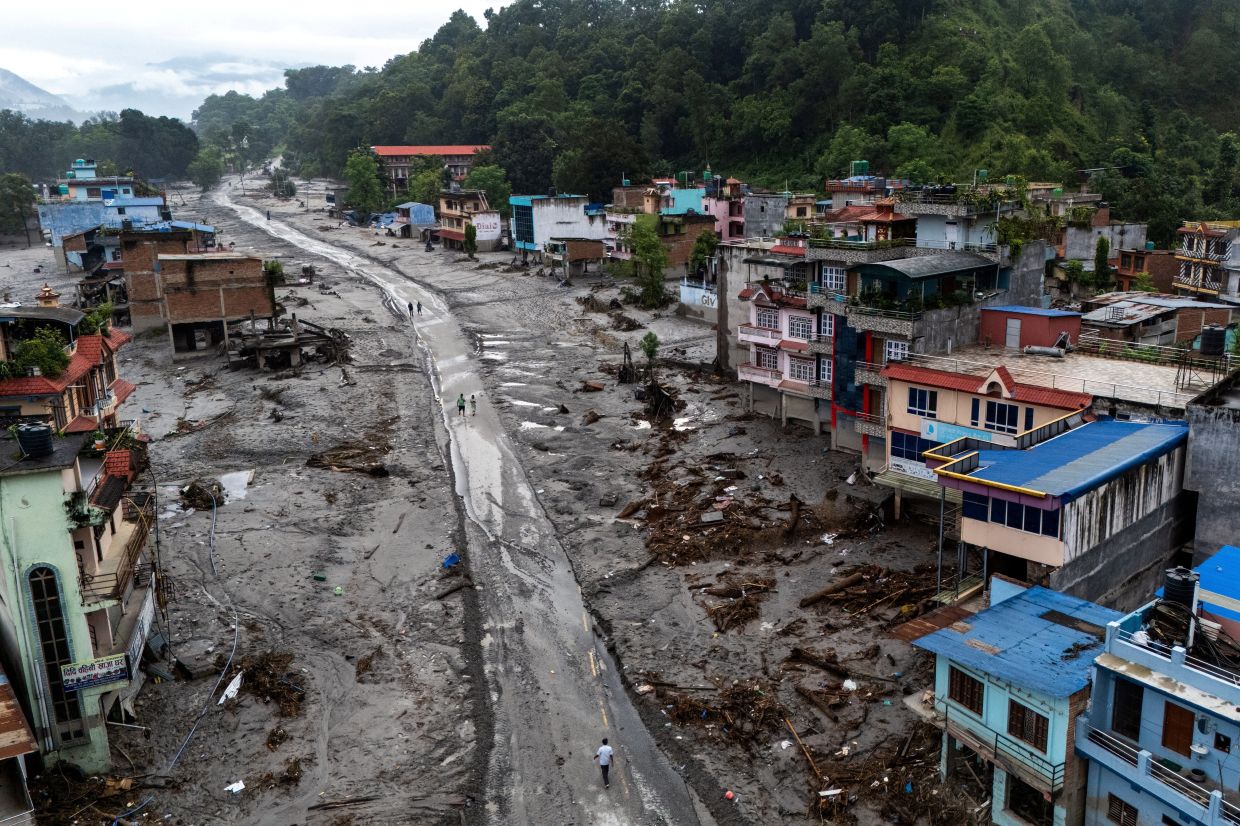
Recently, Nepal’s call for compensation follows catastrophic flash floods in the Bhotekoshi River basin on Aug 26, triggered by a massive rock and ice collapse near the Nepal–Tibet border.
Official figures put the death toll at 1,114, with nearly 4,000 still missing, as floodwaters swept away homes, bridges and critical hydropower infrastructure.
Nepal’s Foreign Minister Shisir Khanal has said China, the United States and India have made “extremely large” contributions to climate change and left smaller nations “enduring the price of it”.
He said the major industrial emitters – such as China, which is the world’s top emitter, the United States at number two, and India at number three – have a historical responsibility to compensate vulnerable nations like Nepal.
The issue is also expected to be raised by Nepal’s Prime Minister Balen Shah at the United Nations General Assembly later this month, ahead of the annual UN climate summit in November..
Dr Rozita said that while the ethical argument was strong, the legal pathway was less certain.
“If you want to make a claim to an international court or something, you have to have a regulation first… They have to have black and white,” she said, noting she was not sure whether specific international regulations on climate compensation claims were already in place.
Still, she stressed that the core idea behind Nepal’s demand aligned with the principle of climate justice: those who pollute the most should bear more responsibility for the consequences.
She drew parallels with low-lying island nations that face existential threats from sea-level rise despite having minimal industry and negligible emissions.
“Scientists have projected that in 150 to 100 years, they will be in the water, drowning… Because all the solid ice is indeed a lot of water volume. So when it melts, it enters the sea, the sea level rise becomes a significant increase,” she said.
“So, it means that other people who pollute, they don’t feel upset. But other people who have nothing to do with it are upset. So, that’s what’s unfair. That’s what he calls climate justice.”
Dr Rozita said vulnerable countries needed to unite and collectively pressure richer, high-emitting nations to adopt stronger mitigation policies.
She also noted the shifting stance of major powers on climate commitments, noting that US President Donald Trump had withdrawn from international agreements, which complicated global efforts.
In Dr Rozita’s view, Nepal’s move to demand compensation is less about immediate legal enforceability and more about forcing the issue of responsibility onto the global agenda.
……Read full article on The Star Online - News
Entertainment Malaysia

One-stop lifestyle app dedicated to making life in Singapore a breeze!




 English
 简体中文
简体中文
Comments
Leave a comment in Nestia App