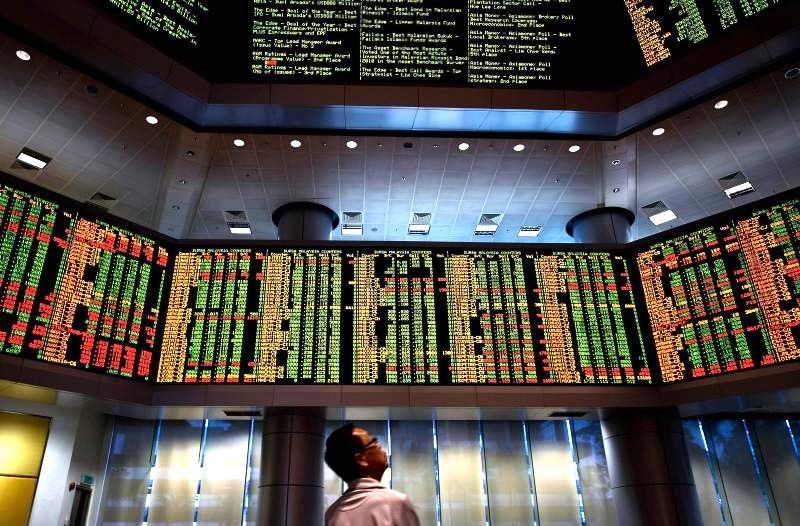
Foreign flows return
PETALING JAYA: Foreign institutions have finally returned to Bursa Malaysia after dumping RM6.43bil worth of local equities on a net basis over the past two months, but the consensus is they are not coming back to buy everything.
Instead, they are gravitating towards quality large-cap stocks, particularly banks and utilities, as investors seek resilient earnings and defensive businesses amid persistent global uncertainties.
According to BIMB Research, foreign funds turned net buyers of RM75.3mil for the week ended July 10, snapping an eight-week selling streak.
IPPFA Sdn Bhd investment strategy director and country economist Mohd Sedek Jantan said the return of foreign investors was an “encouraging signal”, but cautioned that it should not be viewed as the beginning of a broad-based buying cycle.
“Rather, it reflects the initial stage of a selective asset reallocation back into Malaysian equities, driven by improving domestic fundamentals and relatively attractive valuations,” he told StarBiz.
He said foreign institutions are likely to remain focused on high-quality large-cap companies because they offer superior liquidity, stronger earnings visibility and lower execution risk amid an uncertain global environment.
“Malaysia’s macroeconomic fundamentals remain supportive, with resilient domestic demand, robust industrial production, stable inflation and an accommodative monetary policy stance, providing a favourable backdrop for corporate earnings.”
However, Mohd Sedek said foreign inflows are unlikely to broaden meaningfully until there is greater clarity on the US Federal Reserve’s (Fed) interest rate trajectory, trade policy developments and geopolitical risks.
“In other words, foreign investors are likely to remain disciplined, prioritising companies with sustainable earnings growth, strong balance sheets and attractive shareholder returns rather than pursuing higher-beta opportunities.”
He said last week’s fund flow data already reflected this trend, with foreign investors rotating towards sectors offering earnings resilience, defensive characteristics and structural growth.
Looking ahead, Mohd Sedek believes the next phase of foreign inflows will continue to be characterised by “quality rather than breadth”.
“Institutional investors are unlikely to chase momentum across the broader market,” Mohd Sedek pointed out.
“Instead, they will continue to concentrate capital in fundamentally strong large-cap companies with durable earnings, robust governance and clear structural growth drivers.”
This environment, Mohd Sedek said, should continue to favour Malaysia’s market leaders over more speculative segments of the equity market.
Mohd Sedek said financial services remained his highest-conviction sector, noting that Malaysian banks continue to offer resilient earnings, healthy capital positions, improving loan growth and attractive dividend yields.
On utilities, he said predictable cash flows and rising electricity demand from data centres and artificial intelligence (AI) infrastructure provide long-term growth drivers.
Moreover, he added that plantation companies continue to benefit from supportive crude palm oil prices, resilient cash generation and their role as an inflation hedge.
Although technology recorded net foreign outflows during the week, Mohd Sedek said this did not weaken the sector’s long-term investment case.
“Instead, it appears to reflect short-term portfolio rebalancing, following a strong rally.
“Structurally, Malaysia remains well positioned to benefit from the global semiconductor upcycle, AI investment and continued supply chain diversification.”
He expects high-quality technology companies to re-emerge as key beneficiaries of renewed foreign participation once visibility on global interest rates improves.
Bank Muamalat Malaysia Bhd chief economist Mohd Afzanizam Abdul Rashid said expectations that the Fed will keep interest rates on hold have also improved sentiment towards emerging markets, including Malaysia.
Mohd Afzanizam said banks were typically among the first sectors foreign investors buy because they are highly liquid and serve as a proxy for Malaysia’s economic health.
He pointed out that the banking industry loan growth accelerated to 5.7% in May from 4.8% at end-2025, despite geopolitical uncertainties.
“This could mean that the resilience in Malaysia’s domestic demand, especially private investment, has led to higher demand for loanable funds, which then can benefit the banks,” he said.
He noted that utilities also stand to benefit as data centre investments continue to realise.
“This could mean demand for electricity will be higher, which will benefit the revenue stream for the sector in the future.”
According to BIMB Research, foreign buying was led by financials with net inflows of RM121mil, followed by utilities (RM95mil) and plantations (RM42.5mil) last week.
In contrast, industrial and technology sectors saw net outflows of RM94mil and RM60mil, respectively.
Among individual stocks, Tenaga Nasional Bhd
attracted the largest foreign net inflow at RM127.3mil, followed by Public Bank Bhd
with RM103.7mil.
BIMB Research noted that local institutions turned net sellers of RM201mil during the week, while local retail investors remained net buyers with inflows of RM126mil.
Looking ahead, BIMB Research recommended investors to “follow the returning money” by focusing on large-cap banks, utilities and defensive plantation stocks.
“The return of foreign flows into quality large caps should stay dominant,” it said.
“We follow the conviction capital coming home into the large-cap banks, utilities and plantations foreign investors are re-accumulating, while staying selective on the technology names they are exiting, positioning for Malaysia’s oversold quality anchors.”
According to the research house, key catalysts for the market include continued foreign fund inflows, Brent crude oil price movements and subsidy rationalisation.
However, it warned that escalating tensions in the Middle East remain a key risk.
“A sustained spike above US$80 [for Brent] could revive inflation fears and shift Bank Negara Malaysia’s tone, unsettling the rate-sensitive banks foreigners just bought,” it said.
BIMB Research added that a deeper de-rating of North Asian AI-related stocks that crushed South Korea’s KOSPI could spill over to Malaysia’s large-cap technology sector.
**PLS CHECK AFTER MARKET CLOSE**
Yesterday, the FBM KLCI breached the 1,700-point mark, rising 8.92 points, or 0.53%, to close at 1,700.41 despite renewed conflict in the Middle East, which lifted Brent crude prices about 3% to US$78.31 a barrel.
……Read full article on The Star Online - Business
Entertainment Malaysia

One-stop lifestyle app dedicated to making life in Singapore a breeze!




 English
 简体中文
简体中文
Comments
Leave a comment in Nestia App