From molecules to value
IN Part 1, I travelled from the plantation mud of my more familiar world into oleochemicals and discovered something paradoxical.
After decades in which palm helped free natural oleochemicals from raw-material constraints, the industry may once again be learning to respect scarcity. The kernel matters. But once its oil has been transformed into molecules, another contest begins: who gets the molecule, what do they do with it, and who captures the most value?
That takes us immediately to Indonesia.
Telling the molecule to stay home
Indonesia has long used differential export taxes and levies to encourage palm products to be processed domestically rather than exported in a less-processed form.
I describe the strategy simply: policy tells the molecule to stay home a little longer.
Dr Julian McGill’s analysis makes the shift tangible – around 70% of Indonesian palm kernel oil (PKO) is now used domestically, encouraged by differential export taxes that favour processing at home.
There is some historical irony. Indonesia’s downstream strategy followed a path Malaysia had pioneered earlier, but applied it on the scale of a much larger feedstock base. Over time, such incentives shape not just prices, but where refineries, fractionation plants, oleochemical facilities, suppliers and skills cluster.
Indonesia is therefore no longer asking merely whether palm products should be processed at home, but how far downstream the molecule should travel before it leaves.
For Malaysia, that matters.
Indonesia historically exported relatively little PKO in fractionated form, but the analysis shows fractions rising to around 40% of Indonesian PKO-related exports, approaching Malaysian levels. Less raw PKO is freely available, while more specialty fractions find their own markets.
Palm kernel stearin, for example, has applications in specialty fats and cocoa- butter substitutes. This is best described as part of the contest of chemistry versus confectionery.
The same humble kernel can eventually help wash our hair or find its way towards something resembling chocolate. It shows why total PKO production tells only part of the story. The question is also what people choose to turn it into. Allocation matters alongside production.
Geopolitics in the detergent bottle
Economics normally tells us scarcity encourages substitution. But chemistry is not always that accommodating.
LABSA and natural-fatty-alcohol-derived surfactants are not normally straightforward substitutes; their performance and applications differ. Yet, supply disruption can change purchasing behaviour.
Where geopolitical shocks constrain petrochemical surfactant inputs, manufacturers may turn to natural fatty alcohol even when it is more expensive and not the ideal technical substitute.
That is a useful lesson: Substitution is not always about finding something cheaper.
Sometimes, it is about finding something that still arrives at the factory gate. Suddenly, the detergent bottle contains a little geopolitics too.
China: Customer and competitor
Then, there is China. Is China a client or competitor? The answer appears to be both.
China has become an important destination for South-East Asian fatty alcohol, but it can take that imported building block further downstream into surfactants used in detergents, shampoos and cleaning products, some subsequently exported.
For the non-chemist, the business model is what matters: South-East Asia supplies an important chemical building block; China adds another layer of chemistry – and another layer of value.
There is nothing wrong with that. It is exactly what successful downstream industrialisation is supposed to achieve. But China’s example does not mean Malaysia lacks similar capability. Malaysia already manufactures surfactants and specialty oleochemical derivatives. Our challenge is to deepen, broaden and commercialise more of what we already know how to do.
So, the question is no longer “can Malaysia do it?”, it is “how much more value should we capture here before the molecule leaves our shores?”
From capacity to value capture
Malaysia’s oleochemical achievement should not be understated. We possess substantial global manufacturing capacity and decades of industrial experience.
But another factory is not automatically another competitive advantage.
Equipment can be bought, reactors installed and processes licensed. Harder to reproduce are proprietary formulations, application expertise, patents, process know-how, specialty products, technical service and relationships with customers who buy solutions rather than simply tonnes.
A feedstock disadvantage hurts enormously when two producers sell almost identical commodities on thin margins.
It matters less when one transforms the molecule into something specialised enough for customers to pay for performance, reliability and knowledge.
Indonesia may sometimes possess an advantage before the molecule enters the factory. Malaysia must create more advantage before it leaves.
Being close to the molecule matters
High PKO prices sound like universally bad news for South-East Asian manufacturers, but McGill argues they may actually strengthen the region’s relative position because producers elsewhere must secure the same scarce feedstock from much farther away.
Expensive feedstock hurts everybody, but expensive feedstock nearby may still be preferable to expensive feedstock half a world away.
Yet, proximity should never become an excuse for complacency. History is full of countries sitting beside valuable raw materials while somebody elsewhere became richer by knowing what to do with them.
Malaysia has travelled this road before. We did not remain merely growers. We built mills, refineries, ports, laboratories and oleochemical plants around the crop.
The next step may be subtler. It may sit inside a patent, an application laboratory, a customer formulation, a lower-carbon process or a molecule designed for a particular performance.
The next factory may partly be inside somebody’s head. That is why human capital and intellectual property increasingly matter as much as physical capacity.
Europe and the moving chemistry
This brings us to McGill’s most provocative observation. He was less diplomatic when discussing aspects of European policy. His description was essentially “bodoh dan sombong” – foolish and arrogant. Strong language, but behind it lies a more serious economic argument.
His presentation pointed out that declining European Union (EU) palm oil demand can also undermine the availability of PKO associated with that supply chain.
Europe is extending EU Deforestation Regulation coverage further into palm- derived oleochemical products.
According to McGill’s analysis, additional palm-derived intermediates are due to enter the regulatory scope from Dec 30, 2027, a year after the current legislation is expected to take effect, while surfactants and detergents classified under HS 3402 remain outside that product scope.
HS, or Harmonised System, codes classify traded goods globally.
The result is a curious asymmetry: the same palm-derived molecule can face different rules depending on how far the chemistry has progressed before reaching Europe.
Take a covered palm-derived intermediate made in South-East Asia and ship it to Europe for further conversion: it carries the relevant due-diligence obligations.
Perform another layer of chemistry in Malaysia, Indonesia or China first and export the resulting HS 3402 surfactant: the finished surfactant currently sits outside that same product scope.
Same underlying palm supply chain. Different point of conversion. Different regulatory treatment.
This can be reduced to one memorable line: The molecule does not disappear. The chemistry moves.
That is the basis of his warning that Europe risks shooting itself in the foot.
Regulation intended to address deforestation may unintentionally make some European downstream processing less attractive, while encouraging more value addition elsewhere.
The environmental objective can still be legitimate while the industrial consequence remains unintended.
It reminds me of the Cobra Effect – when a well-intentioned policy changes incentives in such a way that the eventual outcome runs partly against what the policy was meant to achieve.
Malaysia can complain about Europe – or ask whether Europe has just provided another reason to do more of the chemistry here. I prefer the second question.
The molecule needs a passport
None of this means Malaysia should resist traceability or environmental accountability. Quite the opposite.
A chemical customer increasingly wants more than purity, composition and performance.
Where did the feedstock originate? Can its provenance be demonstrated? What emissions travelled with it? Was it responsibly produced?
The modern molecule increasingly needs a biography. Perhaps, it needs a passport.
Malaysia has spent years developing certification and traceability upstream.
The opportunity is to carry credible information further downstream and turn sustainability into part of the commercial proposition.
Imagine two drums of fatty alcohol meeting the same technical specification.
One arrives with credible traceability, carbon information and dependable sustainability documentation; the other arrives with much less evidence.
Will sophisticated customers forever regard them as commercially identical? Perhaps not. That is where sustainability begins moving from something we must prove towards something worth selling.
Indonesia possesses a far larger feedstock base and has deliberately structured policy to encourage domestic downstream processing. Malaysia must understand its competitive effects.
But reducing industrial strategy to a permanent tax race carries its own danger. Indonesia adjusts a levy, Malaysia responds; Indonesia changes again, Malaysia follows. Before long, industrial strategy becomes fiscal ping-pong.
Malaysia’s more durable response is to strengthen things harder to reproduce through another tax adjustment: research capability, intellectual property, application centres, engineering knowledge, skilled talent, automation, energy efficiency, customer intimacy and specialty chemistry.
Help industry climb the value chain, rather than endlessly compensate it for standing on the lowest rung.
Our ambition need not be to possess the cheapest carbon entering every factory gate. It should be to make that carbon worth considerably more by the time it leaves.
That is also where the Asean Oleochemical Manufacturers Group (AOMG) has an important role.
Established in Manila in 1986, it now links oleochemical producers across Malaysia, Indonesia and the Philippines.
Its CEOs’ Executive Dialogue on Aug 14, 2026, drew more than 100 participants from industry, finance, research and government around a timely trilemma: growth, green transition and geopolitics.
With Lee Jia Zhang of Kuala Lumpur Kepong Bhd
chairing AOMG for 2026-2028, the association can do more than exchange views – it can help the region think collectively about competitiveness, sustainability and where the next layer of value should be created.
From molecules to knowledge
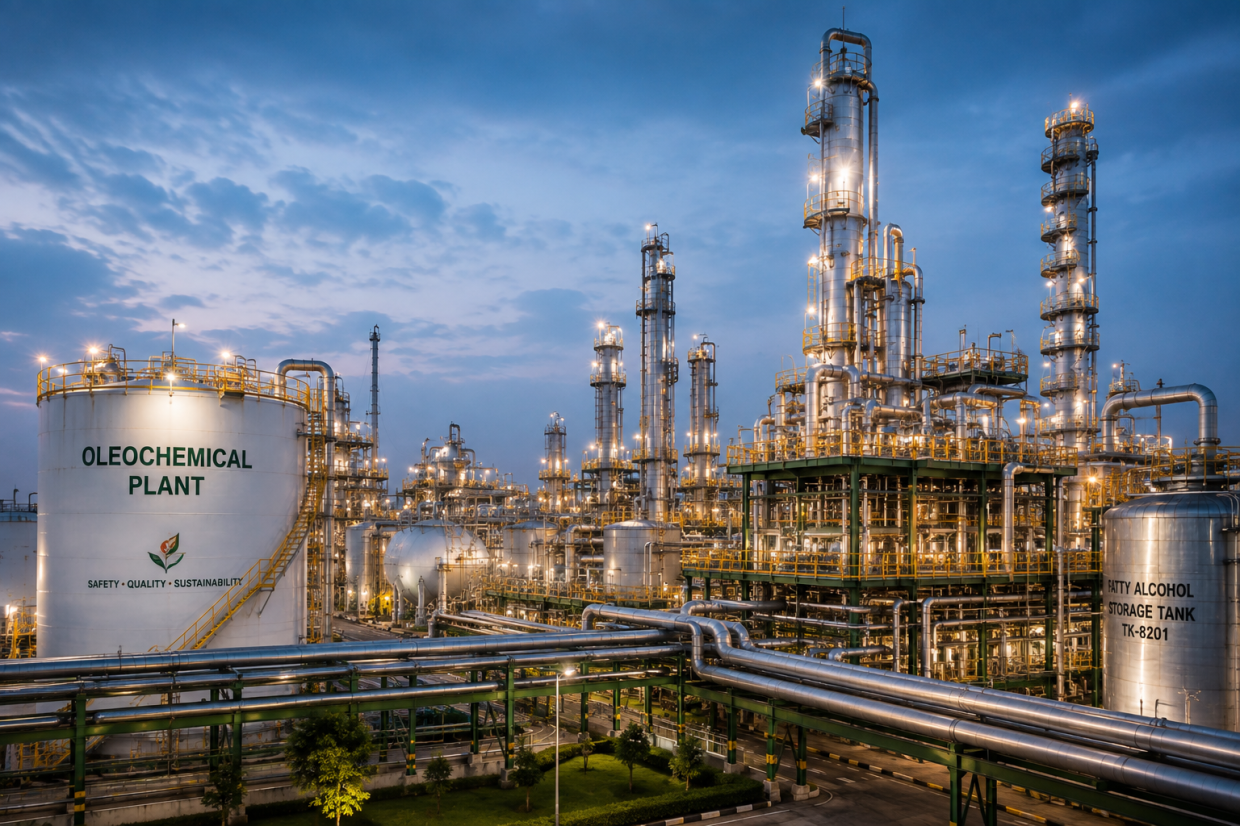
This brings me back to those oleochemical plants in Pasir Gudang that once fascinated the corporate planter and researcher in me.
Malaysia has already achieved something important: we took a tropical agricultural commodity and built a sophisticated chemical industry around it.
But industrial success has a habit of moving the finishing line.
Indonesia is keeping more feedstock at home.
China shows how an Asean intermediate can acquire another layer of chemistry and value.
Europe’s regulations may influence where still more processing takes place.
Malaysia does not need to discover the road from molecules to knowledge – we are already on it. The challenge is to travel further and faster.
That means improving upstream productivity, recognising the kernel’s growing strategic value, securing traceable feedstock, lowering carbon intensity and developing more proprietary chemistry and stronger customer capabilities.
Our factories do not need to close for Malaysia to lose ground. Plants can remain, ships can keep sailing and production statistics can still look respectable while intellectual property, formulations, customer relationships and higher margins accumulate elsewhere.
Then, lo and behold, the end game may not arrive with a dramatic announcement. It may simply dawn one morning after years of comfortable incrementalism.
A factory is only as powerful as the molecule it can secure. Malaysia’s future depends on something more: how much knowledge and value we put into that molecule before we let it go.
After the AOMG engagement, I hope I have at least found the right path into another new planet of the palm-oil supply chain.
I began more comfortable with mud than molecules and emerged with a better appreciation of kernels, fatty alcohols, surfactants, geopolitics – and an entirely new alphabet of acronyms.
Writing about it has opened another learning lane for me. From mud to molecules, and from molecules to knowledge, I am still learning.
For now, however, I have had enough of LAB and LABSA. I am going for my laksa – the one bit of chemistry I know exactly what to do with.
Joseph Tek Choon Yee has over 30 years of experience in the plantation industry, with a strong background in oil palm research and development, C-suite leadership and industry advocacy. The views expressed here are the writer’s own.
……Read full article on The Star Online - Business
Entertainment Malaysia

One-stop lifestyle app dedicated to making life in Singapore a breeze!




 English
 简体中文
简体中文
Comments
Leave a comment in Nestia App