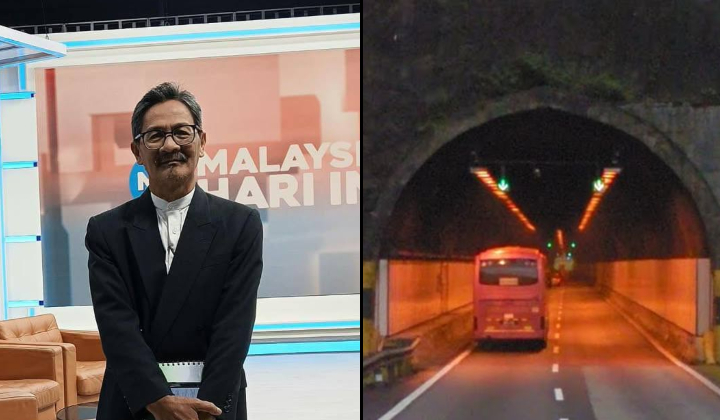
Haunted Roads? Maybe It’s Not The Pontianak, Just Infrastructure Problems
Subscribe to our FREE Newsletter, or Telegram and WhatsApp channels for the latest stories and updates.
Frequent crashes along certain notorious Malaysian bends are often attributed to supernatural disturbances, but a road safety expert has warned that treating accident black spots as paranormal hotspots blinds drivers to real, preventable infrastructure flaws.
Jamil Manan Supri, founder of the Road Safety Expert Association (RSEA), said authorities and road users must separate cultural beliefs from measurable safety risks.
Rather than dismissing public accounts entirely, Jamil said persistent claims that a spot is “haunted” should serve as an early community warning to investigate structural and environmental issues.
“We should not immediately label a location as haunted to the extent that we overlook the actual contributing factors,” he said in a recent statement.
Such factors include road curvature, surface conditions, inadequate lighting, visibility, vehicle speed and driver behaviour.
Jamil pointed out that superstitious beliefs can actively increase the risk of an accident by distorting driver behaviour.
He identified four main behavioural risks when motorists fixate on supernatural fears:
Distraction: Motorists shift attention away from traffic and surroundings to look out for perceived apparitions.
Panic reactions: Drivers who are startled may suddenly brake, swerve abruptly or lose vehicle control.
Poor hazard perception: Focus shifts toward imagined phenomena rather than actual road hazards, such as oncoming vehicles, nearby motorcyclists, or sharp bends.
Neglecting preventive measures: Attributing crashes to spirits removes the urgency to push for improved lighting, clearer signage, speed enforcement and road redesigns.
“Do not allow fear to override your awareness and judgement when driving,” Jamil said, urging motorists to follow his core principle: Manage Your Speed, Keep Your Distance.
Jamil explained that high-risk locations typically involve an overlap of human error, poor infrastructure and vehicle deficiencies rather than a single isolated cause.
These include driver fatigue and micro-sleep, speeding into blind curves, poorly lit stretches, uneven tarmac, poor drainage causing aquaplaning, and worn-down tyres or faulty brakes.
“Sometimes, a driver is fatigued, the road is poorly lit, the bend has restricted visibility, and the vehicle is travelling at an inappropriate speed,” he said.
When these factors converge simultaneously, the risk of a severe crash spikes dramatically.
He noted that statistics, road geometry and crash history – rather than urban legends – must determine whether an area qualifies as an official accident black spot.
Addressing calls for solat hajat (special prayer gatherings) or communal rituals at crash-prone stretches, Jamil said he respects religious and cultural practices, but stressed they cannot replace practical safety remedies.
He said community complaints should be treated as “Community-Based Road Safety Risk Reporting” to trigger formal reviews with agencies like the Public Works Department (JKR), police (PDRM) and the Malaysian Institute of Road Safety Research (MIROS).
“Religious activities should never replace the technical responsibility of relevant authorities to identify and eliminate road safety risks,” Jamil said.
Citing Islamic teachings, he noted that verses from Surah Al-Mujadilah and Surah Al-Baqarah remind believers not to let fear dictate actions or deliberately expose themselves to destruction.
Tawakal (trust in God), he added, must always be paired with personal precautions, maintenance, and addressing hazardous infrastructure.
In a separate reminder, Jamil urged Klang Valley motorists to prioritise safety when travelling through 56 identified flood hotspots and 232 flood-prone areas during the monsoon season.
Citing data from the Selangor Drainage and Irrigation Department, he said Klang recorded the highest number of flood hotspots at 13, followed by Petaling (11) and Gombak (10).
Drivers should exercise extra caution in high-risk Selangor areas, including Taman Sri Muda, Sections 7 and 13 in Shah Alam, as well as Bukit Raja, Kapar, Kampung Rantau Panjang and Jalan Kebun in Klang.
Share your thoughts with us via TRP’s Facebook, X, Instagram, or Threads.
……Read full article on The Rakyat Post - News
Other

One-stop lifestyle app dedicated to making life in Singapore a breeze!




 English
 简体中文
Comments
Leave a comment in Nestia App