IMH nurses trained to defuse tense situations before they escalate into abuse and assault
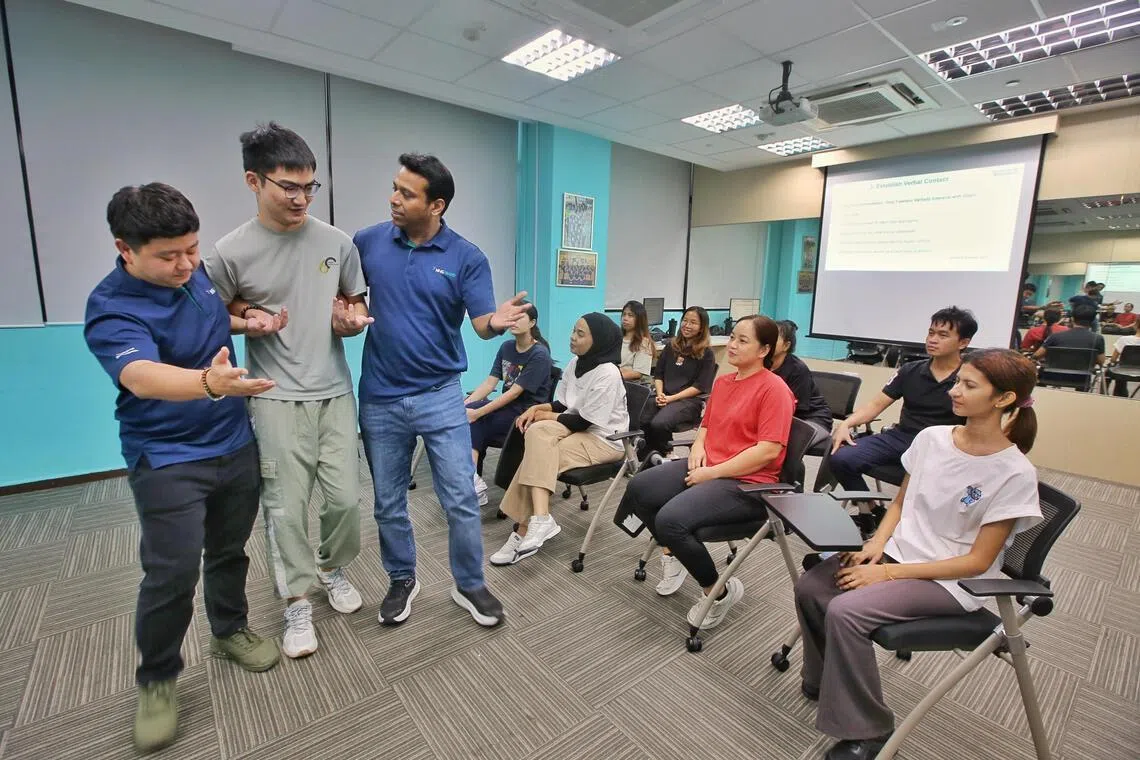
IMH senior nurse manager Win Min Htet (left) and assistant director of nursing Kalaivanan Dakshnamoorthy (third from left) demonstrate a scene during the Code Grey training programme.
SINGAPORE – Something as simple as a different turn of phrase has the power to prevent a tense situation from turning violent.
By specially training nurses in techniques ranging from de-escalation to negotiation, to deal with incidents before they get out of hand, the Institute of Mental Health (IMH) was able to cut the number of physical assaults by half during a six-month trial.
The institute now plans to scale up this effort, called the Code Grey team initiative, to all its 40 wards by December 2027, so as to elevate psychiatric care standards and create safer workplaces for staff.
In the healthcare setting, “Code Blue” refers to a life-threatening medical emergency. “Code Grey”, on the other hand, is a psychiatric emergency which requires a response appropriate to the “grey situation” of dealing safely with somebody who is aggressive or disruptive, but unarmed.
The IMH initiative was helmed by two IMH front-line staff – assistant director of nursing Kalaivanan Dakshnamoorthy, 47, and senior nurse manager Win Min Htet, 36.
IMH staff care for patients with acute psychiatric conditions every day, which is meaningful work, though demanding, they said.
When patients become acutely unwell, they may not be fully aware of their own conditions and can feel distressed. This can rapidly escalate to aggression.
“There are various treatment modalities that nurses would have to use, one of which is using themselves as a therapeutic tool to calm the patient down, using their verbal de-escalation skills. As long as the end result of that crisis doesn’t result in the patient being restrained, that is successful de-escalation,” Kalaivanan said.
All IMH clinical staff go through a standard three-day Care and Response (C&R) training programme, and have the skills and knowledge to manage disturbed patients.
Code Grey takes this further by giving staff additional intensive training.
IMH ran a six-month pilot from January to July 2025, where 20 registered nurses – those with a diploma or a bachelor’s degree in nursing – were specially selected for Code Grey training, based on their personality, interpersonal skills and medical fitness.
The three-day Code Grey training programme taught them skills related to risk assessment, de-escalation, negotiation and physical intervention.
For instance, Kalaivanan said that commonly used phrases such as “what is your problem?” or “calm down” might end up triggering patients instead of resolving the issue on hand, as these might be perceived as blaming, dismissive or pressurising to the patients.
Examples of alternative phrasings would be “help me understand what happened?” or “let’s take a moment to work through this together”, he added.
Such phrases empower and assure patients that they play a part in co-managing their own condition.
“Nursing used to be paternalistic in nature, but now it is more about collaboration... We are really advocating independency from patients... we are going towards person-centred care,” Kalaivanan explained.
Training included role-play and scenario training, some with people acting as patients, as well as dialogues with senior nursing leaders who spoke about their experiences.
Code Grey-trained nurses were better able to build rapport with at-risk patients, identify early warning signs of aggression such as clenching fists, staring into the eyes of staff and pacing around. They also knew to intervene at the first sign of distress.
Kalaivanan recounted an incident that he observed involving a senior female nurse and a young male patient, which underscored the importance of staff keeping their own emotions in check.
He said the young man had been shouting and demanding to be discharged, but the nurse calmly explained why his parents had wanted him to seek treatment.
The man eventually calmed down and even broke down, and the nurses walked up to him and comforted him.
“That was really very powerful... That taught me that you don’t have to use violence on violence. I think sometimes we really can go in, in a therapeutic manner. We are not against anybody,” Kalaivanan said.
During the pilot, Code Grey-trained nurses were deployed across four wards which handled more of the first-line cases, such as those admitted through the emergency department.
Incidents of physical assaults in these wards, such as staff being pushed, punched or slapped, were reduced by almost half, from 108 to 58 cases.
Staff also reported that they consistently felt safer, had much better support, and felt more capable to deal with tense situations.
IMH said its patients also benefited from the calmer living environment.
The institute plans to scale the initiative to about 40 wards by end-2027. This translates to five Code Grey-trained nurses in each ward to ensure there will be at least one or two there round the clock.
About 40 per cent of IMH’s 3,000 staff members are nurses, making it the largest staff group, ahead of doctors, allied health, ancillary and administrative staff.
Training for new batches of Code Grey nurses began in mid-June.
Kalaivanan and Win Min Htet spent more than three months since late 2024 to develop the training curriculum from scratch. Their research involved examining evidence in current literature as well as consolidating practical lessons from their experiences as C&R instructors.
Their Code Grey project was recognised when IMH clinched the Wellbeing Innovation Award at the WorkWell Leaders Award 2026 on April 24. The awards were presented by local charity WorkWell Leaders to recognise leadership that successfully advances organisational well-being.
Kalaivanan said the recognition was unexpected and that the duo had started the project as a way to protect both patients and fellow colleagues.
Added Win Min Htet: “As staff at a psychiatric hospital, we really want to prioritise the well-being of our staff and also our patients’ safety.”
……Read full article on The Straits Times - Singapore
Singapore

One-stop lifestyle app dedicated to making life in Singapore a breeze!




 English
 简体中文
简体中文
Comments
Leave a comment in Nestia App