Is The True Crime Community Influencing Malaysia’s School Attacks?
Subscribe to our FREE Newsletter, or Telegram and WhatsApp channels for the latest stories and updates.
The recent school attacks in Malaysia have raised questions about whether online communities that glorify real-life killers could be influencing young people who commit violence.
One community drawing attention internationally is the True Crime Community (TCC), an internet subculture centred on real-life violent criminals and mass killers.
Think the Columbine High School shooters, Jeffery Dahmer, Charles Manson, and Ed Kemper.
While many people consume true crime content out of an interest in criminal psychology or investigations, more extreme corners of the TCC turn perpetrators into objects of fascination, admiration and, in some cases, imitation.
A February 2026 analysis by the Combating Terrorism Center at West Point examined how this online subculture can turn violent perpetrators into figures of internet fandom. Some users create fan edits, memes and artwork celebrating attackers, while others share manifestos and discuss previous attacks in ways that can encourage imitation.
Although there’s no hard evidence linking this murderous phenomenon with the murders and attacks here, there are some reasonable hints that have led the public to believe some Malaysian youth have been exposed to the TCC.
The discussions on TCC became a trend after an international school student in Kuching, Sarawak, attacked a class teacher with a hatchet, all the while broadcasting the act on a livestream using a smartphone attached to his forehead.
He committed the assault in a classroom full of other students, but they walked away unschathed although the teacher did sustain some injuries.
In the footage, the teenager is seen looking at himself in a bathroom mirror before running towards a classroom and shouts “This is what you get!” before swinging a hatchet at the teacher.
The footage went viral on social media, and screen recordings as well as screenshots of it are still circuating. However, the original video has been deleted from the online platform.
READ MORE: Police Confirm 16-Year-Old Armed With ‘Kapak’ At Sarawak School
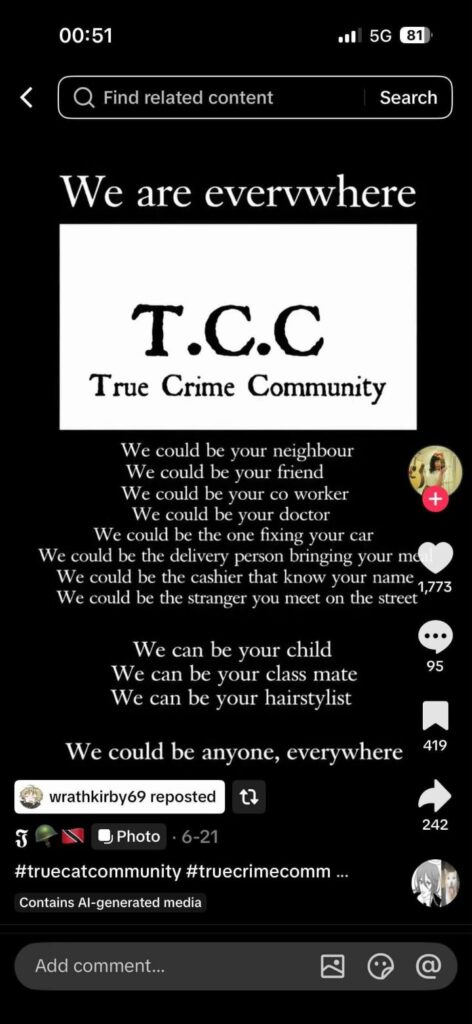
In a separate post, @dragonforceio shared a screenshot from TikTok where a user uploaded content related to TCC.
“The picture happens to be a repost by the account of a stabbing suspect in Makaysia. It’s clear that the suspect consumes content linked to TCC,” he claimed.
The post conveyed a sinister message, saying that people you might or might know you such as neighbours, delivery personnel, co-workers, or even a cashier could be part of the TCC.
Pic: Threads / @dragonforceio
Copycat murders have happened before, but with the advent of the internet and social media, it’s possible that the stories of past serial killers may have gained widespread attention and cause mass inspiration among the online community, particularly the youth.
The TCC has roots from the Columbine High School Massacre and its perpetrators Eric Harris and Dylan Klebold, two teenage students in North America who shot and killed 13 students, one teacher, and wounded 23 others on 20 April, 1999.
Both ended the attack by committing suicide and marking the incident as one of the most infamous massacres in the United States, inspiring more than 70 copycat crimes in a phenomenon dubbed as the “Columbine Effect”.
Those who perpertrated the crime in similar fashion (mass shooting in a school), are called “Columbiners”.
In fact, a 15-year-old who stabbed his classmate more than 200 times at SMK Bandar Utama Damansara (4) on 14 October, 2025, allegedly wrote a letter or manifesto that contained the names of Harris and Klebold.
Another student from a school in Banting, Selangor, stabbed a fellow school mate 12 times in the back on 6 July, 2026.
The 15-year-old suspect reportedly wrote a “hit list” with the names of 10 students, which went viral on social media.
Based on research, a letter, manifesto, or any written content on papers seem to be a consistent pattern among school students involved in homicide, attempted or otherwise.
These reports point to a question worth investigating: could online peer groups be reinforcing violent thoughts, normalising attacks or encouraging vulnerable teenagers to act?
But still, they do not establish that the Bandar Utama and Banting incidents were connected to each other through the TCC, or that the suspects belonged to it.
Research into the TCC offers a possible framework for understanding the risks. In some of its more extreme spaces, perpetrators are celebrated as infamous figures, and their attacks become material for online content.
The attention given to previous attackers may create a disturbing cycle in which later offenders seek recognition by referencing or imitating those who came before them.
However, this is not the same as saying that watching true crime documentaries, playing video games or participating in online discussions makes someone violent.
The vast majority of people who consume such content never commit violent acts, and the TCC itself encompasses different kinds of participation. The concern is specifically about spaces that glorify perpetrators, encourage violence or reward people for demonstrating an obsession with real-life attacks.
For Malaysia, the next step is to establish whether investigators have found concrete evidence of these dynamics in any of the school attacks, such as participation in relevant online groups, admiration for previous perpetrators or communications encouraging violence.
Until such evidence emerges, it would be premature to label the recent incidents as TCC-linked attacks. The more defensible conclusion is that online influence is already a line of inquiry in some Malaysian school-stabbing investigations, while the specific role of the True Crime Community remains unconfirmed.
READ MORE: 16-Year-Old Girl Stabbed To Death In Bandar Utama School
READ MORE: Teen’s Schizophrenia Went Untreated For Five Years Before Bandar Utama School Stabbing, Court Finds
READ MORE: Bandar Utama School Stabbing: Boy, 15, Acquitted, Then Locked Away Indefinitely
Share your thoughts with us via TRP’s Facebook, X, Instagram, or Threads.
……Read full article on The Rakyat Post - News
Other

One-stop lifestyle app dedicated to making life in Singapore a breeze!




 English
 简体中文
Comments
Leave a comment in Nestia App