Is the $2.18m, now $1.99m, jumbo flat in Telok Blangah worth its potential record price?
A jumbo HDB flat at 93B Telok Blangah Street 31 made headlines when it was listed for $2.18 million. Its asking price has since been reduced to $1,999,999 — just $1 shy of the $2 million mark.
According to listing agent Thomas Tong, the adjustment was made to facilitate a sale and shift the focus away from the media attention surrounding the home. The revised price is also negotiable.
Even after the reduction, the listing remains noteworthy. If the flat sells at its current asking price, it would surpass the $1.728 million national HDB resale record reported in April 2026.
But what exactly does close to $2 million get you in an HDB flat, and how much of that asking price comes down to the home's rarity?
Living room in the Telok Blangah jumbo flat, with a grey sectional sofa, tiled flooring and large windows.
The combined flat offers five bedrooms and four bathrooms, alongside this spacious living area.
The flat sits within Telok Blangah ParcView and combines two adjoining three-room BTO flats under a single title.
According to Thomas, the owners first bought their original flat directly from HDB before seeking approval to purchase the neighbouring unit, after its owner was allowed to sell before completing the minimum occupation period (MOP). HDB has said the first flat was purchased in December 2017, followed by the adjoining unit in August 2021.
The combination was approved under HDB's Conversion Scheme, which allows eligible owners to join adjoining three-room or smaller flats after the necessary assessment.
The result is a high-floor corner home spanning 1,465 sq ft, with five bedrooms, four bathrooms and two entrances. The living room faces east, while the main entrance faces west.
According to Thomas, the orientation allows the living area to receive natural light without direct afternoon sun, while the higher floor opens up views towards Sentosa, Mount Faber and Pinnacle@Duxton.
At the current asking price, the home works out to about $1,365 psf, while the listing indicates that approximately 91 years remain on the lease.
Thomas describes it as "one of one", pointing to its combination of size, relatively young age and location within an established city-fringe neighbourhood.
The sellers also put considerable work into making the two original flats feel like a single home. According to Thomas, the works included removing walls, evening out an approximately 3cm difference between the original floor levels and retiling the space throughout.
Among other changes, one of the former kitchens was converted into a study, while an integrated audio system was installed across the home.
For multi-generational or larger households, the resulting 5-bedroom layout provides room for family members to have their own spaces while still living under one roof. Its corner position also offers greater privacy than a flat along a busier corridor.
The flat's size stands out, but its location makes day-to-day life easier too. Telok Blangah MRT is around 554m away, or roughly a seven-minute sheltered walk.
From there, residents can take the Circle Line one stop to HarbourFront and change to the North East Line. Nearby bus stops are also accessible by sheltered walk, while Labrador Park MRT offers another option in the wider neighbourhood.
Closer to home, families have a community club, supermarket and Telok Blangah Market and Food Centre nearby, with Blangah Rise Primary School beside the development.
On days they want to head outdoors, Telok Blangah Hill Park and the Southern Ridges, including Henderson Waves, are within easy reach. For a multigenerational household, that mix gives family members room to follow different routines without travelling far for daily needs.
Thomas also thinks the estate's relative youth sets it apart from older jumbo flats. "You can renovate your house, but not its corridors, lifts, playground and neighbourhood," he says. That makes the condition of the wider estate part of the appeal, alongside the home itself.
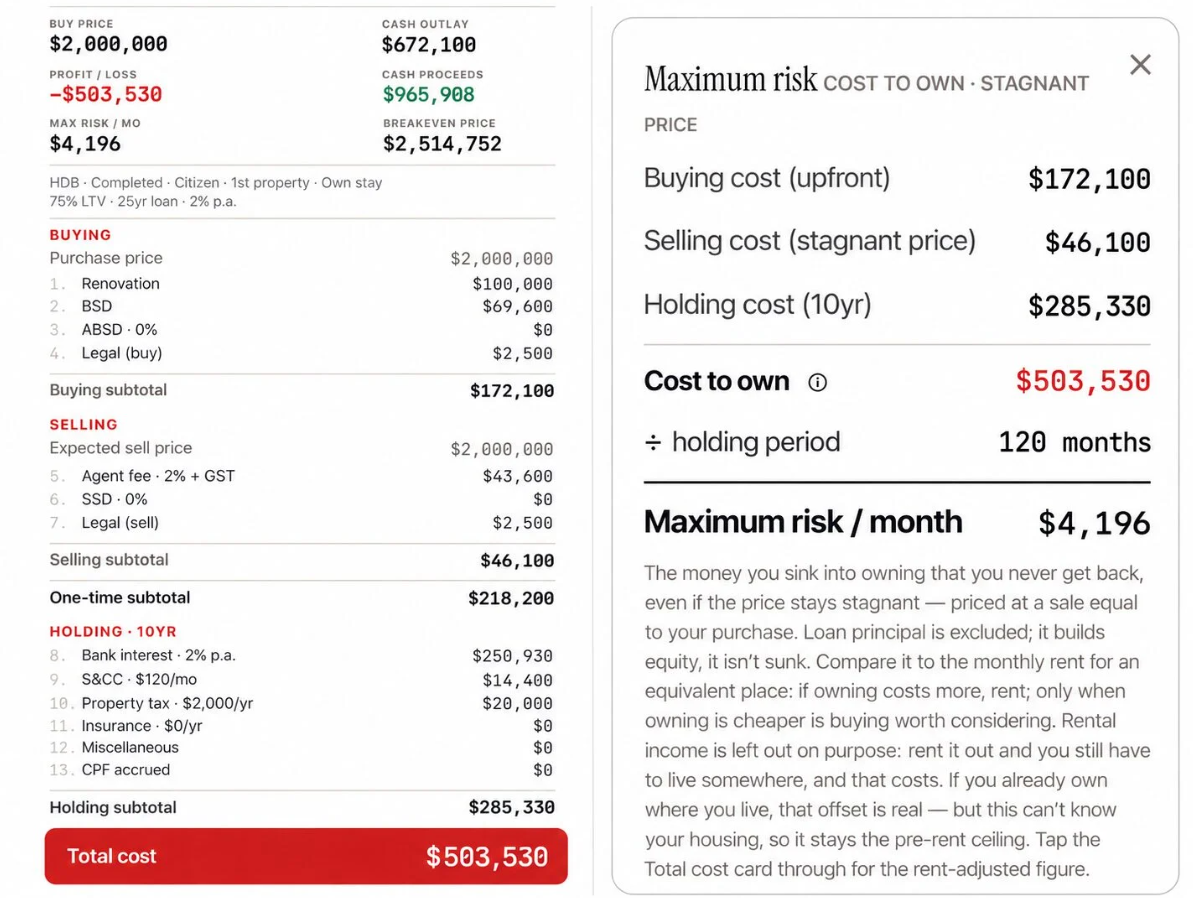
To put the asking price into perspective, Thomas worked through a hypothetical 10-year ownership scenario. His example assumes a buyer purchases the flat for $2 million today and sells it for the same amount a decade later.
While Thomas believes the flat could appreciate over that period, his calculation assumes zero price growth as a more conservative scenario.
He factors in a $100,000 renovation budget, buyer's stamp duty, legal fees, bank interest at two per cent a year, property tax, an allowance of $120 a month for HDB service and conservancy charges, and eventual selling costs.
Based on these assumptions, the total unrecovered cost over 10 years comes to $503,530, or around $4,196 a month when spread across 120 months. In this scenario, the buyer would need to sell the flat for more than $2,514,752 to make a profit, after accounting for the costs included in Tong's calculation.
Of course, this is only an illustration. The eventual cost would depend on factors such as the buyer's loan amount, interest rate, renovation spending and how much the flat eventually sells for.
Still, Thomas believes the monthly figure provides another useful point of comparison: what could someone rent in the same area for around $4,196 a month, with a similar amount of space, five bedrooms, four bathrooms and comparable features?
Ultimately, the calculation offers another way of looking at a near-$2 million asking price — not just as a lump sum, but in terms of what the buyer gets from the home over the years they live in it. Whether that makes the price worthwhile is ultimately for buyers to decide.
The flat retains both of its original entrances, giving a buyer the option of using the space much like a dual-key home. According to Thomas, a divider could be restored between the two sides, allowing the owner to live in one section while renting out rooms on the other, which has its own entrance.
While the layout could function almost like two separate living spaces, the combined property remains a single HDB flat.
Thomas estimates that such an arrangement could generate around $3,500 a month in rental income.
Compared with the hypothetical ownership cost of $4,196 a month above, this could offset a substantial portion of the estimated expense, leaving a difference of around $696 a month, assuming HDB approves the arrangement and it achieves the estimated rent.
For households that do not need all five bedrooms, this offers another way to make use of the additional space. The two entrances could also provide greater separation between the owner's and tenants' living areas, allowing both to enter and leave without having to share the same main entrance.
[[nid:745631]]
There is no straightforward like-for-like transaction against which to price this flat, which is part of what makes its asking price difficult to benchmark.
Thomas points to an older jumbo flat that transacted for $1.53 million with about 45 years remaining on its lease. By comparison, the Telok Blangah flat has roughly twice as many lease years remaining, which he believes warrants a premium.
However, remaining lease is only one part of a home's value. Floor area, location, condition, financing and other property characteristics can also influence what buyers are ultimately willing to pay.
HDB offered another reference point when the flat was listed at $2.18 million. It noted that nearby three-room flats had transacted for around $673,000 to $771,000 in the preceding six months.
Two flats at the upper end of that range would total approximately $1.54 million. Even at its revised $1,999,999 asking price, the difference from the $1.54 million benchmark is still around $458,000.
HDB also notes the $2.18 million asking price was significantly above comparable transactions and could involve substantial cash over valuation.
While the revised asking price has narrowed that gap, the flat's eventual valuation and any cash over valuation remain unknown until a transaction progresses through the relevant process.
So far, the listing has attracted interest. Thomas says the campaign had received around 60 inquiries and 12 to 15 physical viewings by the time of our interview, including retirees, couples and multi-generational families. However, no formal offer had been made at that point.
The interest suggests there is curiosity around such an unusual home, but the eventual transaction will provide the clearest indication of what buyers are prepared to pay for that rarity. As Thomas puts it: "It's not about what the seller wants. It's not about what the bank can offer. It's about what the buyers are willing to pay."
The removal of the 15-month wait-out period in July 2026 opened another possible route to this flat. Eligible private homeowners no longer have to wait 15 months after selling their property before buying a non-subsidised HDB resale flat, provided they do not take an HDB housing loan.
Thomas thinks that change improves the flat's chances of finding a buyer. When asked whether a sale would have been possible under the old rule, he said it would have been "less likely". A family selling a private home, for example, could now consider moving directly into this spacious HDB flat rather than finding somewhere else to live during the wait. Thomas says some of the people who have viewed the flat appear to have sold a larger property and are looking for their next home.
Thomas believes a S$2 million HDB resale transaction is only a matter of time. In his view, the flats most likely to approach that level will be large, relatively new and centrally located.
He points to Berlayar as a longer-term example. Some four-room flats there were launched at prices approaching $800,000, and it could be around 15 years before the first homes enter the resale market, after accounting for construction and the 10-year minimum occupation period. Thomas believes prices could rise considerably over that time, with some eventually approaching the $2 million mark.
Since the Telok Blangah listing first drew attention, Thomas says he has also noticed other HDB homes being marketed at $2 million or more. In his view, the attention surrounding this home may have made some sellers more willing to test higher asking prices.
There is also some uncertainty over whether more homes like it could be created in future. HDB is reviewing the Conversion Scheme that allowed the two adjoining flats to be combined, although the outcome has yet to be announced. Any changes to the scheme could affect whether owners are able to create similar homes going forward.
For now, the Telok Blangah flat remains an unusual test of how much buyers are willing to pay for space, a long remaining lease and a configuration rarely found in public housing. Whether that combination is enough to produce Singapore's first $2 million HDB resale transaction will depend on where a buyer draws the line between rarity and price.
[[nid:746056]]
……Other

One-stop lifestyle app dedicated to making life in Singapore a breeze!




 English
 简体中文
简体中文
Comments
Leave a comment in Nestia App