Joko Anwar Reveals How The Hollywood Con Queen Inspired A Character In His Horror-Comedy Ghost in the Cell
“I hated the first five minutes of your film.”
That was the opener I had planned — something to jolt Joko Anwar a little, maybe throw him off balance. Think of it as me returning the favour for all those movies he’s made that sent shivers down my spine and gave me endless nightmares (hello, Impetigore!).
Instead, he grinned. “Nice,” he casually replied. That was it? The Indonesian filmmaker’s reaction was more curious than angry — not exactly the response I was gunning for. Shoot.
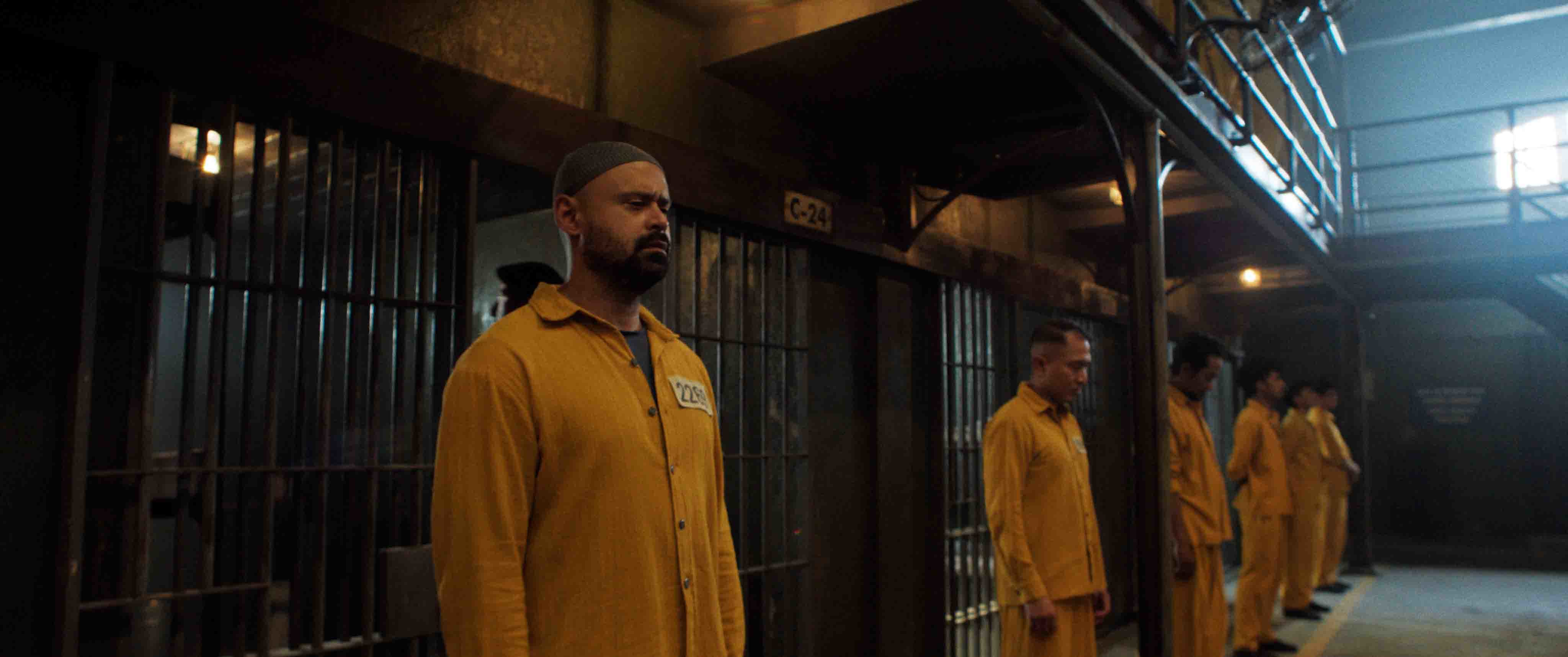
Joko, 50, has spent the past 48 hours in Singapore promoting his latest film, Ghost in the Cell. The horror-comedy, which had its world premiere at the Berlin Film Festival in February, follows inmates in a Jakarta prison who must unite for survival when a phantom menace — with a penchant for turning its victims into gruesome art installations — begins picking off those with the darkest auras.
Just to be clear: it wasn’t really hate-hate — more like the “it brought back some bad memories” kind.
The opening in Ghost in the Cell, with a journalist (Endy Arfian) scrambling against a deadline — just before the shit hits the fan, literally — hit a little too close home.
I briefly worked in The Straits Times newsroom — less than a year though I might have lasted longer if it weren’t for a, whatchamacallit, demanding supervisor. But that’s another story for another time.
Joko knows the feeling. He’s been there — as a journalist for The Jakarta Post.
As our conversation unfolded — at the open atrium space on the ninth floor of the Mediacorp Campus — it became clear that Ghost in the Cell, for all its supernatural mayhem, comes from a very real place.
Even the film’s strangest thread — a voice-mimicking scammer ( Dimas Danang Suryonegoro) inspired by the infamous Hollywood Con Queen — is rooted in something Joko personally investigated and helped expose.
8days.sg: I absolutely hated the first five minutes of the movie — not for the reason you think. Watching Dimas rushing to meet a deadline was triggering; as someone who used to work in a newspaper, it hit a little too close to home. Back in the day when you were a journalist, did you ever miss a deadline?
JOKO ANWAR: No, but I was like Dimas. I mean, the way the office is arranged in the film exactly matches the room I worked in when I was a journalist at The Jakarta Post. Even the name — Dimas was actually [named after] my boss! So everything reflects what I experienced… chasing deadlines was, oh my God, so stressful.
That’s why I respect journalists so much, especially those who stay in the profession. Every day, trying to meet deadlines — it’s crazy. It’s very stressful.
Last night at the Q&A after the Singapore premiere, you mentioned that you wrapped the film in 22 days and locked it in just four. Did your journalistic background instil that kind of discipline?
JOKO: Yes, that’s very true. You have to be concise, right? Every time you write an article, you have to be very concise. You start with your lead and then everything is supposed to support it… there’s no room for flowery language. That’s how I approach filmmaking — I don’t just write the script; I also do previsualization. What we shoot in production has to match the storyboard. That’s why the process is very tight and effective.
Twenty-two days is pretty fast. Did it ever feel rushed? And was that intentional — maybe to keep self-doubt from creeping in?
JOKO: We don’t rush anything. If we need more time, we’ll take it. So why is it so fast? Because everything is pre-planned. A director has to be decisive about everything — otherwise, we’re wasting money and other people’s time.
You also mentioned during the Q&A how the actors had to come up with their own character bible. How did that process work?
JOKO: Yeah… it starts with the character from the moment they’re born —everything they experience leading up to the timeline of the script. [He whips out his iPhone to show me their character bibles.] Their internal emotional map, their fears… everything. So when they come to set, they are the character. And I don’t have to direct them as much, because we’ve already done that work before the shoot.
The characters all have cell numbers. Was there any significance?
JOKO: Yes, of course. I’m not going to tell you — but there’s already been a lot of discussion about it online. Every number is different. I gave them to the costume designers so each character would have their own.
Do you have any superstitions before a shoot?
JOKO: I’m not superstitious at all, but you need that kind of mindset to make everyone feel safe. For instance, I don’t believe in a “rain stopper,” but every production in Indonesia has to have one — just for peace of mind.
Do you believe that if someone escapes human justice, karma will catch up with them? And which is more satisfying— man’s law or divine justice?
JOKO: Sometimes the law doesn’t work like that — especially in countries where the justice system doesn’t really side with the people. Those who commit large-scale corruption don’t get punished. It’s very disheartening… it makes you feel like we need some kind of supernatural force to deliver justice. And that, in itself, is sad.
Jailhouse rot: The prison in Ghost in the Cell is a set modelled after Sukamiskin , a real Indonesian prison which houses high-ranking officials convicted of corruption. When asked if he sees it as a Halloween Horror Nights attraction at Universal Studios Singapore, Joko said, ”Can!” (Photos: Come and See Pictures)
One of the scammers in the film can mimic a female voice, which brings me to the Hollywood Con Queen case. Was that character based on it?
JOKO: Yes — but nobody mentioned it.
It was one of the biggest things to happen during that period of my life. About 15 years ago, people in Indonesia’s film industry were buzzing about this supposed big Hollywood project. There were auditions, phone meetings… crew members, even some actors. Some of my friends went to Bali and other places, and they swore they had met this person. I kept wondering—why them, and not me?
Then it came to me, and I started digging into it — because [of my journalism background]. That’s when I found out about this guy impersonating people from Hollywood.
After I exposed him in Indonesia, he moved to London and started scamming people in the US, posing as top Hollywood figures. I later read about the case in The Hollywood Reporter, and they had no idea who he really was. So I reached out and said, “I know this person. If you want to find him, contact me.”
One of the journalists did, and I helped them expose him.
Yeah, it’s a fascinating story. I didn’t realise the scale of the scam until I saw the true-crime docu-series on Apple TV.
JOKO: Crazy.
It really is. The fact that he could mimic the voices of top female executives — it’s unbelievable. It’s truly stranger than fiction.
JOKO: Yeah. In the original interviews, the scammer actually talked about me at length. He was furious — kept going on about me. “That guy… I’m gonna f***ing get him…”
A European distributor for Ghost in the Cell described the film as having “ the gore of Terrifier, the action of The Raid with the humour of Stephen Chow.” Going in, what were your influences?
JOKO: Honestly speaking, when I was doing this, I didn’t have any specific influences. Usually, when I’m preparing a project, I’ll have one or two films that I ask my crew — especially my DP and my art director — to watch as reference. But for this one, I didn’t.
I can totally see Stephen Chow as an influence.
JOKO: I love Stephen Chow, yes.
That scene, where one inmate, played by Morgan Oey, gets his head kicked while praying, is funny.
JOKO: The prayer scene is actually symbolic. In Indonesia, minorities are often bullied by the majority. Even just last month, during Easter, there were incidents where groups disrupted people while they were praying. That’s very sad.
So when the characters are praying to Jesus and someone suddenly hits one of them, it’s meant as a [metaphor] — but maybe not everyone picks up on it yet.
For me, it’s not entirely funny — it’s actually sad.
I came into Ghost in the Cell expecting it to be gory, but I didn’t expect it to be so funny. Then again, you started out writing comedies. Did that background help in setting the tone for this film?
JOKO: Yeah. The idea was to capture the essence of the world we’re living in right now — to bottle it. It’s not just Indonesia; everywhere feels a bit crazy and absurd.
There are countries you’d expect to make better choices in choosing their leaders, but the people in power now… they make decisions that make life feel even more absurd.
So how do you put that into a film? The tone keeps shifting —horrifying, then funny. At some point, you just say, “**** it, let’s laugh it off.” That’s why Ghost in the Cell feels the way it does.
My background in comedy definitely helped keep that balance. I didn’t want a horror-comedy where the horror isn’t fully terrifying and the comedy just acts as relief from the tension.
I wanted everything to blend together — to the point where the audience doesn’t even know when to laugh or when to be horrified, sometimes both at the same time. That was the mission.
Your film, beyond its commentary on the prison system, seems to advocate using the arts as an outlet for dark, negative energy.
JOKO: I’ve always believed this: in Indonesia— especially in big cities— we don’t have enough art centres.
Because of that, we don’t really learn how to regulate our emotions. Through art, you feel things — you cry, you connect, whether it’s dance, theatre, or other forms.
Without those outlets, people tend to turn to anger, because they don’t know how else to channel what they’re feeling.
So when something happens, it becomes an outlet for that anger and frustration — because there aren’t enough healthy alternatives.
How do you clear your negative energy?
JOKO: I have a band — we’re on Spotify. It’s called Lima Pagi, or 5AM.
I watch films. I make films. I sing. I play in a band. I travel—travel is very important to me. My joy in life comes from small things. It doesn’t take much to make me happy. I collect little things—like speakers, tiny speakers. And power banks. I love power banks.
Speaking of music, you capped the film with the song, Patience and Prudence’s ‘Tonight You Belong To Me’. It’s been used in everything from American Horror Story to The Beast in Me. What’s the appeal of that song? Is it purely creative or does budget play a part? There’s something ironically creepy about it …
JOKO: Oh no, it’s actually quite expensive [to licence it] — at least for us. I love the song, and I made a bet with the producer. When I was trying to secure the rights, she said, “But the tone of the song is quite dark — we need something happier for the ending.” I told her, “We’ll make it feel happy.”
It’s about perception. If we can shift how people perceive the song in the context of the film, then we’ve done our job. So we used it for the ending, but it doesn’t feel creepy at all — unlike how it’s often used in other contexts. In Ghost in the Cell, it feels warm.
That’s right. By the end, I felt like joining in on the group hug.
And that means we got it right. I just love the song. To me, it’s very romantic and optimistic.
Night watch: A scene from Joko Anwar’s Nightmares and Daydreams. “Inspired by my curiosity and fascination with alien stories, I dug deep into the intriguing concept of aliens that might not be far from us,” said Joko in a Netflix interview. (Photo: Eriek N Juragan/Netflix)
Closer to home, you worked with Eric Khoo on the HBO anthology Folklore. Did that experience help when you were working on Netflix’s Nightmares and Daydreams?
JOKO: Certainly it did, yeah. Nightmares and Daydreams is probably one of our most ambitious projects. We had seven episodes, and each one tells a different story — with its own world-building and characters.
It was like making seven different feature films over two-and-a-half years. So when Netflix gives us the green light for a second season — okay, we’ll find the time.
There’s a second season?
JOKO: Yeah, but we’re still trying to find the time. Our company is very small, so we can’t…
There better be a Season 2. Because it ended on a cliffhanger. If you don’t do it, I’m so going to put a hex on you.
JOKO: The second season is going to blow minds away!
Last year, your fellow Indonesian filmmaker Timo Tjahjanto made his Hollywood debut with Nobody 2, and the year before, Mouly Surya did the same with Trigger Warning. You’ve also been attached to a few Hollywood projects. How’s that coming along?
JOKO: I have three or four projects in development, and two of them are very close to production at the moment.
But I want to emphasise that making films anywhere is essentially the same. In Indonesia, I’m able to make films that speak about something meaningful.
So the projects I take on outside Indonesia should do the same— address important issues, not just serve as entertainment.
Filmmaking takes time. You have to dedicate at least a year-and-a-half of your life to it. So if you’re going to commit to something, it should aim to be more than just entertainment — that’s what matters.
Speaking of cross-border collaborations, Ghost in the Cell features Malaysian actors Brontë Palarae and Ho Yuhang. Do you see more Southeast Asian collaborations in the future — perhaps involving Singapore's Sunny Pang, who has appeared in several Indonesian productions?
JOKO: Yes, because I think we need to build stronger networks within Southeast Asia — not just among actors, but filmmakers as well.
We need to work together. Culturally, we’re very close and share many similarities. If we join forces, we’ll be stronger and have a bigger footprint on the global film scene.
By the way, your company is named after the 1985 Russian movie Come and See by Elem Klimov…
JOKO: It’s one of my favourite films of all time. I think it’s the most powerful movie ever made. I first watched it when I was 17, 18. And I revisit it like every year or two. It’s still powerful now — even more so today.
Ghost in the Cell (M18) is now in cinemas.
……Other

One-stop lifestyle app dedicated to making life in Singapore a breeze!




 English
 简体中文
简体中文
Comments
Leave a comment in Nestia App