Malaysia’s strategic edge in the Asean power trade
MALAYSIA can leverage its geographical position and existing power interconnections to develop into a regional electricity trading hub.
The Energy Exchange Malaysia (Enegem) provides a starting point for cross-border renewable electricity sales to Singapore, while the Asean Power Grid (APG) could eventually broaden this into a more integrated regional electricity market.
Data centres (DCs) are one of the clearest drivers of Malaysia’s rising electricity demand, as the country continues to attract large investments in the sector.
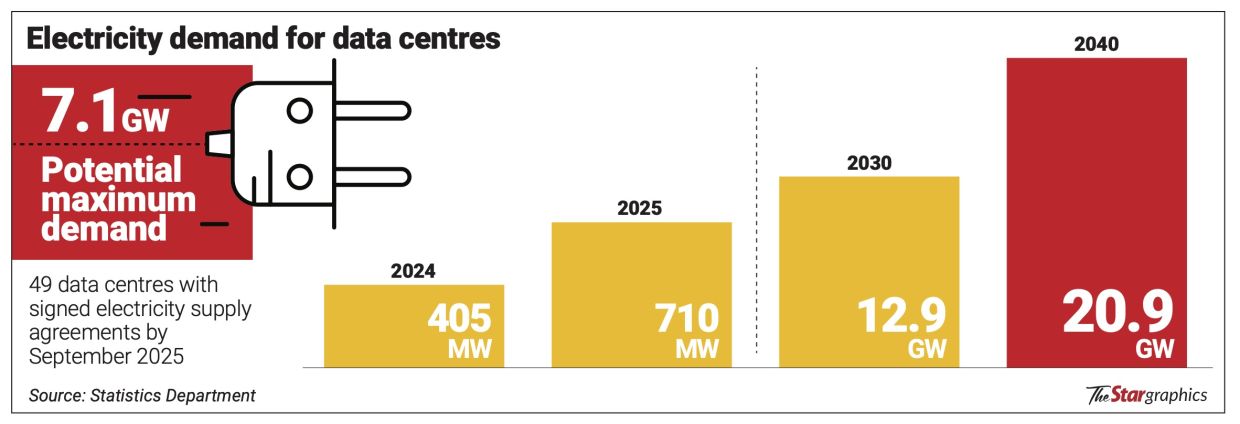
By September 2025, 49 DCs had signed electricity supply agreements with Tenaga Nasional Bhd
, representing potential maximum demand of about 7.1GW. Actual electricity use had also risen to about 710MW, from 405MW at end-2024.
This highlights both the economic opportunity and the challenge for Malaysia.
The government estimates DC electricity demand could reach 12.9GW by 2030 and 20.9GW by 2040, highlighting the need to expand its electricity grid while increasing the availability of renewable energy.
The country is also expected to benefit from the shift towards green manufacturing, as multinational companies increasingly consider the carbon intensity and reliability of electricity when deciding where to locate production.
This is particularly relevant to semiconductors, electronics, electrical equipment and electric vehicle-related manufacturing, which require reliable power.
The government is also expanding corporate access to renewable electricity through the Corporate Renewable Energy Supply Scheme, allowing businesses to procure green electricity through the National Grid.
The broader regional outlook points to strong growth in electricity demand. According to the International Energy Agency (IEA), Asean electricity demand rose by more than 7% in 2024, nearly twice the global average.
It is projected to grow by about 4% annually through 2035, rising from more than 1,300 terawatt-hours (TWh) to over 2,000TWh.
The IEA estimates Asean will require more than US$300bil in electricity grid investment between 2025 and 2040, 72% more than the US$174bil invested between 2009 and 2024.
Against this backdrop, Malaysia’s participation in the Lao People’s Democratic Republic-Thailand-Malaysia-Singapore Power Integration Project is an example of this regional approach and forms part of the wider APG initiative.
Operational since 2022, the project enables electricity trading among Laos, Thailand, Malaysia and Singapore, with its transfer capacity doubled to 200MW in 2025.
Recently, Brunei, Indonesia, Malaysia and the Philippines have also announced the BIMP Power Integration Project to deepen regional power integration.
Malaysia has a strategic advantage as the only Asean economy spanning two of the APG’s three main subsystems.
Peninsular Malaysia is interconnected with Thailand and Singapore, while Sarawak is connected to West Kalimantan. Malaysia also serves as a wheeling economy in Asean’s first multilateral electricity trade.
Sarawak’s hydropower resources could further strengthen Malaysia’s role as regional demand for cleaner electricity grows.
Greater interconnection could allow Malaysia to export electricity when it has surplus generation while accessing power from neighbouring markets when domestic supply is tight.
This could create opportunities across the energy value chain, including for utilities, energy companies, financial institutions and other businesses supporting regional power infrastructure and electricity trading.
However, regulatory differences remain a key challenge to expanding cross-border electricity trading.
Asean member states have different electricity laws, market structures, pricing systems and technical standards, making regulatory harmonisation necessary.
Issues such as third-party access to transmission networks, wheeling charges, transmission pricing and responsibility for supply disruptions also need to be addressed.
The different levels of electricity-market development across Asean mean the region is likely to take a gradual and voluntary approach towards greater power integration.
Stronger regional market rules, institutional coordination and regulatory frameworks will therefore be essential to fully realise the potential of the APG.
……Read full article on The Star Online - Business
Entertainment Malaysia

One-stop lifestyle app dedicated to making life in Singapore a breeze!




 English
 简体中文
简体中文
Comments
Leave a comment in Nestia App