More seniors in S’pore living alone in 2025, though most elderly still live with spouse or children
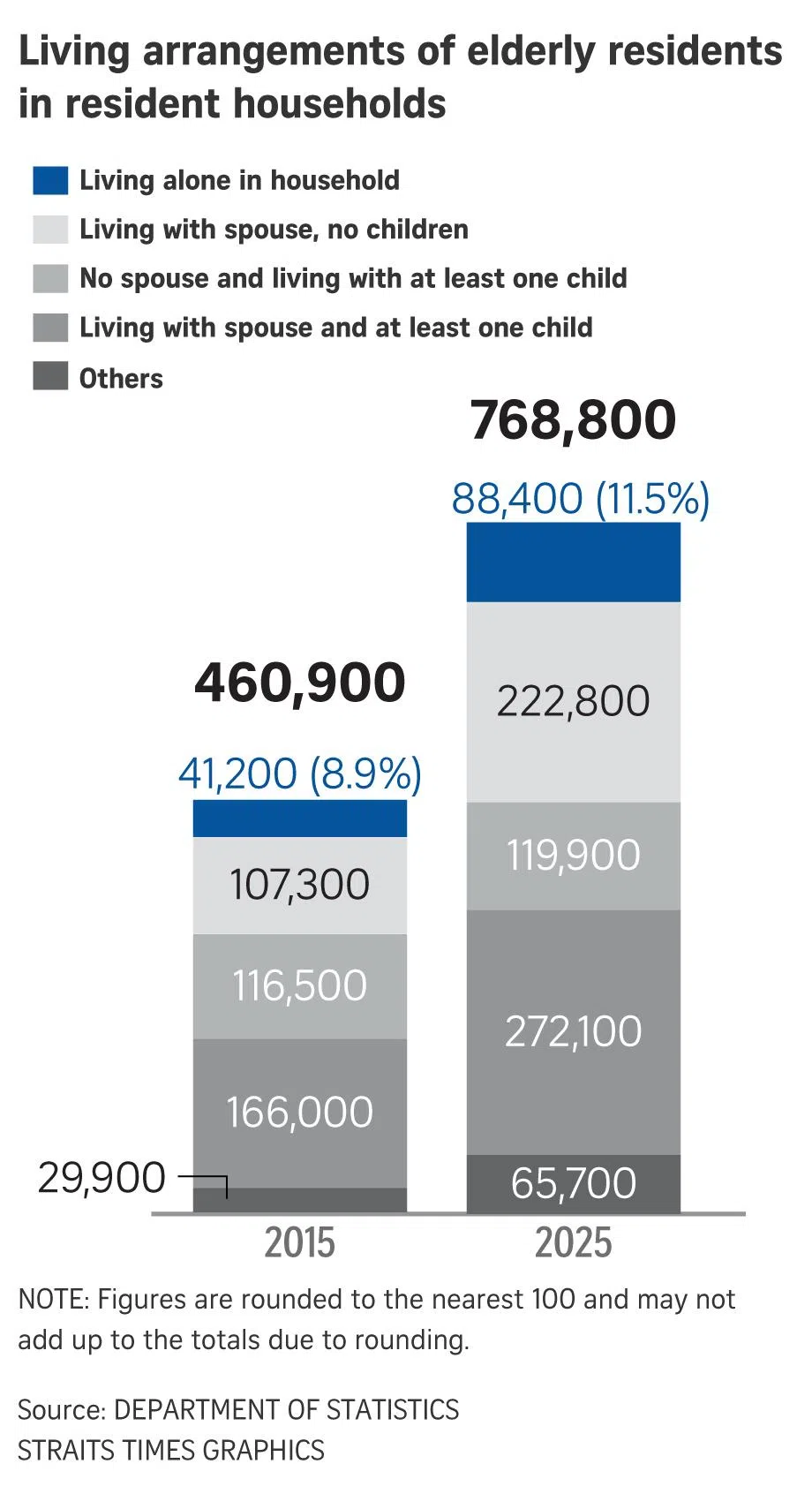
Seniors aged 65 and above who are living alone make up 11.5 per cent of all senior residents in households.
SINGAPORE - The number of seniors aged 65 and above in Singapore living alone rose to 88,400 in 2025, up from 87,200 in 2024.
This figure has more than doubled from 41,200 a decade ago in 2015.
Overall, this group of elderly is still a minority: they make up 11.5 per cent of all senior residents in households, with the majority still living with their spouse and/or children.
The Ministry of Social and Family Development’s (MSF) report on family trends, which was released on July 10, also showed that families have close ties.
The report indicated that 95.2 per cent of respondents aged 15 to 64 agreed that it is their responsibility to take care of their parents. This is up from 93.1 per cent in 2023.
According to a survey conducted by MSF, 89.6 per cent reported having a close-knit family in 2025, up from 86 per cent in 2023.
Married respondents were more likely to report having a close-knit family, as compared to those who were single, divorced, separated or widowed.
They were also more likely to maintain close ties with relatives outside their immediate families.
Over 90 per cent of families reported moderate to high family resilience scores, an improvement from 85.9 per cent in 2023. This refers to the ability to cope and adapt to challenges or adversity, and bounce back from difficult life events.
Family resilience scores were also higher among married respondents.
The report highlighted that caregivers reported a lower quality of life, compared with those who were not caregivers. This data was from a 2025 study by the National Council of Social Service.
It found that caregivers scored lower across the physical, psychological, social relationships and environment domains compared to non-caregivers. These indicators measure different aspects of their lives, like how satisfied they are with themselves, their living spaces, and social relationships.
Caregivers were also less satisfied with the family support they received, as compared to non-caregivers.
Even so, both groups reported similar levels of happiness with their family relationships. About 60.3 per cent of caregivers said they were happy with their family relationships, compared with 61.2 per cent of non-caregivers.
Singapore Management University sociology professor Paulin Tay Straughan told The Straits Times this may be so because caregiving is a labour of love.
“Perhaps they remain positive on the family front when it comes to relationships with care recipients, and experience dissatisfaction with other members of the family who are not pulling their weight in the care of a loved one.”
Principal research fellow at the National University of Singapore’s Institute of Policy Studies Mathew Mathews said a caregiver may feel tired, stretched or unsupported, but still feel emotionally close to the family member they care for.
Apart from less sleep and personal time, caregivers have fewer social activities and more stress about money, health or the future. These pressures can leave them feeling unsupported, but do not necessarily reflect poor family relationships, he added.
“Many caregivers continue to find meaning, love and fulfilment in caring for their loved ones. They may feel burdened by the responsibility but still value the relationship deeply.”
But strong family bonds should not be taken to mean that caregivers do not need help, he said.
“Support should focus on practical relief such as respite care, training, counselling, financial support, workplace flexibility and better coordination of services.”
MSF’s report said families also continue to be the key source of caregiving support.
Most respondents reported that they would provide financial, emotional and physical support to family members if needed.
But there was a dip in the number of people who said they were willing to provide physical support if their family members needed help with daily living activities, like washing, dressing, and feeding.
The proportion fell from 81.4 per cent in 2023 to 73.8 per cent in 2025.
The share of respondents willing to give financial and emotional support grew slightly over the same period.
Mathews said the decline in willingness to provide physical support may not mean that people care less about their family members. It may reflect the awareness of how demanding physical caregiving can be, with people less certain they can personally provide it.
Households are also becoming smaller, with more dual-income couples and many adults balancing work and caring for children and elderly parents at the same time.
“In such circumstances, family members may still be willing to provide emotional and financial support, but may feel less able to personally provide daily hands-on care,” he said.
Hence caregiving responsibilities may increasingly be shared with or outsourced to domestic workers and formal care services, he added.
“Still, the fact that willingness to provide financial and emotional support remained stable suggests that family commitment has not disappeared. Rather, the form of support may be changing.”
……Read full article on The Straits Times - Singapore
Singapore

One-stop lifestyle app dedicated to making life in Singapore a breeze!





 English
 简体中文
简体中文
kktk 12/07/2026
and which is why at the end of the day we would always need to make sure to remain cautious and vigilant at all times especially in the midst of this challenging period that we are faced with and ensure that we are always well and safe regardless of the situations and circumstances that we would need to contend with as well too
Reply