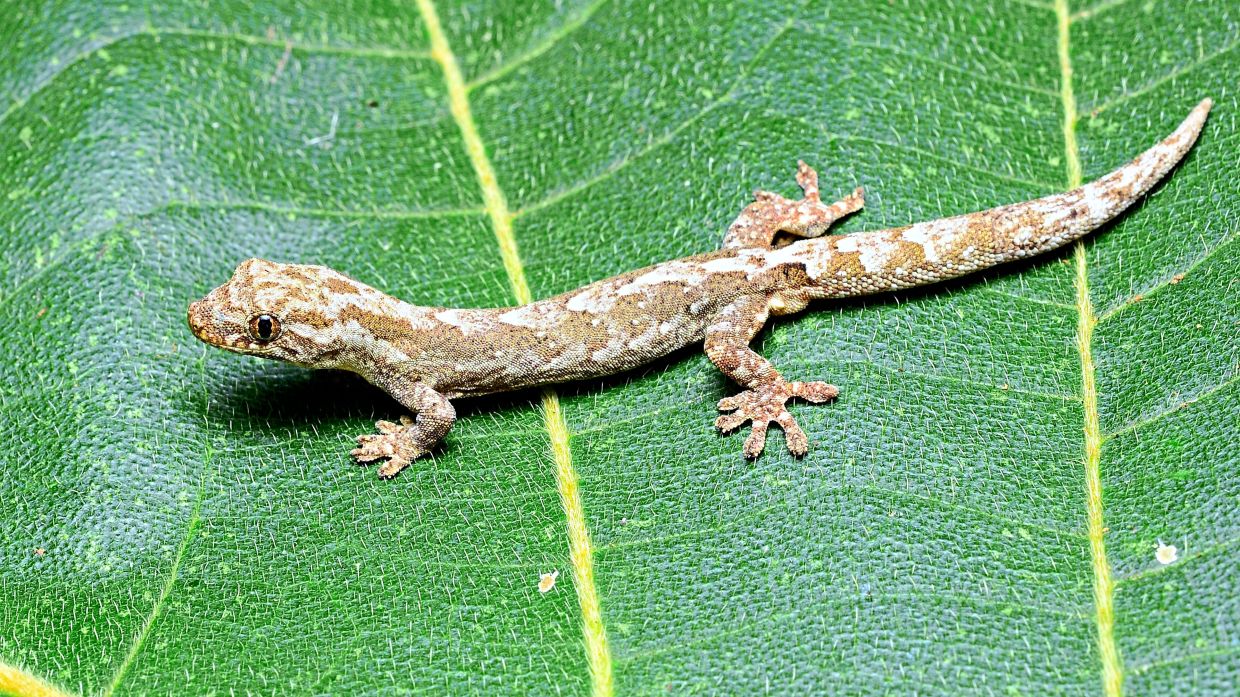
New gecko species found at Sabah’s Crocker Range
KOTA KINABALU: A new gecko species living in the Crocker Range has been discovered by Universiti Malaysia Sabah (UMS) researchers.
The small lizard, which has gone almost unnoticed on the walls and eaves of buildings at Tambunan’s Gunung Alab, has been confirmed as a species yet to be recorded in science after detailed genetic and morphological investigations.
The newly discovered species was formally named Lepidodactylus crockerensis or the Crocker Range Mourning Gecko after its discovery at Gunung Alab, which is part of Sabah’s Crocker Range.
The species discovery was led by Assoc Prof Dr Evan SH Quah, a herpetologist from the Institute for Tropical Biology and Conservation, along with Aderina Dukit (Monash University), Fred YY Tuh (Sabah Parks) and L. Lee Grismer (La Sierra University).
Their scientific paper was published on Sept 22 in the international taxonomic journal Zootaxa.
UMS described it as “a tiny discovery with a big scientific story”.
The holotype, the specimen upon which the new species is formally based, was collected by Quah in the old Rhododendron Hut at an elevation of 1,909m above sea level on Aug 23, 2025.
Two additional male specimens form part of the type series.
The geckos were found at night during cool and misty conditions, with temperatures between 14°C and 16°C. Individuals were found in the old Rhododendron Hut and were also observed on the walls and roof eaves of nearby buildings, where they were presumed to feed on insects attracted to lights.
But identifying them was not straightforward, the researchers explained.
The Gunung Alab gecko closely resembles Lepidodactylus ranauensis (L. Ranauensis), another Bornean endemic associated with Mount Kinabalu. But science revealed what appearances alone could not.
Genetic analyses showed that the Gunung Alab population forms its own strongly supported evolutionary lineage.
“The new species differs genetically from L. ranauensis and shows statistically significant differences in morphology and scalation.
“The two occur in separate mountain ranges approximately 36km apart, with unsuitable lowland habitats between them,” the UMS researchers said, adding that the species was the third of its kind recorded in Borneo.
Quah said the discovery was a reminder that there is still more to fully understand the herpetofauna (reptiles and amphibians) of Borneo.
“Even in locations that are relatively well-studied, there are species that have lived alongside us for generations that have not yet been formally recognised by science. We now have a responsibility to better understand and conserve it and the vulnerable ecosystem it occupies,” he said.
UMS vice-chancellor Prof Datuk Dr Kasim Mansor said a small gecko found in the highlands of Sabah carried a much bigger message to the world that Borneo was still revealing its secrets.
……Read full article on The Star Online - News
Entertainment Malaysia

One-stop lifestyle app dedicated to making life in Singapore a breeze!




 English
 简体中文
简体中文
Comments
Leave a comment in Nestia App