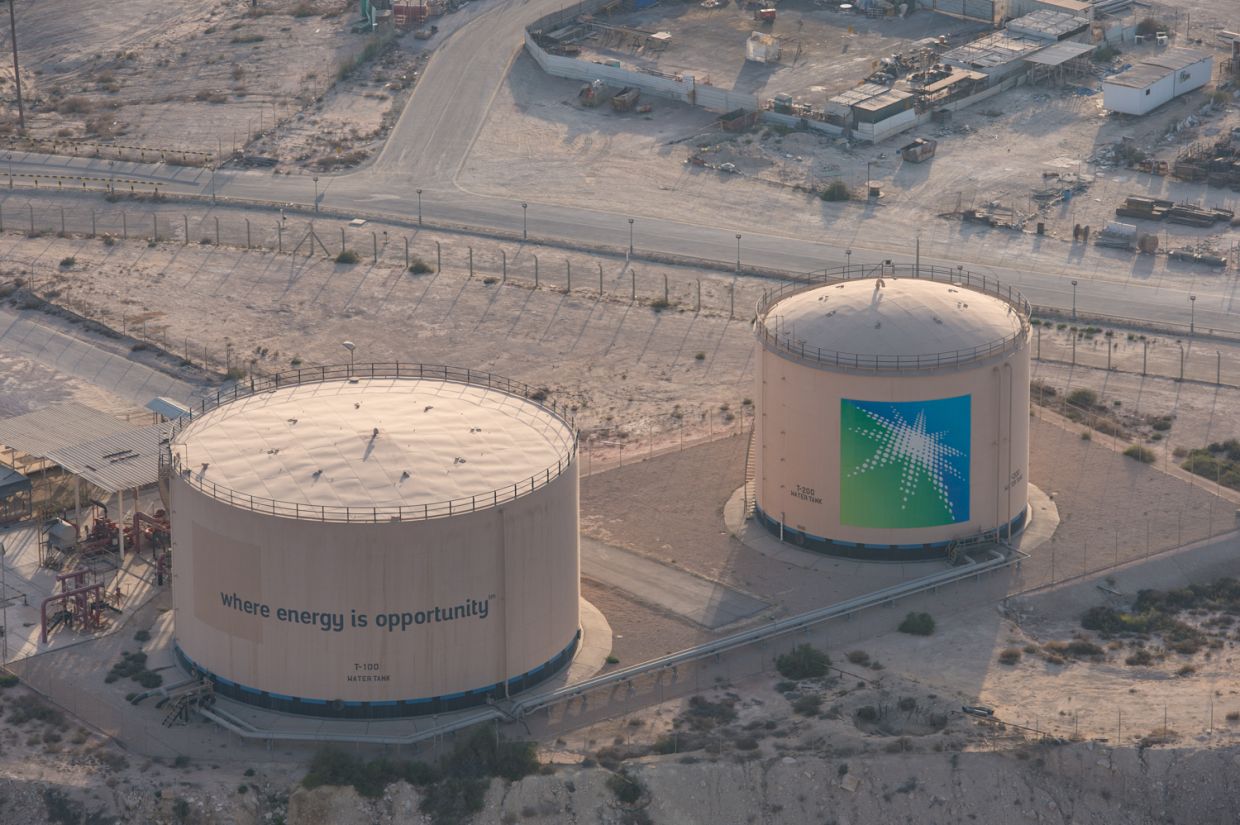
Saudi Aramco resumes oil loading at Ras Tanura
SINGAPORE: Saudi Aramco has resumed crude loadings at its Ras Tanura terminal in the Gulf after a near four-month halt, shipping data show, as the world’s biggest oil exporter joined a rush to move cargoes amid industry hopes of a return to normal.
The Saudi oil loadings come even though a ship belonging to Taiwan’s Evergreen Marine was hit by an unknown object in the Strait of Hormuz last Thursday.
Middle Eastern producers had been ramping up oil and gas output and exports in the lead-up to the interim deal between the United States and Iran to halt the war and reopen the strait where a fifth of the world’s oil and liquefied natural gas supplies used to pass.
Two very large crude carriers (VLCCs) controlled by Saudi’s shipping arm Bahri were seen loading crude at Ras Tanura, the world’s biggest oil port, while another is heading towards the terminal, the data showed last Friday.
A fourth VLCC waited nearby.
Each VLCC is capable of loading two million barrels per day (bpd) of oil.
British navy agency UKMTO paused its operation to escort ships through the strait after the attack on the cargo ship, reigniting concerns about whether the preliminary deal to end the Iran war will hold.
Two US officials told Reuters that Iran had fired on the ship, while Iran’s Persian Gulf Strait Authority, which Tehran established to manage requests for ships to travel through the strait, said vessels outside routes it has set will not be guaranteed safe passage.
Ras Tanura sits on Saudi Arabia’s eastern coast on the Gulf and is west of the Strait of Hormuz.
It used to export more than five million bpd of crude before the conflict.
The country’s largest domestic 550,000 bpd refinery is also located at Ras Tanura, which was shut during the war as a precautionary measure.
Aramco last loaded a cargo from Ras Tanura port for China on March 8, LSEG data showed, and had to divert its exports to the Red Sea port of Yanbu after the Iranian blockade of the strait during its war with the United States and Israel prevented ships from entering the Gulf.
The war has caused Saudi crude exports to slump to about four million bpd in the past three months, the data showed, from more than seven million bpd in February.
Global oil prices fell more than US$1 a barrel last Friday after edging up on the reports of the attack on the cargo ship.
Supply pressure is increasing after crude shipments through the strait rose this week to their highest level since the conflict broke out.
Saudi Aramco may cut August prices sharply next week as competition among producers intensify.
“Two million barrels a day came back online in three weeks, and the recovery is spread across the region,” Rystad Energy’s MENA research director Aditya Saraswat said in a note.
He added that the supply picture was clearly improving. — Reuters
……Read full article on The Star Online - Business
Entertainment Malaysia

One-stop lifestyle app dedicated to making life in Singapore a breeze!




 English
 简体中文
简体中文
Comments
Leave a comment in Nestia App