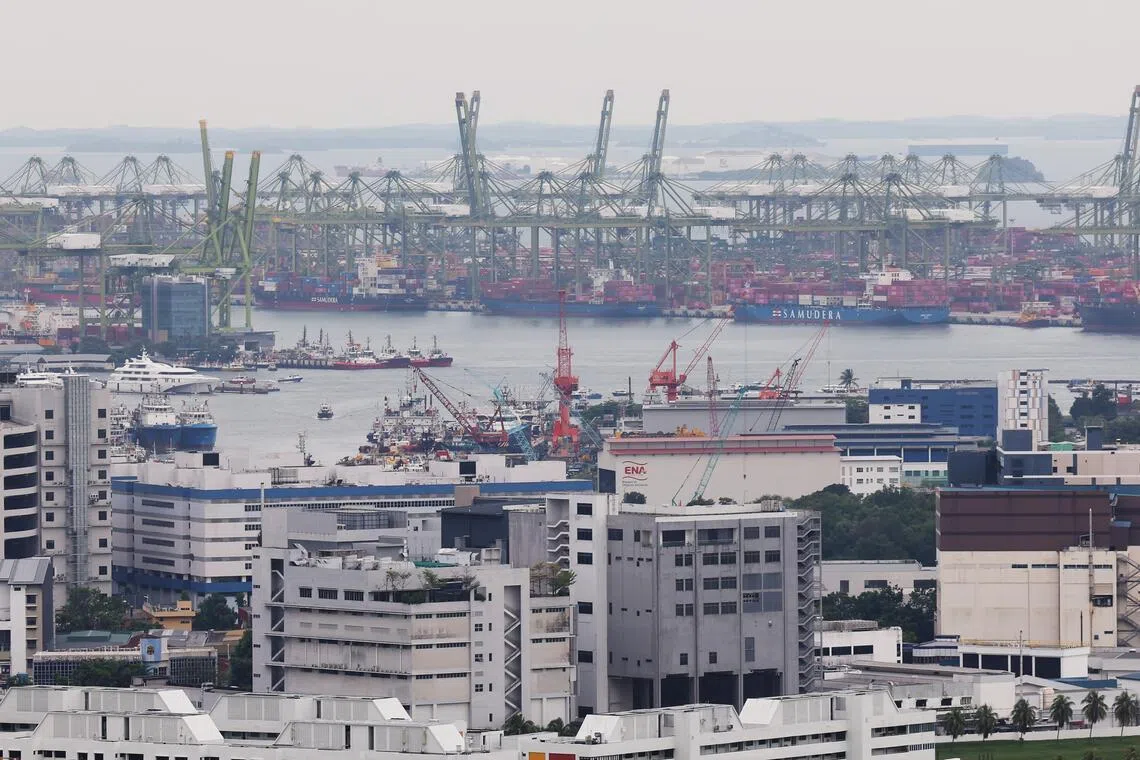
Singapore MPA offers more LNG bunkering licences to address growing demand for cleaner marine fuels
SINGAPORE - The Maritime and Port Authority of Singapore (MPA) is offering permits to existing and new applicants to supply liquefied natural gas (LNG) as a marine fuel in the Port of Singapore.Companies that obtain the licence will be required to implement end-to-end LNG bunkering supply arrangements, MPA said on Jan 14.These arrangements will include securing LNG supply, demand planning, cargo transfers operations, storage and safe handling of LNG, as well as the sale, supply and delivery of LNG fuel to vessels in Singapore – one of the world’s largest bunkering ports.Industry experts say that demand for LNG bunkering has grown significantly over the past few years.The demand is driven not only by regulatory mandates – on reductions in greenhouse gas intensity for fuels used in shipping – but also by the growth of the LNG dual-fuel fleet which consists of ships designed to run on both LNG and conventional marine fuels.According to Norwegian classification society and risk consultant DNV’s Alternative Fuels Insights platform, 642 LNG-powered vessels were in operation in 2025 worldwide. Of these, 169 were delivered in 2024, the highest delivery of such vessels ever.The growth in demand is expected to continue, with 264 new orders for LNG-fuelled vessels placed in 2024 – also a record and more than double the number of orders placed in 2023.Experts believe the total addressable market for LNG pathway fuels – that include LNG, bio-LNG and e-methane – will grow exponentially by the end of this decade.The LNG pathway fuels use LNG’s established infrastructure to fuel ships and are increasingly recognised as a practical route to take the shipping industry to net-zero emissions.Singapore’s call for additional applications follows the recent updates to the Singapore LNG bunkering licensing framework and standards.They now include the provision of sea-based LNG reloading and the supply of liquefied bio-methane and e-methane in the Port of Singapore, the port regulator said.MPA on Jan 14 said the licensees are now required to own or charter at least one LNG bunker vessel (LBV) for the entire licence period. The LBV must be registered with the Singapore Registry of Ships and comply with MPA’s Standards for Port Limit LNG Bunker Vessels, it said.To support international shipping’s decarbonisation efforts, applicants are also required to submit a proposal detailing their technical readiness to supply LNG fuels with lower lifecycle greenhouse gas emissions, such as liquefied bio-methane and e-methane.The proposal should also cover intended supply pathways and sourcing arrangements.Applicants for the new licences are also required to outline measures to monitor and mitigate methane slip – which refers to the leakage of methane fuel – from LNG bunker vessels.The outline of measures should include vessel design features, operational practices, and monitoring or reporting approaches. The measures will be assessed as part of the licence evaluation process, said MPA.In July 2025, MPA conducted a large-scale chemical spill drill simulating a methanol leak, ahead of issuance of the first batch of methanol bunkering licences in November to Global Energy Trading, Golden Island, and PetroChina International (Singapore).The regulator on Jan 14 said that in order to further enhance Singapore’s LNG bunkering ecosystem, MPA and Enterprise Singapore, through the Singapore Standards Council, will upgrade the existing Technical Reference for LNG Bunkering (TR56) to a Singapore Standard (SS) in Q2 2026.The new SS will update and strengthen the requirements under TR56, aligning them with Singapore’s broader bunkering standards and serving as a key reference for LNG bunkering licence applicants. MPA has also published the Standards for Port Limit LNG Bunker Vessels, developed in consultation with the industry, to ensure the safe operation of LNG bunker vessels in Singapore.These standards specify requirements for equipment, operational performance, and efficiency of LNG bunker vessels.Singapore’s LNG ecosystem has developed fast since the opening of its first terminal in 2013 – making LNG the top fuel for power generation.The first Request for Proposal for LNG bunkering was launched in July 2015. In the same year, MPA announced a co-funding scheme to support the building of LNG-fuelled vessels.In May 2021, FueLNG – a joint venture between Keppel and Shell Eastern Petroleum – completed Singapore’s first bunkering of an LNG-fuelled oil tanker.Shell has become one of the biggest players in LNG trading and bunkering in Singapore after it completed the acquisition of Pavilion Energy from Temasek in April 2025.The other big names in LNG bunkering in Singapore are Total Energies Marine Fuels, BP, Vitol and Chevron.
……Read full article on The Straits Times - Sports
Other

One-stop lifestyle app dedicated to making life in Singapore a breeze!




 English
 简体中文
简体中文
Comments
Leave a comment in Nestia App