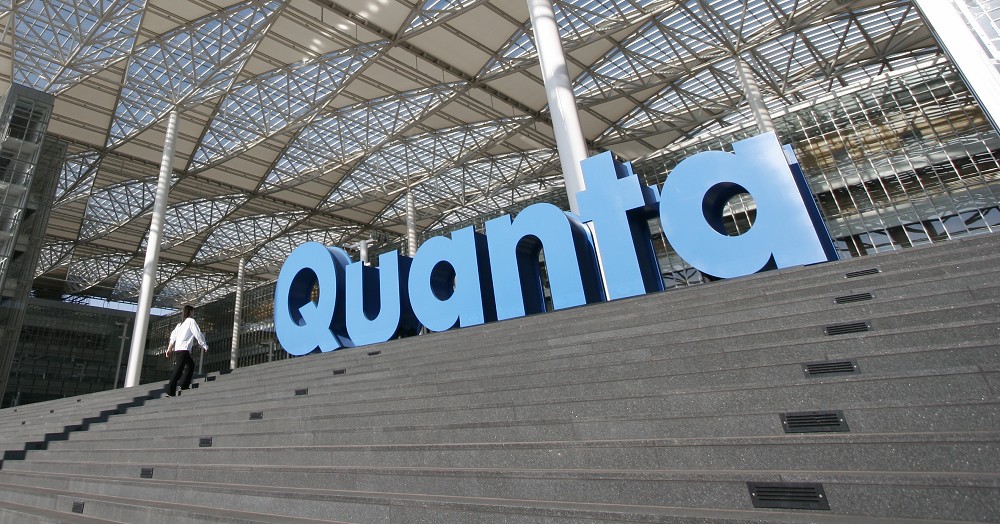
Taiwanese contract manufacturer Quanta Computer said on May 14 that its AI server revenue would rise by a double-digit percentage this quarter, citing clearer cloud customer orders through 2028.
First quarter revenue rose 66.6% year on year to NT$809.22 billion (US$25.7 billion).
Servers made up 80% of sales, with AI servers accounting for 75% of server revenue, while server revenue climbed 30% from the prior quarter.
Net profit increased 8.7% to NT$21.19 billion (US$672 million), but gross margin fell to 4.78% from 7.92% a year earlier as higher AI server rack costs and a transition between Nvidia GB200 and GB300 platforms weighed on margins.
Quanta plans NT$30 billion (US$952 million) in 2026 capital spending for AI expansion in the US and Thailand.
It also approved a US$800 million injection into three overseas units, mainly for its US expansion.
.source-ref{font-size:0.85em;color:#666;display:block;margin-top:1em;}
🔗 Source: Taipei Times
🧠 Food for thought
Implications, context, and why it matters.
The high price of AI revenue growth
Margin pressure at Quanta also affects AI server makers such as Foxconn and
Wistron, a Taiwanese electronics manufacturer
1.
The business model has a built-in mismatch. Fees paid to Original Design Manufacturers (ODMs), companies that design and build products for other brands, do not rise as fast as the cost of graphics processing units (GPUs) and advanced memory
2.
Consignment models add to the squeeze. In these deals, used by Foxconn, also known as Hon Hai, cloud customers supply the costly GPUs themselves
3.
Revenue can climb with component prices while profit from assembly and integration stays thin
2.
AI’s economic benefits are not evenly distributed
Quanta’s results suggest high-priced GPU and memory suppliers take an outsized share of profit in the AI hardware boom
2.
The AI server market could pass US$352 billion by 2034, yet the companies building these systems may still operate on slim margins
4.
The same pattern could spread across AI. Companies building foundation models, large AI systems trained on vast amounts of data, may capture more value while companies deploying them face commoditization, meaning their services become harder to differentiate and less profitable
2.
The build-out also puts pressure on energy systems. Global data center electricity use is expected to more than double by 2030, driven mainly by AI workloads, the computing tasks required to train and run AI systems
5.
……





 English
 简体中文
简体中文
Comments
Leave a comment in Nestia App