Take a Closer Look at These ‘Great’ New York City Trees
Share full article
By Alex Kent and Dodai Stewart
Alex Kent made over 8,000 photographs and videos of New York City’s official “Great Trees.” Dodai Stewart researched them all and visited a few.
Aug. 22, 2025
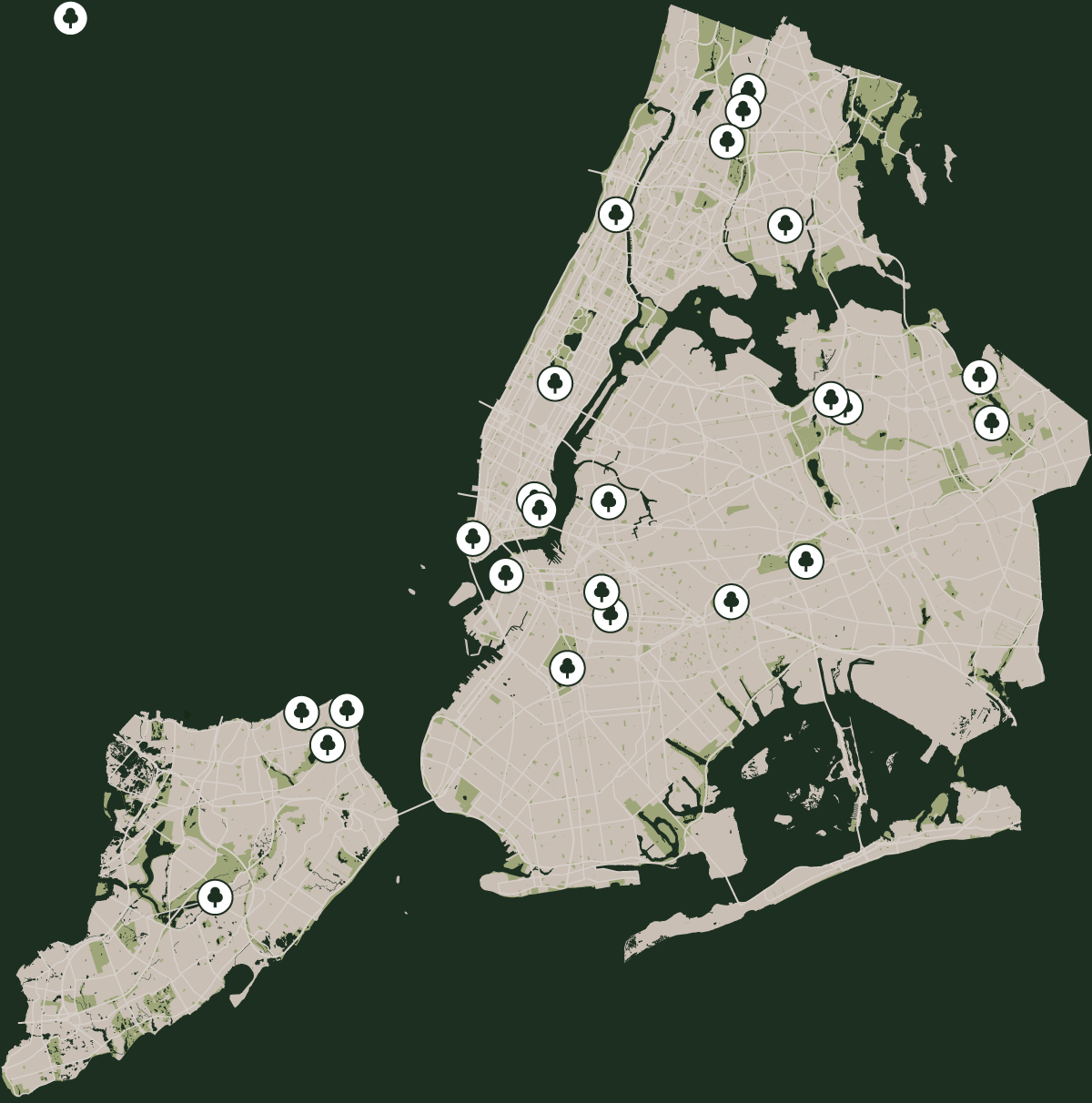
One could argue that all trees are great. But for the past 40 years, New York City has declared certain truly exceptional trees to be officially great. There are 120 Great Trees in the Parks Department’s roster, nominated by residents for their historical, botanical or cultural significance. Together, they represent the diversity of New York’s foliage. All are marked with a small rectangular “Great Trees of New York” sign, either on the tree or nearby. Some are in public places; others are on private property.
Great tree
BRONX
MANHATTAN
QUEENS
BROOKLYN
STATEN ISLAND
Great tree
BRONX
MANHATTAN
QUEENS
BROOKLYN
STATEN ISLAND
The New York Times
Here is a close-up look at 25 of the greatest Great Trees. Tap the tree icon next to your 5 favorites to create a list of the ones you want to see. It’s worth visiting them all, but even if you can only manage to visit one, be sure to take your time. Observe the bark, the leaves, the roots and the branches. Notice what has grown up around the tree over the years and, in some cases, centuries.
0 1 2 3 4 5 6
tree s on your list ›
677 Lafayette Avenue , Brooklyn
Save
Tap to save this tree to your list
A tree that inspired a movement
In 1968, this magnolia tree, then over 40 feet tall, was supposed to be cut down to make way for an apartment complex. Hattie Carthan jumped into action. Ms. Carthan, an environmentalist and activist in the Black community, moved to Brooklyn in 1928 and had a deep love for trees. In 1966, she founded the Bedford-Stuyvesant Beautification Committee, which planted more than 1,500 trees and also taught youth groups about caring for them — not a popular mission at the time. “When I first suggested that we buy trees, I almost got thrown out of the block association,” Ms. Carthan told The New York Times in 1975. “They said, ‘Oh, trees make leaves and you have to sweep.’”Ms. Carthan was so determined to save the magnolia on Lafayette Avenue, which was estimated to have been planted in about 1885, that she campaigned for it to be designated by the city’s Landmarks Preservation Commission as a living landmark — and won. Today it is the sole remaining landmark tree in New York City. In 1972, Ms. Carthan created the Magnolia Tree Earth Center, which, despite her death in 1984, continues to educate young people about environmental issues. The center is facing financial hardship, but there is hope that it will be revitalized, said Wayne Devonish, the chairman of its board. “We need to embrace all that it represents in terms of being like a little urban oasis, smack dab in central Brooklyn,” he said. “If we show the tree, and the center, love, hopefully there’s another good 100 — or 200 — years.”
Tap to read more about this tree
Hunter Island in Pelham Bay Park , Bronx
Save
Tap to save this tree to your list
A hidden spot, known to gulls and egrets
If you have a sense of adventure, take the Bx12 bus to Orchard Beach and walk north, where you’ll find the 138-acre Hunter Island Marine Zoology and Geology Sanctuary and the Kazimiroff Nature Trail, which winds through an old oak forest and a salt marsh. Follow the boardwalk over the grassy marshland to discover the post oak grove, a cluster of trees that date back to the 1760s. Their rocky perch on the edge of Pelham Bay has kept them safe from development or destruction for generations. Though you’re just about half a mile from the lively clamor of Orchard Beach, the post oak grove feels like a secret world, a peaceful spot for meditation and gazing out at the water, where your only company may be snowy egrets, double-crested cormorants and ring-billed gulls.
Tap to read more about this tree
The Mall at Central Park , Manhattan
Save
Tap to save this tree to your list
Two trees in one
Central Park is full of amazing trees, but this rugged elm, located just east of the Mall and Literary Walk (and west of East 69th Street) is actually two individual trees, curving out of a rock. With deeply grooved trunks and ancient-looking roots clutching the jagged stone crevices, these twisted twins are straight out of a mystical storybook.
Tap to read more about this tree
Tompkins Square Park , Manhattan
Save
Tap to save this tree to your list
In memory of lives lost
This tall Colorado blue spruce in the southeast corner of Tompkins Square Park’s central lawn was donated by the Parks Department in 1992 in remembrance of Glenn Barnett and all those in the neighborhood who had been lost to AIDS. During the holidays, the spruce is festively decorated and serves as a Christmas tree. But on a recent sunny afternoon, it was on duty as a shady spot for a couple lying on the grass beneath its branches.
Tap to read more about this tree
El Jardin del Paraiso Garden , Manhattan
Save
Tap to save this tree to your list
A magnet for a vibrant community
Over the decades, a set of vacant lots has been transformed into a thriving community garden where neighbors gather for film screenings, fashion shows, concerts, puppet shows and more. On a recent Tuesday, as a Puerto Rican flag flapped over a vegetable patch, a group of men congregated to play dominoes. Hula hoops leaned against a shed. At the center of it all was the willow, which provided a shady place to play or relax. “It’s very special,” said Bonnie Sue Stein, who has lived next door for over 30 years. “People just come in and sit.”In 2001, the artist Roderick Wolgamott built a nest-shaped treehouse in the willow. It was just after the Sept. 11 attacks, and he wanted to work on something positive. “I got so much energy from just working around the tree,” he said recently. “It’s so beautiful.” The nest was dismantled in 2019 and replaced with a tiered platform, and the willow remains a magnet for the community.
Tap to read more about this tree
New York Botanical Garden, near Bedford Park Boulevard entrance , Bronx
Save
Tap to save this tree to your list
A species in danger
Standing over 100 feet tall, with a diameter of more that 47 inches, the white ash inside the New York Botanical Garden, with its stunning, diamond-patterned bark, is remarkable for simply existing. When this tree was donated to the garden in 1907, the white ash species was plentiful in New York forests. In addition to being considered a keystone species, since it provided food and habitat for a range of other organisms, its strong, durable wood made it a valuable choice for baseball bats, furniture and guitars. But since the mid-2000s, the emerald ash borer, a tiny green beetle native to Asia, has decimated the region’s white ash population. The species is now considered critically endangered; the emerald ash borer has killed hundreds of millions of trees throughout North America so far.
Tap to read more about this tree
Cypress Hills Cemetery at Jamaica Avenue , Brooklyn
Save
Tap to save this tree to your list
A natural umbrella in a solemn spot
Crooked branches twist and turn, forming a wide canopy that casts a serene shade over gravestones more than a century old. There are 21,000 veterans and their loved ones buried here, including 24 recipients of the Medal of Honor, and on most days, this is a place of reverent silence. The beech’s trunk is scarred from people carving their names. Its thick, leafy foliage creates a natural umbrella, under which it’s possible to remain cool even in scorching sunshine.
Tap to read more about this tree
Snug Harbor Cultural Center , Staten Island
Save
Tap to save this tree to your list
Flowers with a whiff of vanilla
When Robert Richard Randall, heir to a shipping fortune, died in 1801, his will stipulated that the family’s wealth and estate be used to build and operate a haven for “aged, decrepit and worn-out sailors.” That haven, known as Sailors’ Snug Harbor, eventually became the Snug Harbor Cultural Center & Botanical Garden. In addition to a theater, a Tuscan garden, a rose garden and a Chinese scholar garden, Snug Harbor has a royal paulownia, sometimes called a princess tree, an empress tree or a foxglove tree. It is native to central and eastern China and the Korean Peninsula and produces huge leaves, sometimes 16 inches across, and lavender, funnel-shaped flowers that smell like vanilla.
Tap to read more about this tree
Msgr. McGolrick Park , Brooklyn
Save
Tap to save this tree to your list
‘Stunning’ — and ‘confusingly shaped’
This unique, twisty, umbrella-shaped tree joined the Great Trees list just last year. Its low branches often serve as a jungle gym for children. When it blooms in the spring, its flowers are bright pink. “Children are drawn to it, often sneaking over the fence and into its low, twisted branches when they think no one is watching,” said Jodie Love of Friends of McGolrick Park, a volunteer organization run by residents of the Greenpoint neighborhood. On the group’s Instagram account, the tree is described as “stunning,” “iconic” and “confusingly shaped.” In the comments, fans simply gush: “Love this tree!!”
Tap to read more about this tree
Forest Park, near Jackson Pond Playground , Queens
Save
Tap to save this tree to your list
In memory of local soldiers
Planted in 1919 as a tribute to soldiers from the neighborhood who lost their lives in World War I, this row of pin oaks gets decorated with flags and ribbons every year on Memorial Day. The trees stand proudly along Memorial Drive, from Jackson Pond Playground to Forest Park Drive.
Tap to read more about this tree
138-10 Northern Boulevard , Queens
Save
Tap to save this tree to your list
A connection to an early landscape architect
Amid the heavy traffic at the intersection of Northern Boulevard and Union Street, drivers may miss the six bald cypress trees in front of Flushing High School. They stand on the former grounds of the home of Samuel Bowne Parsons Jr., whose father was a well-known horticulturist and founded a plant nursery. The Parsons’s nursery supplied trees to Frederick Law Olmsted and Calvert Vaux, the designers of Central Park. The younger Parsons become the head landscape architect of the Parks Department in 1865, and in 1899 he founded the American Society of Landscape Architects. He also designed Union Square Park, St. Nicholas Park (which includes Alexander Hamilton’s home, the Grange) and Balboa Park in San Diego.
Tap to read more about this tree
3331 Perry Avenue , Bronx
Save
Tap to save this tree to your list
More powerful than concrete
This huge willow oak bursts through the sidewalk in front of some wood-sided two-family houses built around 1901 in the Norwood section of the Bronx. The architecture here is perhaps not as ornate as that in the Perry Avenue Historic District down the street, with its stately Queen Anne-style homes. But this block — and this tree — have watched families come and go for over a century. Perhaps the oak was just a sapling in 1888, when the natural lake nearby became the Williamsbridge Reservoir. But old photographs show the tree was at least two stories tall even in the 1940s. It is now a whopping 55 inches in diameter, its robust roots cracking and overtaking the sidewalk surrounding it. It cannot be contained!
Tap to read more about this tree
87 MacDonough Street , Brooklyn
Save
Tap to save this tree to your list
Witness to history
With a trunk nearly 15 feet in circumference and 80 feet tall, this massive ginkgo is a stately sentry outside the New York headquarters of the United Order of Tents Eastern District No. 3. In recent years, the Tents, a secret society of Black women whose 19th-century founders had once been enslaved, have been working to save and restore their mansion, a striking neighborhood landmark. In the fall, the ginkgo puts on a show, its leaves changing from green to a dazzling yellow.
Tap to read more about this tree
Woodlawn Cemetery’s Jazz Corner , Bronx
Save
Tap to save this tree to your list
At home in the Jazz Corner
Duke Ellington purchased a family lot at Woodlawn Cemetery in 1959 after seeing this littleleaf linden tree and imagining it as his final resting place. His gravesite is a humble, flat stone, installed in 1974, long before the cemetery became a National Historic Landmark in 2011. Woodlawn’s southwest section is nicknamed the “Jazz Corner”; Miles Davis, Lionel Hampton, Max Roach and Ornette Coleman are among the musicians buried there, and the cemetery occasionally conducts tours. The littleleaf linden, native to Europe, has been known to reach 131 feet tall, and one tree in Sweden had a trunk circumference that measured an extraordinary 27 feet around. Bees are attracted to its pale flowers in early summer, and littleleaf linden honey, which is said to have a fresh, floral taste with hints of mint and citrus, is known for its anti-inflammatory properties.
Tap to read more about this tree
Hero Park , Staten Island
Save
Tap to save this tree to your list
Pretty, but poisonous
This yew tree is believed to be one of the original evergreen trees planted in 1920, when Hero Park was dedicated to the 144 Staten Island soldiers who died in World War I. In late summer and early fall, the yew produces vivid red berries that stand out against its dark green needles, but the fruit is highly poisonous, so don’t eat it!
Tap to read more about this tree
Weeping Beech Park , Queens
Save
Tap to save this tree to your list
A tie to the Underground Railroad
In 1998, New York City had a funeral for the 151-year-old weeping beech tree that once stood near this site. Weeping Beech Park was once a grassy field and part of the nursery of Samuel Bowne Parsons Sr., a noted horticulturist whose son became the head landscape architect of the Parks Department. The beech may be gone, but this Cedar of Lebanon also began life in the Parsons’s nursery, the grounds of which once extended throughout the area.Across the street is the Bowne house, which was built around 1661, and is the oldest building in Queens. Mr. Parsons married Mary Bowne in 1806, and the couple were known as fierce abolitionists. Mr. Parsons and his brothers were actively involved in the New York Underground Railroad, raising funds for people escaping slavery and often sheltering them.
Tap to read more about this tree
La Tourette Golf Course, near St. Patricks Place , Staten Island
Save
Tap to save this tree to your list
A reminder of the city’s past
The town of Richmond, established in the 1690s, became the seat of Staten Island’s county government in 1728. After Staten Island became part of New York City in 1898, Richmond became a more residential area. Today, Historic Richmond Town is a 100-acre living history museum and village that includes 28 buildings, some dating from the late 17th century. This catalpa tree, located behind the tinsmith shop on Center Street has a trunk that measures over 47 inches in diameter. In the late spring, it blooms with large ruffled white flowers that look like orchids.
Tap to read more about this tree
2151 Newbold Avenue , Bronx
Save
Tap to save this tree to your list
Star-shaped leaves and spiky fruit
Nearly 100 years old, this sweet gum tree stands in the yard of American Legion Post 1065, a hub for military veterans and their families. Even as far back as 1940, this sweet gum towered over the Legion hall, providing lots of shade for the block. Its star-shaped leaves turn yellow and red in the fall, and it drops spherical, spiky “gumball” fruit in the late winter and early spring. In the South, people used to chew the sap, which is actually bitter, not sweet. The sap, known as storax, has been used in herbal medicine as a remedy for congestion, and studies have shown that it is also a strong antimicrobial agent.
Tap to read more about this tree
9/11 Memorial Plaza , Manhattan
Save
Tap to save this tree to your list
A life before and after 9/11
Found damaged in the rubble after the attacks on the World Trade Center on Sept. 11, 2001, this pear tree was excavated and relocated to Van Cortlandt Park in the Bronx, where it was carefully taken care of by the Parks Department. It was returned to Lower Manhattan in 2010 and has grown to be over 30 feet tall. The lower half of the tree is rough, with deep grooves, while the newer branches are smooth — a visible difference between its life before and after the attacks. Visitors often tie handwritten notes to the fence protecting the tree.
Tap to read more about this tree
Tulip Trail at Alley Pond Park , Queens
Save
Tap to save this tree to your list
An ancient giant by the highway
This tulip tree may be the tallest and oldest living being in New York City. Measurements taken 25 years ago recorded its height as 133 feet and girth at over 18 feet. Its secrets are protected by a chain-link fence. Estimated to be about 400 years old, it was perhaps a sapling in the 17th century when the Dutch arrived to colonize New Amsterdam. It stands just a couple hundred feet from the noisy Long Island Expressway, a silent, solid, commanding presence. A catbird calls, a cabbage-white butterfly flutters and the giant remains immovable. A breeze blows and the tree’s branches, which start so high above the ground they’re hard to spot, don’t even sway.
Tap to read more about this tree
15 Shore Road , Queens
Save
Tap to save this tree to your list
The smell of cotton candy
Just outside of a charming shingled house, in a quiet historic neighborhood, stands the katsura, a species native to China and Japan. With its heart-shaped leaves, this tree puts on a show all year long: reddish-purple in the spring, blue-green in the summer and yellow-apricot in the fall. Additionally, in the fall, the katsura gives off a sugary scent that some compare to caramel or cotton candy. An added bonus when visiting this tree: sweeping views of Little Neck Bay.
Tap to read more about this tree
Prospect Park, near the Boathouse , Brooklyn
Save
Tap to save this tree to your list
Beautiful — and perhaps good for you, too
Located near the oddly shaped, cat-infested Camperdown Elm in Prospect Park, this tree is — despite its name — native to China. Unlike many other flowering trees, the Japanese pagoda blooms in the early fall. Many parts of the tree are used in traditional Chinese medicine: From the leaves to the flower buds to the beanpod-like seeds, its extracts have been found to have anti-inflammatory properties and have been used to treat dizziness, headaches and hypertension, as well as swollen legs, varicose veins and cramps.
Tap to read more about this tree
151 Willow Street , Brooklyn
Save
Tap to save this tree to your list
Yes, Brooklyn has redwoods!
This particular tree, located near 151 Willow Street, is over 100 feet tall and stands on a quiet residential block where some of the homes were built in the early 19th century; a star-studded carriage house nearby is from 1876. This species of redwood is originally from China but is a distant relative of the giant sequoia and redwood trees of California. In the 1950s, Arthur Miller, the playwright, lived next door at 155 Willow Street, a Federal-style brick house built in the 1820s. He wrote “The Crucible” there, and trees are an important symbol in that play: The girls seen dancing in the forest were thought to be flirting with a dangerous, untamed evil. Miller moved away when he left his wife for Marilyn Monroe.
Tap to read more about this tree
St. Nicholas Avenue at 163rd Street , Manhattan
Save
Tap to save this tree to your list
George Washington stood here
Standing tall on the corner of 163rd Street and St. Nicholas Avenue, this tree is believed to have been planted on the estate of Manhattan’s oldest surviving residence, the Morris-Jumel Mansion. Built in 1765 for the Morris family, the original property lines stretched 50 modern city blocks. The house served as Gen. George Washington’s headquarters during the American Revolution, and it is said that Washington stood beside this tree on the night of Sept. 21, 1776, to watch as a fire set by American rebels blazed through New York City.A New York Times article from 1901 reported that Washington Heights was once home to many historic trees, including 13 gum trees planted by Alexander Hamilton. In 1810, the house became a summer villa for the wealthy New York couple Stephen and Eliza Jumel. Mr. Jumel died in 1832, when he accidentally fell off a hay wagon onto his pitchfork, and about a year and a half later, Ms. Jumel married former Vice President Aaron Burr. Today, the mansion is a landmark and museum.
Tap to read more about this tree
Stuyvesant Place , Staten Island
Save
Tap to save this tree to your list
A hybrid discovered by the ‘Staten Island Thoreau’
William T. Davis, a prominent naturalist and an expert on cicadas, was born on Staten Island in 1862. He was known for carrying opera glasses into the woods to look at birds and was called the “Staten Island Thoreau” because he had abandoned a career in business to dedicate his life to cataloging the biodiversity of the borough. In 1892 he wrote a book, “Days Afield on Staten Island,” cataloging the island’s plants and animals. In his work identifying species, he discovered a hybrid oak, a mix of willow oak and black oak. He planted this one himself in the 1930s, outside of the building that was once the Staten Island Institute of Arts and Sciences; he was a founding member. This tree is just down the block from 146 Stuyvesant Place in the St. George neighborhood, where Mr. Davis once lived.
Tap to read more about this tree
Now that you’ve learned about all 25 trees, here is your list of the ones you would like to visit. If you haven’t saved any yet, you can go back and add up to five.
Download
Share full article
……Read full article on The New York Times-NY
America

One-stop lifestyle app dedicated to making life in Singapore a breeze!




 English
 简体中文
简体中文
Comments
Leave a comment in Nestia App