The Wartime Mining Boom Exporting Rare Earths, and Toxins The Wartime Mining Boom Exporting Rare Earths, and Toxins
When Phra Maha Nikhom was a boy, he swam and splashed in the crystalline Kok River. He caught crabs and fish. Today, he is the abbot of a Buddhist temple near Thailand’s border with Myanmar, and monks, with their copious saffron robes, don’t tend toward water play. But even if he wanted to, this tributary of the Mekong, Southeast Asia’s life force, is now a forbidden zone.
Unregulated rare earth mining in Myanmar, directed by Chinese enterprises, is poisoning the Kok and at least three other rivers that flow through Thailand. For months, levels of arsenic and other toxic metals have spiked to dangerous levels in Thai waterways, including the Mekong, government data shows.
The Kok, which normally flows limpid at this time of year, now runs brown, sullied with sediment believed to have been churned up by the mining in Myanmar. People who enter the river complain of skin ailments. The threat of longer-term health problems associated with toxins from rare earth extraction is sobering, including lung, bladder and kidney cancers.
Image
Farmers taking a break after applying pesticides on a corn field, high on a hill alongside the Kok River on the outskirts of the small village of Baan Phana Sawan, in northern Thailand.
Image
A woman using piped-in water to do dishes. She previously used water from the Kok in her village in Thailand, near the Myanmar border.
Video
Levels of arsenic and other toxic metals have spiked to dangerous levels in Thai waterways for months. CreditCredit...
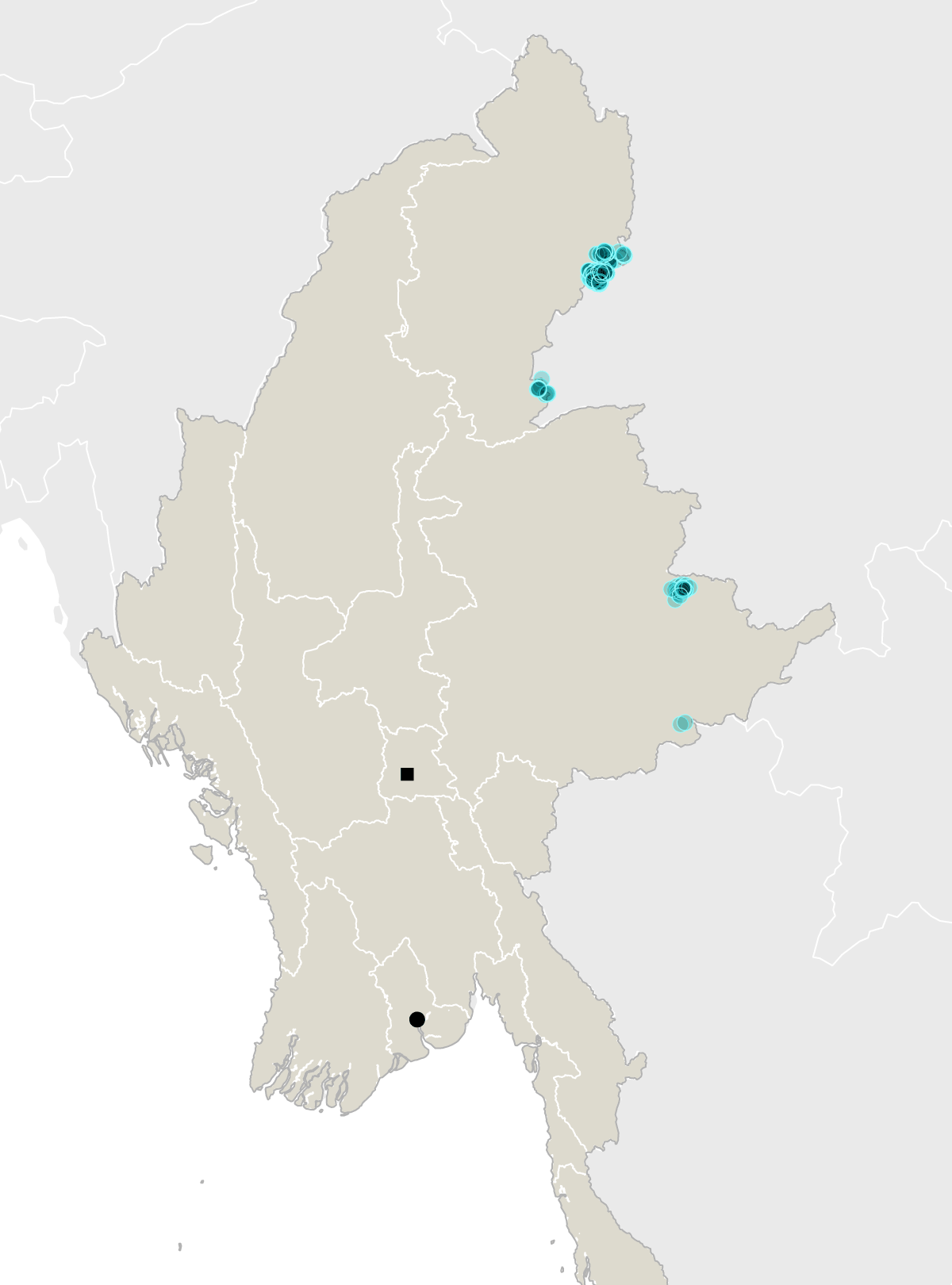
In the jungles of Myanmar’s borderlands, two rare earth mines emerged in recent years.
They are built along the Kok River, which flows into Thailand.
Residents of riverside villages, like Thaton, say pollution from the mining is causing health problems.
The Kok is a tributary of the Mekong River, and the pollutants have also entered Southeast Asia’s most important waterway.
CHINA
Kachin
State
INDIA
There are more than
300 rare earth mines
clustered near the
border between
Myanmar and China.
BANGLADESH
Shan
State
MYANMAR
LAOS
Naypyidaw
Yangon
THAILAND
CHINA
Kachin
State
INDIA
There are more than
300 rare earth mines
clustered near the
border between
Myanmar and China.
Shan
State
MYANMAR
LAOS
Naypyidaw
Yangon
THAILAND
CHINA
Kachin
State
There are more than
300 rare earth mines
clustered near the
border between
Myanmar and China.
Shan
State
MYANMAR
LAOS
Naypyidaw
THAILAND
Yangon
Sources: Shan State mine locations from the Shan Human Rights Foundation; Kachin State mine locations from Institute for Strategy and Policy (ISP) – Myanmar
About a dozen rare earth mines have sprung up in
a small area in northern Myanmar in recent years.
Area of
detail
Shan
State
Naypyidaw
Yangon
Built in 2024
Built before 2020
1 mile
Built in 2024
Built in 2022
MYANMAR
Built in 2022
2 miles
Built in 2022
Built in 2022
Built in 2020
Built before 2020
Built in 2024
Built in 2024
3 miles
About a dozen rare earth mines have sprung up in
a small area in northern Myanmar in recent years.
Area of
detail
Shan
State
Naypyidaw
Built in 2024
Yangon
Built before 2020
1 mile
Built in 2024
Built in 2022
MYANMAR
Built in 2022
2 miles
Built in 2020
Built in 2022
Built in 2022
Built before 2020
Built in 2024
3 miles
Many rare earth mines have
sprung up in a small area in northern
Myanmar in recent years.
Area of
detail
Shan
State
Built in 2024
Naypyidaw
Yangon
Built before 2020
Built in 2024
Built in 2022
Built in 2022
MYANMAR
Built in 2022
Built in 2022
Built before 2020
Built in 2024
Many rare earth mines have
sprung up in a small area of northern
Myanmar in recent years.
Built in 2024
Built before 2020
1 mile
Built in 2024
Built in 2022
Built in 2022
MYANMAR
2 miles
Built in 2022
Built in 2022
Built before 2020
Area of
detail
Shan
State
Naypyidaw
3 miles
Yangon
Sources: Shan Human Rights Foundation; New York Times analysis of satellite imagery from Planet Labs. Satellite image by Airbus via Google Earth captured in February 2025.
Thank you for your patience while we verify access. If you are in Reader mode please exit and log into your Times account, or subscribe for all of The Times.
Thank you for your patience while we verify access.
Already a subscriber? Log in.
Want all of The Times? Subscribe.
……Read full article on The New York Times-World
SE Asia Thailand Myanmar

One-stop lifestyle app dedicated to making life in Singapore a breeze!




 English
 简体中文
简体中文
Comments
Leave a comment in Nestia App