They’re Some of the Most Famous Words Ever Written. Have You Ever Really Read Them?
By A.O. Scott
A.O. Scott is a Times critic who writes about literature and ideas.
June 8, 2026
Share full article
8
“The United States themselves are essentially the greatest poem,” Walt Whitman wrote, but the nation was conceived in prose. Other countries have national holidays that commemorate feats of revolutionary or military glory. This one celebrates a document. The Declaration of Independence was a charter and a manifesto, yes, but in essence it was a memo, a hastily drafted, feverishly edited, hand-copied piece of committee work. A masterpiece, too.
It’s poetry, philosophy and polemic, all in a little more than 1,300 words and all represented in its second and most famous sentence.
The Declaration of Independence
1776
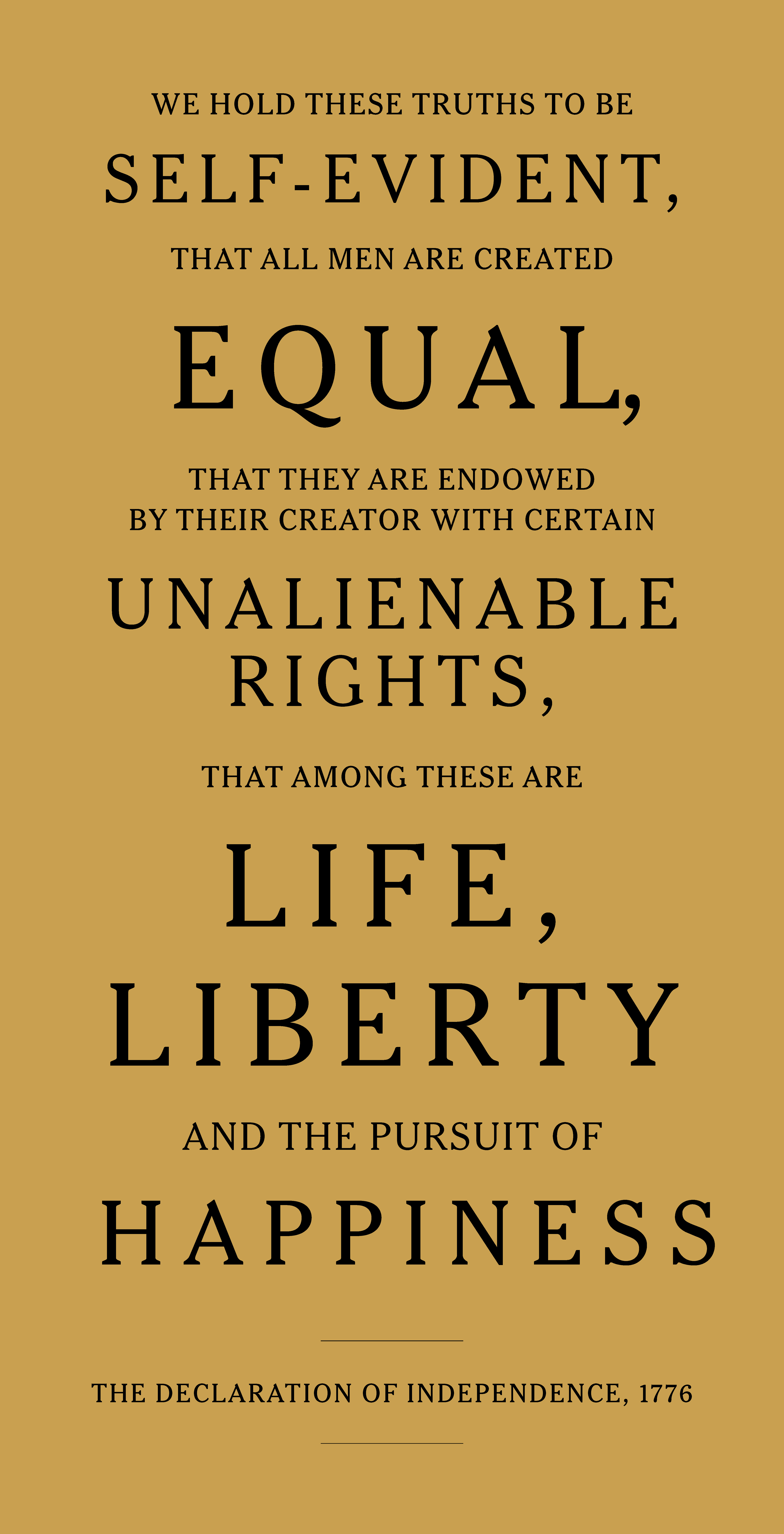
We hold these truths to be self-evident , that all men are created equal , that they are endowed by their Creator with certain unalienable Rights , that among these are Life , Liberty and the pursuit of Happiness .
No matter how many times you’ve read it before, it’s worth reading again. Each idea flows from the previous one, and a comprehensive argument takes shape.
We are equal.
We have rights.
Those rights describe the very essence of our humanity.
That’s a lot. Pages and pages have been written on this passage, seeking out its ideological subtext, its historical context and its intellectual pretexts in classical and early modern thought. But the plain English of the first 35 words — from “We” to “happiness” — is still remarkable in its sweep and radical in its implications.
It moves from a theory of knowledge to a vision of the good.
We — putting aside for a moment just who this “we” might be — don’t appeal to precedent, tradition or any other external authority, but to the evidence of our own eyes. Human equality is not aspirational: It’s obvious.
Furthermore, this equality isn’t just a formal, mathematical axiom. It has a specific moral and metaphysical content. A human creature is defined by the possession of rights, by a divinely granted entitlement to live, to act and to prosper.
This is remarkable writing — and also a slippery and variable text.
English grammar was a more fluid enterprise in 1776; punctuation and capitalization were irregular.
In the first printed version, for example, there was no period after “happiness.” The sentence kept going, swelling to paragraph length and encompassing all of human nature in a chiming succession of clauses.
Even the simplest gloss — the near-heretical attempt to put the language of the Declaration “in other words” — hints at the complexities rippling through the crystalline clarity of the prose. Every word is a fighting word, begging to be contested. What exactly did they mean by “equal”? By “Creator”? By “Liberty”? By “We”?
Over the years, writers of various scholarly, literary and political temperaments have proposed answers.
One assumption that has guided generations of interpreters is that Thomas Jefferson, John Adams and their collaborators meant a lot more than they said. Their simple words reflect deep learning and complicated agendas. Some historians have highlighted the influence of John Locke and other philosophers of the Enlightenment; others have emphasized the economic and political concerns of merchants, artisans and farmers in a prosperous outpost of the British Empire.
Those specific contexts and hidden meanings are important. But if the Declaration remains relevant and vital for ordinary readers after 250 years, it may be for the opposite reason: Its writers said so much more than they meant. The genius of the document lies not in the original, local intentions that might be excavated from it, but in the meanings that later generations have projected onto it.
An 1823 facsimile engraving by the printer William Stone of the Declaration of Independence. National Archives
Unlike its younger sibling, the U.S. Constitution, the Declaration isn’t an instruction manual. Interpreting it isn’t the job of tenured specialists. It belongs to the secular realms of politics and literature, which means that it lives to be adapted, quoted (and misquoted), wrenched out of its original bearings and repurposed.
The contradictions and limitations of the historical text are self-evident. The founders proclaimed liberty in a slave-owning society. They could hardly have anticipated the raucous, pluralistic, self-polarizing democracy the United States would become. (For what it’s worth they didn’t, in 1776, imagine what we know as the United States at all, but rather 13 autonomous, loosely affiliated political entities.) They wrote, as everyone does, in the heat of a chaotic present and in the face of an unknowable future.
That future, a succession of chaotic presents, including the one we now occupy, has looked back at those men gathered in Philadelphia as signers of an as yet uncashed check.
Abraham Lincoln at Gettysburg cited the words of the Declaration as a promise to be, however belatedly, fulfilled.
Four score and seven years ago our fathers brought forth on this continent, a new nation, conceived in Liberty, and dedicated to the proposition that all men are created equal.
And nearly 100 years later, at the March on Washington, the Rev. Dr. Martin Luther King Jr. warned that the check had bounced.
When the architects of our Republic wrote the magnificent words of the Constitution and the Declaration of Independence, they were signing a promissory note to which every American was to fall heir. This note was a promise that all men — yes, Black men as well as white men — would be guaranteed the unalienable rights of life, liberty and the pursuit of happiness.
It is obvious today that America has defaulted on this promissory note insofar as her citizens of color are concerned.
For Lincoln and King, the Declaration functions as both a sacred text and an unfulfilled promise. The conditions that it holds to be self-evident in that second sentence did not, at the time it was written, exist in any known reality. Whether they subsequently did or ever could is the subject of debates that have more or less defined our politics ever since, but the ringing confidence of the statement has not diminished.
Abraham Lincoln’s Gettysburg address and Martin Luther King Jr.’s speech at the March on Washington both hearkened back to the Declaration of Independence. Library of Congress/Getty Images, CNP/Getty Images
The source of that confidence, the conviction that gives the prose its bracing clarity, lies in the founders’ understanding of what they were against. Liberty and equality were ideals yet to be realized, but tyranny was a fact. The main body of the Declaration is devoted to describing its manifestations in exacting detail — taxing the colonists without their consent, suspending their legislatures, keeping standing armies among them — in order to justify the radical and unprecedented disruption of the status quo put forth at the beginning.
The invocation of self-evident truths and inherent rights is a warrant for the destruction of existing order, a rhetorical erasure not only of the divine right of kings but also, more generally, of the prerogatives of power.
This is a revolutionary document. Many years after it was written, when the world, emerging from the Napoleonic Wars, seemed to be entering an era of reaction and retrenchment, Jefferson wrote to Adams that “the flames kindled on the 4th of July 1776 have spread over too much of the globe to be extinguished by the feeble engines of despotism. On the contrary they will consume those engines, and all who work them.”
By A.O. Scott
By Parul Sehgal
By Jia Lynn Yang
By Peter Baker
By Wesley Morris
By A.O. Scott
Share full article
8
……Read full article on The New York Times-Arts
Other

One-stop lifestyle app dedicated to making life in Singapore a breeze!




 English
 简体中文
简体中文
Comments
Leave a comment in Nestia App