Think Your Takeaway Is Safe? Study Finds Nearly Half Had More Salt Than Advertised
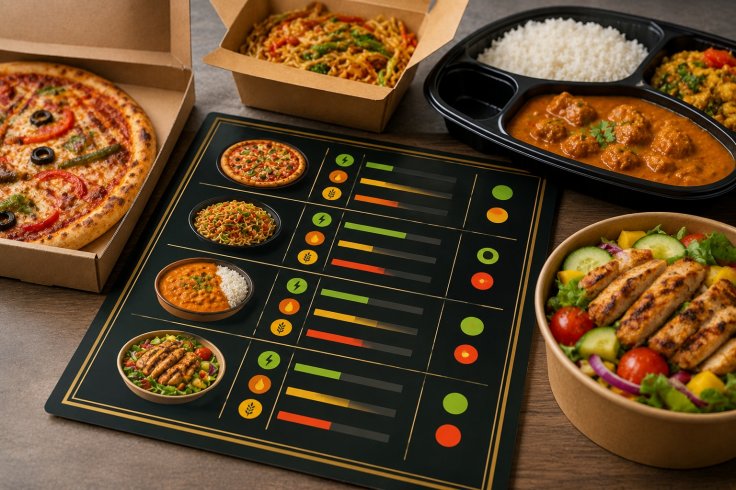
Takeaway meals displayed alongside nutrition information on a menu. (Reprasentational Purpose Only) AI Generated
KEY POINTS
Researchers found 47% of takeaway meals contained more salt than advertised.
The study analyzed 39 meals from 23 takeaway outlets in England.
Some pasta dishes exceeded the UK's recommended daily salt intake.
Researchers said menu nutrition labels should be treated as estimates.
Millions of people rely on restaurant nutrition labels to make healthier food choices, but researchers found that nearly half of the takeaway meals they tested contained more salt than advertised, with some single servings delivering almost twice the recommended daily limit for adults.
The study, led by researchers at the University of Reading and published in the peer-reviewed journal PLOS One, analyzed popular takeaway meals from restaurants and independent outlets. It found that 47% of meals exceeded their stated salt values, while several dishes contained enough sodium to surpass the UK's recommended daily intake of 6 grams in just one meal.
Researchers say the findings highlight the limitations of current menu labeling and underscore the need for consumers to treat nutrition information as an estimate rather than a precise measurement.
According to the World Health Organization, excessive sodium intake contributes to an estimated 1.8 million deaths worldwide each year.
The findings have also generated discussion on X, where science and health-focused accounts highlighted the gap between menu labels and actual salt content. Physician Dr. Pooja Garg shared the research, noting that nearly half of the takeaway meals tested contained more salt than advertised while pointing to one of the study's biggest surprises: fish and chips ranked among the lowest-salt options, whereas pasta, pizza and curries were among the saltiest.
To understand how accurately restaurants report sodium content, researchers purchased 39 takeaway meals from 23 locations in Reading, England, including both national restaurant chains and independent businesses.
The results showed significant differences between menu claims and laboratory measurements.
Pasta dishes emerged as the saltiest meals overall, averaging 7.2 grams of salt per serving, already exceeding the recommended daily intake. One pasta meal contained 11.2 grams, nearly twice the recommended daily limit in a single serving.
Meat pizzas recorded the highest salt concentration at 1.6 grams per 100 grams, while curries displayed the widest variation, ranging from 2.3 grams to 9.4 grams per serving.
One of the study's biggest surprises involved a traditional British favorite.
Contrary to expectations, fish and chips ranked among the lowest-salt takeaway meals tested. Researchers said this is largely because salt is generally added only after cooking and typically only when requested by customers. Chips purchased from fish and chip shops contained just 0.2 grams of salt per serving, compared with about 1 gram in chips from other takeaway outlets.
Researchers say the discrepancies do not necessarily mean restaurants are intentionally providing misleading nutrition information.
Professor Gunter Kuhnle, who led the research at the University of Reading, said accurately measuring salt content is far more difficult than many consumers realize.
"We conducted this research because we suspected that many menu labels were inaccurate on salt," Kuhnle said. "It is very difficult for restaurants to provide accurate values without measuring each meal. Variations in preparation methods, ingredients used and portion sizes mean food labels are often guess work. It's virtually impossible to know exactly how much salt is being added to your dinner."
He noted that while food manufacturers have steadily reduced sodium levels in packaged supermarket products over recent years, takeaway meals have not necessarily followed the same trend.
"Food companies have been reducing salt levels in shop-bought foods in recent years, but our research shows that eating out is often a salty affair," Kuhnle said. "Menu labels are supposed to help people make better food choices, but almost half the foods we tested with salt labels contained more salt than declared. The public needs to be aware that menu labels are rough guides at best, not accurate measures."
The findings also reignite debate over restaurant nutrition labeling. Public health advocates argue consumers should be able to rely on menu information when making dietary decisions, while restaurants face practical challenges because recipes, ingredients and serving sizes often vary from one order to the next.
Health experts say the study should not discourage people from ordering takeaway meals but should serve as a reminder that nutrition labels may not always be exact.
Consumers who are trying to reduce sodium intake, particularly those with high blood pressure, heart disease or kidney disease, may want to be cautious with meals known to contain higher amounts of salt, including creamy pasta dishes, meat pizzas and some curries.
Assorted takeaway dishes with visible salt seasoning, highlighting the issue of high sodium intake. Representational image. AI Generated
The researchers also suggest that choosing freshly prepared meals where salt is added separately, as is often the case with fish and chips, may sometimes result in lower sodium intake than heavily processed takeaway options.
Ultimately, the study points to a broader challenge facing both regulators and restaurants: balancing the demand for transparent nutrition information with the practical realities of preparing freshly cooked meals.
For diners, the message is straightforward. Menu nutrition labels remain a useful guide, but they should not be viewed as exact measurements. As researchers found, a meal that appears to fit within daily sodium recommendations on paper could, in reality, contain significantly more salt than expected.
X/ Dr Pooja Garg @poojagarg1111
……Finance International

One-stop lifestyle app dedicated to making life in Singapore a breeze!




 English
 简体中文
Comments
Leave a comment in Nestia App