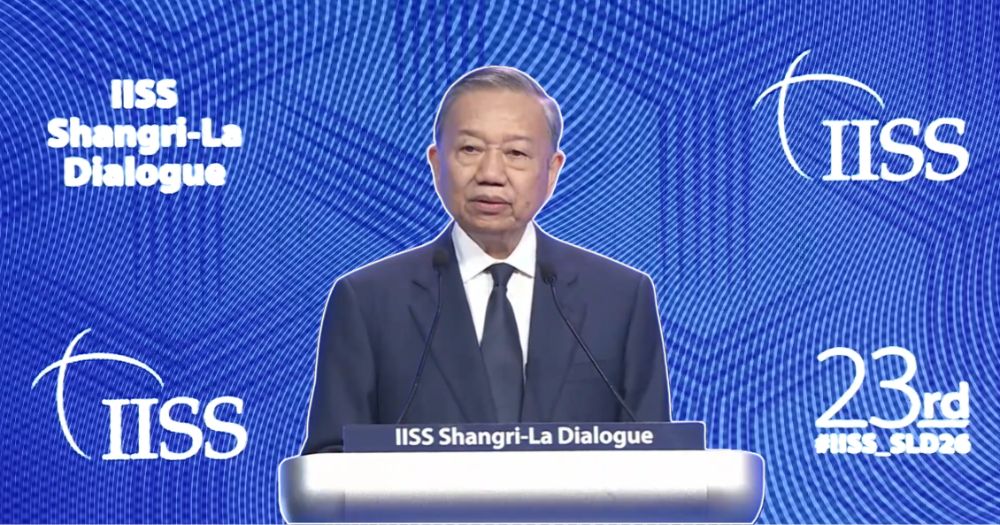
Vietnam President To Lam warns of '3 foundational crises' in 2026 Shangri-La Dialogue keynote speech
To Lam, the President of Vietnam and the General Secretary of the Communist Party of Vietnam, delivered the keynote speech at the 2026 edition of the Shangri-La Dialogue on May 29.
Present for the keynote were the leaders and defence ministers of several regional powers, including Prime Minister Lawrence Wong and U.S. Secretary of Defense Pete Hegseth.
Under To Lam, Vietnam’s traditional "bamboo diplomacy," which emphasised national interests and resilience, has been altered to a position of “fenceless diplomacy”, which emphasises international outreach and multilateral cooperation.
In his speech, he warned that the SLD convenes at a time when the world is confronted with multiple sources of risk and uncertainty.
To Lam highlighted what he called “three foundational crises” that are unfolding simultaneously and reinforcing each other.
The first is a crisis of the international order.
That order was never static, and adaptations had to occur through “rules, dialogues, mutual accommodation, and self-restraint, not through coercion, unilateral imposition, threats of force, or creation of fait accompli.”
The world faces a situation where the rules of such an order are still imposed, yet undermined in practice, and principles of international law are "interpreted selectively" and "applied inconsistently", subordinated to the logic where "might makes right" and the "strong prey upon the weak" in such an environment.
Small and medium states face mounting pressure, and are increasingly vulnerable to coercion.
The very space in which they connect with others, such as sea lanes and undersea cables risked “becoming areas of strategic contestation”.
Referencing the current Middle East crisis, he warned that a single flashpoint in one area could rapidly disrupt life across the globe.
Second, he believes there is a crisis of developmental models.
The very engines that “once allowed for extraordinary development opportunities for many countries”, such as globalisation, technological diffusion, and supply chain integration, are now under unprecedented strain.
To Lam warned of the threat posed by climate change and the rising cost of public debt, which threatened the livelihoods of "hundreds of millions".
He also warned that when opportunities for developing countries' advancement are narrowed, economic fragility can quickly evolve into social and political instability and even strategic uncertainty.
The third crisis, he said, was a crisis of strategic trust, what he called a silent yet dangerous crisis, as it might cause states to interpret each other's actions through the lens of mistrust and anxiety.
When trust declines, defensive measures may even be perceived as provocation, and a minor incident may trigger "spirals of reaction" in the absence of dialogue, communication and restraint.
To Lam said: "A durable regional order cannot be built upon perpetual fear and mutual distrust."
Overcoming such crises requires a strategic framework for trust-building, as well as transparency, dialogue, substantive information sharing to reduce misunderstanding, as well as clear codes of conduct.
After his speech, To Lam took questions from the audience, including questions about Asean, the security mechanism that Vietnam has co-developed with China, as well as Artificial Intelligence.
The first questioner referenced To Lam's domestic reforms over the past two years, which had focused on his efforts to streamline Vietnam's bureaucracy and promote the private sector, asking how those efforts affected Vietnam's foreign policy.
He also asked what To Lam envisioned a stronger and more confident Vietnam's role in Asean and a wider region would be.
To Lam said that he perceived Asean as a strategic space directly aligned with ensuring peace and security, and that Vietnam had always “considered Asean’s successes to be our own.”
Vietnam does not aspire to be a hub of power, but rather strives to be an active and reliable partner. As its capacity as a nation grew, the more it would be able to contribute to Asean.
"We believe that a united, resilient Asean that can uphold its centrality will continue to be an important foundation for peace, stability, and security in the Indo-Pacific," To Lam said.
The second question was asked by a member of China's military, who referred to the "3+3" ministerial-level strategic dialogue mechanism between Vietnam and China, which covers diplomacy, defence and public security.
He asked whether the mechanism could provide a new approach to promote regional security cooperation.
To Lam said Vietnam adhered to its “Four-Nos” foreign policy: no to engage in military alliances, no to aligning with one country against another, no to allowing a third country to station troops or bases in Vietnam, and also no to resorting to the threat or use of force.
The 3+3 Mechanism, he said, reflects Vietnam's position of self-reliance and resilience.
To also said that Vietnam reaffirmed the need to comply with the principles of international law and the UN Charter to pursue peace and mutual benefit, and remain an active and responsible member of the international community.
To that end, the 3+3 mechanism brought forth practical values in bolstering Vietnam's relations with China and ensuring and contributing to peace, stability, and cooperation in the region.
The final question of the session revolved around artificial intelligence and how AI, as a technology, might be a solution to defence modernisation and military capability issues.
To Lam acknowledged the tremendous advantages of AI as a new technology, but warned that it had its share of detrimental issues.
Vietnam believes that human decisions remain important, especially in defence and security.
He said that AI has the capability of contributing to efforts of the protection of key and essential civil infrastructure, such as healthcare facilities and undersea cables.
But he also said that there is a need for transparency and the building of trust when it comes to the utilisation of such technological advancements in areas such as manufacturing, but also in areas like defence.
……Read full article on Mothership - News
News Singapore

One-stop lifestyle app dedicated to making life in Singapore a breeze!








 English
 简体中文
简体中文
SunMoonStar12345 31/05/2026
Do you believe what Too Lan had said? Saying is easy.
Reply