Watch fans can explore the world of fine timepieces in Geneva
Cedric Johner is at home in the middle of what looks a lot like organised chaos.
His two rooms in a commercial building in Carouge near Lake Geneva in Switzerland are lined with tables and workbenches, strewn with milling machines, lathes, precision tools plus magnifying glasses.
At the back is a table lined with files of varying grades. All are crucial for watchmaker Johner who laboriously crafts each timepiece by hand.
Johner produces around 12 watches each year – more would be impossible.
“Every one is unique,” he says.
Geneva is where the big names in watchmaking are based and Johner is one of the best-known independent watchmakers on the scene.
His name is synonymous with excellent craftsmanship. His watches are regarded as works of art – and he is widely seen as one of the guardians of traditional watchmaking.
Fans of watches can spend weeks exploring the world of fine timepieces in Geneva.
After Zurich, Switzerland’s second-largest city is one of the world’s most important horology centres.
It is home to renowned watch brands and producers including Rolex, Patek Philippe and Vacheron Constantin, plus boutiques, museums and manufactories.
Art-deco showcases for priceless watches at the Patek Philippe museum in the Plainpalais area of Geneva. — Tourism Geneva/dpa
One of the most striking examples of Geneva’s rich watchmaking heritage is the Malbuisson Clock in the Passage Malbuisson, with its bronze figures and bells.
Or head to the working floral clock (Horloge Fleurie) in the Jardin Anglais (English Garden), which dates back to the mid-20th century.
But the area’s proud history of horology goes back far further. Geneva calls itself the cradle of watchmaking, as of 1601.
The first watchmakers’ guild was set up on Lake Geneva after the city broke with the Catholic Church in 1536. The citizens decided to make changes, and a few months later, reformer John Calvin came to Geneva – a Protestant, hard-working and ambitious man.
“Wastefulness and idleness were his greatest enemies,” says Margit Schwiegelhofer, a city guide in Geneva.
Jewellers were struggling at the time. But the watch trade fared better, as watches were everyday items, though at that time, “watches” still meant clocks or pocket watches, initially with only an hour hand.
The wristwatch only appeared after World War I, says Schwiegelhofer. Further features came later – known as “complications” in the field and meaning functions such as a date display, moon phase display, perpetual calendar and chronograph.
The job of a watchmaker was not prestigious. Women and children worked in the impoverished district of St Gervais.
The dirty water created in the production process was channelled directly into the River Rhone and Lake Geneva.
Men were the master craftsmen, though they were not formally trained at the time.
So the people of Geneva made watches. They were fortunate that there was already a bridge across the river and that crossing the Alps here was relatively easy, establishing the city as a trading centre.
Every day, as Johner crafts the watches in his workshop, he follows in the footsteps of industry’s storied ancestors. Take Audemars Piguet, Patek Philippe and Vacheron Constantin, Swiss businesses referred to as the “Holy Trinity of Watchmaking”.
The three companies are among the oldest in their craft.
Vacheron Constantin is regarded as the world’s oldest watchmaker still in continuous operation (1755), while Blancpain has been producing mechanical watches since 1735, albeit with some interruptions.
Today, all have shops and distribution networks in Geneva, but there are also sites worth exploring beyond the city.
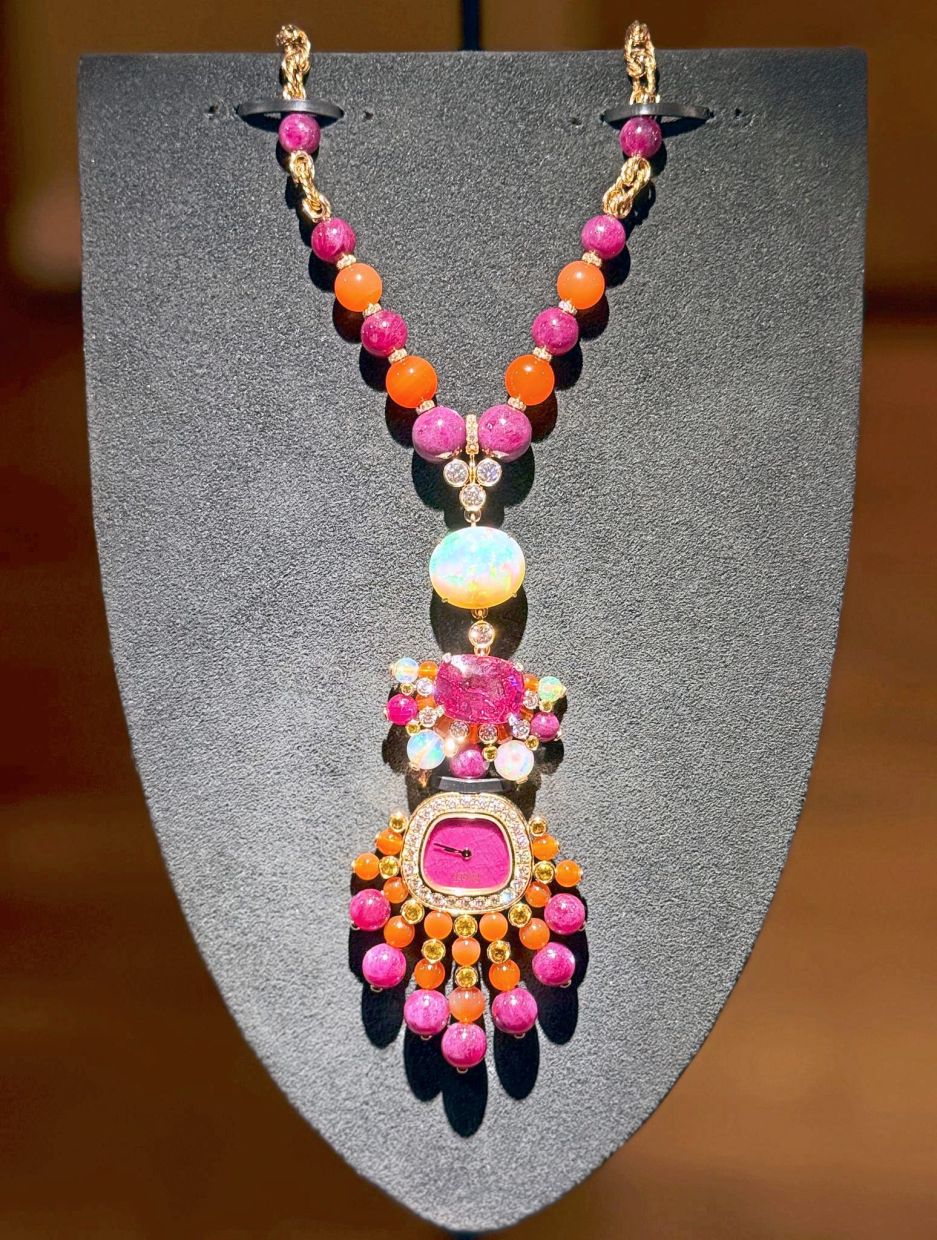
The Swinging Sautoir, a watch from Piaget’s the Shapes of Extraleganza high jewellery collection in Geneva. Such watches, made as part of necklaces, brought Piaget fame in the 1960s. — VERENA WOLFF/dpa
Many producers maintain workshops in the Vallee de Joux in Vaud, which is about an hour’s drive from Geneva.
Up in the Jura, the climate is harsh, and people traditionally lived off the land. But, cut off by snow in winter, many sought other kinds of work in the colder months of the year, to supplement their income.
The farmers became precision engineers, crafting movements for the major watch manufacturers. Many worked in small rooms on an upper storey of their homes where it stayed light for longer and was free of dust.
Once the paths thawed, they would walk to Geneva for two days in order to sell what they had made.
The Espace Horloger watch museum in Le Sentier, 30km north of Lake Geneva is the heart of this centre of craftsmanship.
Here is the place to see antique watches dating back to the 16th century. Visitors also learn about the watchmaker’s craft and how complications work – such as the tourbillon, which mechanically ensures accuracy.
The Patek Philippe Museum in Geneva’s Plainpalais district is where senior executive Philippe Stern finally found a place to display his extraordinary watch collection, shown in Art Deco cases.
The collection includes more than 2,500 timepieces – including a pocket watch that belonged to Jean-Jacques Rousseau’s grand- father. He came from a family of watchmakers, as you learn on a guided tour.
The first wristwatch, dating from 1868 and made for a woman, can also be seen behind multi-layered security glass. At that time, men still wore pocket watches.
Women wore an elegant piece of gold jewellery with a large gemstone on their wrist which concealed the dial.
Bespoke watches are also the speciality of Watchmakers United, situated right on the lakeshore. “We are a collective through which watchmakers can market their work,” says general manager Vincent Vuillaume in the heavily secured shop.
Here, you can buy watches for less than 1,000 francs (RM4,951), but also some that cost more than a hundred times that sum.
For watch enthusiasts who don’t want to visit one of the chain shops along the Rue du Rhone, this is certainly the place to go. And for small, independent manufacturers, this is not only a place to sell their goods but also to network, says Vuillaume. – VERENA WOLFF/dpa
……Read full article on The Star Online - Lifestyle
Entertainment Malaysia

One-stop lifestyle app dedicated to making life in Singapore a breeze!




 English
 简体中文
简体中文
Comments
Leave a comment in Nestia App