Wildfires Live Updates: Spain and France Face Extreme Heat as Flames Rage
Pinned
Updated
July 27, 2026, 4:57 a.m. ET
Breaking news reporter
Firefighters were racing to contain wildfires across Spain and France on Monday ahead of a new wave of extreme temperatures that forecasters warned would worsen conditions and potentially start new blazes.
Deadly fires around the cities of Valencia, Madrid and Bordeaux, fueled by parched vegetation after weeks of successive heat waves, have forced hundreds of thousands of people to evacuate and burned hundreds of homes.
In Spain, a worsening blaze in the eastern province of Castellón forced the evacuation of another 16,000 people. Prime Minister Pedro Sánchez of Spain was scheduled to visit the province, where fires have scorched more than 16,000 acres, later in the day.
In central Spain, a wildfire that has burned more than 190,000 hectares across Ávila, Toledo and Madrid, the capital, is now the largest in the country’s modern history, according to Spain’s Ecological Transition Ministry.
President Emmanuel Macron of France is set to chair a crisis meeting on Monday, while ministers are expected to meet with representatives of industries from the southwestern regions of Gironde and Landes surrounding Bordeaux, which have been severely hit by the fires. Some 115,000 hectares have burned in France so far this summer, Interior Minister Laurent Nuñez said on Sunday.
Here’s what else we’re covering.
Evacuations: Hundreds of thousands of people have been warned to evacuate or shelter in place since the latest wildfires began last week. In France’s Gironde and Landes regions, local officials warned more than 220,000 to leave their homes. Across the border in Spain, the authorities called for 60,000 people to evacuate from around Madrid and an additional 16,000 around Valencia.
Extreme heat: A new heat wave forecast for western Europe this week could send temperatures soaring to 40 degrees Celsius (104 degrees Fahrenheit) or higher, forecasters said. Read more ›
Scorching summer: Record-setting heat waves in western Europe created the conditions for the latest wildfires in France and Spain, parts of which had already faced unusually hot and dry summers. Read more ›
Show more
July 26, 2026, 5:25 p.m. ET
Mark Landler and Giulia Imbert
Reporting from Bordeaux, France
Image
An exhibition center in Bordeaux, southwestern France, where people sheltered after being displaced by the wildfires on Sunday. Credit...Ed Jones/Agence France-Presse — Getty Images
As a fierce, fast-moving, and capricious wildfire spread to within 10 miles of Bordeaux on Sunday, the city, France’s sixth largest, had become a refuge for thousands of people evacuated from their towns and villages.
Many of them took shelter in Bordeaux’s cavernous exhibition center, united by fear, confusion, and a determination to get back their homes, which they desperately hoped would be spared by the flames.
There are differing voices in this instant community, attesting to the divergent lives of the people across the Gironde region. Fear is leavened by hope, gratitude to the firefighters is tinged by anger toward the authorities, and optimism in a swift recovery is offset by uneasiness about the natural forces that led to this disaster.
“I don’t want to start again at zero to find a new apartment,” said Imane El Idrissi, 35, a single mother who fled at 4 a.m. on Saturday, after the police pounded on her door to warn her it was time to leave. “I don’t have the means.”
Ms. El Idrissi, who was born in Morocco, said she had carefully gathered all her immigration and residency documents, filling her suitcase with papers in place of clothing. Her two daughters were born in France, she said, but she couldn’t shake the fear that if she left the country, she might not be allowed back in.
Her friend, Atika Farhati, 77, a retired hospital worker, said she worried about losing her apartment and treasured possessions, including a Chinese vase. Her town, Eysines, northwest of Bordeaux, lies in the path of the fires, which were blown east by swirling winds from the Atlantic toward the city.
Image
Trees engulfed in flames in Marcheprime, west of Bordeaux, France, on Sunday. Credit...Alain Jocard/Agence France-Presse — Getty Images
“The sky was red,” she said, recalling the flame-scarred view from her fifth-floor balcony. “Now that we’re here, we can only wonder how it’s going to end.”
For Roger Peuron, that outcome is not seriously in doubt. A retired engineer who worked at an armaments factory in Saint-Médard-en-Jalles, Mr. Peuron, 89, said he was confident the fire would be stopped short of his town, if only to prevent it from igniting a factory that makes fuel for strategic ballistic missiles.
“If that ever happened to the industry,” he said, “it would be a true catastrophe.”
Still, Mr. Peuron said France had never witnessed a fire like this, and it raised profound questions about how people should change their relationship to their environment. Sprawling pine forests that were planted across the region over centuries are now an accelerant for fire.
“We need to replace the trees because the sap in the pines is flammable, and the trees don’t have deep roots, so they are easily blown over by the wind,” Mr. Peuron said. “The pines were planted to drain the region’s swamps, but they’re no longer suited to the environment.”
“We need sequoias,” he added. “They’re sturdy!”
French officials backed up Mr. Peuron’s contention about the extraordinary nature of the fire, reflecting a warming climate. About 42,000 hectares, or 103,000 acres, have burned in Gironde since the fire started last week. It has forced the evacuation of about 220,000 people, one of the largest peacetime evacuations in French history.
At the same time, fires in central Spain have burned about 50,000 hectares and displaced 105,000 people.
So far this summer, forest fires have burned 115,000 hectares in France, according to the French interior minister, Laurent Nuñez. By comparison, the average yearly loss from 2014 to 2023 was 9,000 hectares. In the summer of 2022, which was considered devastating and led France to bolster its firefighting resources, about 70,000 hectares burned.
On Sunday, a heavy yellow-orange cloud of smoke hung over Bordeaux, an elegant city of 260,000 that is famous as the center of France’s wine industry. An acrid smell pervaded its streets, and tiny particles of soot flecked the air. Pedestrians wore face masks, and many shut themselves in their homes.
Image
People wearing masks along the river promenade in central Bordeaux on Sunday. Credit...Ed Jones/Agence France-Presse — Getty Images
As the fire crept toward the city limits, Bordeaux’s mayor, Thomas Cazenave, said on Sunday that the authorities did not expect they would have to order an evacuation. But he and other officials warned that uncertainty was the watchword, as shifting winds and heat made it difficult for firefighters to gain control of the blaze.
The forecast for Bordeaux calls for high temperatures of 37 degrees Celsius on Tuesday and 41 on Wednesday — about 99 and 106 degrees Fahrenheit.
At the exhibition center, the talk was of how long people would have to wait before they would be allowed back home. People passed the time reading, playing cards, and, in the case of one young man, Julien Hochard, picking at his guitar.
“There’s a solidarity that we’ve seen emerge here, one that’s slowly growing,” said Mr. Hochard, sitting on a camp bed next to his friend, Céline Lartigue. She said she had been impressed by firefighters’ efforts to stem the blaze.
But from a nearby bed, Rabah Boukabous piped up to disagree.
“I think the authorities reacted late,” he said. “They should have recognized the gravity of the situation.”
“They could not have prevented it,” said Mr. Boukabous, 70, “but they could have limited it.”
Catherine Porter contributed reporting from Paris
Show more
July 26, 2026, 12:52 p.m. ET
Reporting from Villamanta, Spain, near Madrid
Image
Consuelo Lorza, 88, and her 11-year-old granddaughter, Sara, at an evacuation center in Villamanta, a town southwest of Madrid, on Sunday. Credit...Joseph Fox for The New York Times
Arantxa Alcázar stepped into her garden on Thursday when she heard police officers shouting at residents to evacuate their homes in Villa del Prado, a town west of Madrid. The blazes that had been raging in the distant mountains were now sweeping down their street.
“Like a river of fire,” she said.
She fled with her mother, Consuelo Lorza, 88, and her 11-year-old daughter, Sara, to another town, only to have to evacuate again hours later, to a nearby village. The following day, they were forced to flee once more, this time to the town of Villamanta.
“I’ve been sleeping here for three days — if you can call that sleep,” Ms. Lorza said on Sunday morning. She shared a bunk with her granddaughter, while Ms. Alcázar spent the night in her car with the family dog. They eventually found out that Ms. Alcázar’s home had been spared.
Image
A fire on Sunday in Betxi, along Spain’s Mediterranean coast, north of València, the country’s third largest city. Credit...Eva Manez/Reuters
More than 200 people were staying on makeshift bunks inside a sports hall in Villamanta on Sunday, anxiously waiting to learn whether they would be allowed to return home or whether the flames were advancing toward them. Some tried to nap after lunch while children kicked a football around, using one of the hall’s goals.
In total, around 90,000 people in central Spain had been evacuated from their homes or ordered to take shelter as firefighters battled what Isabel Díaz Ayuso, the Madrid region’s president, described as “the worst wildfire” in the region’s history.
Ms. Lorza had just been comforted by King Felipe VI and Queen Letizia, who visited the sports hall to show their support. “The queen told me she couldn’t believe it. Evacuated three times!” Ms. Lorza said.
Image
The evacuation center in Villamanta, a repurposed sports hall, on Sunday. Credit...Joseph Fox for The New York Times
King Felipe VI said on Sunday that the wildfires in Madrid and the neighboring Toledo and Ávila regions remained active but that there were some “positive signs” in the fight against the blazes.
In the Madrid region, fire had destroyed 43 homes and severely damaged more than 300 others, Ms. Díaz Ayuso said. “That number will rise enormously, as we have never seen before,” she said, tears welling in her eyes.
Across central Spain, 77,000 hectares — about 190,000 acres — have burned, the country’s public broadcaster reported.
Image
A street in the town of Pelayos de la Presa, less than 20 miles northwest of Villamanta. The scale of the damage from the wildfires west of Madrid is only beginning to emerge. Credit...Oscar Del Pozo/Agence France-Presse — Getty Images
Some evacuees in Villamanta complained that they had received little information about the status of the fires. They waited nervously near their cars, eating churros.
“We watch the fires every minute” through security camera feeds, said Carmen Bautista, 53, who had slept, along with her husband, in their van beside the sports center. They had watched the flames approach their home in Caravan Garden, a nearby development, but it was now safe.
Ms. Bautista lamented that residents had endured one natural disaster after another — the pandemic, then the deadly floods that swept away three bridges — and that each one seemed worse than the last.
“With the previous catastrophes, you could stay at home. Now …” she broke off, spreading her arms in resignation.
Image
Carmen Bautista, 53, with her son next to and her husband in the front seat. The family has been sleeping in their vehicles in Villamanta since Thursday. Credit...Joseph Fox for The New York Times
While firefighters struggled to bring the blazes under control, some residents took matters into their own hands. In the mountains around Robledo de Chavela, where the flames had torn through pine forests and holm oaks, several residents on Saturday slipped past police roadblocks to fight the fires.
“We may be doing something slightly illegal, but we have saved this part of the mountain,” Javier Quijada, 30, said on a video call. Mr. Quijada and dozens of other residents, all members of the local hunting association, had been fighting the flames with hoses, shovels and even green branches they used to try to smother the fire. He said police officers eventually waved them through, warning them to be careful.
“This is our mountain. Our lives are going up in flames,” Mr. Quijada said. “I’ve lost count of how many tears I’ve shed since the fire began.”
Show more
July 26, 2026, 5:39 a.m. ET
Nazaneen Ghaffar is a reporter on The Times’s weather team. She is based in London.
Note: Data is as of Source: European Centre for Medium-Range Weather. William B. Davis and Bea Malsky/The New York Times
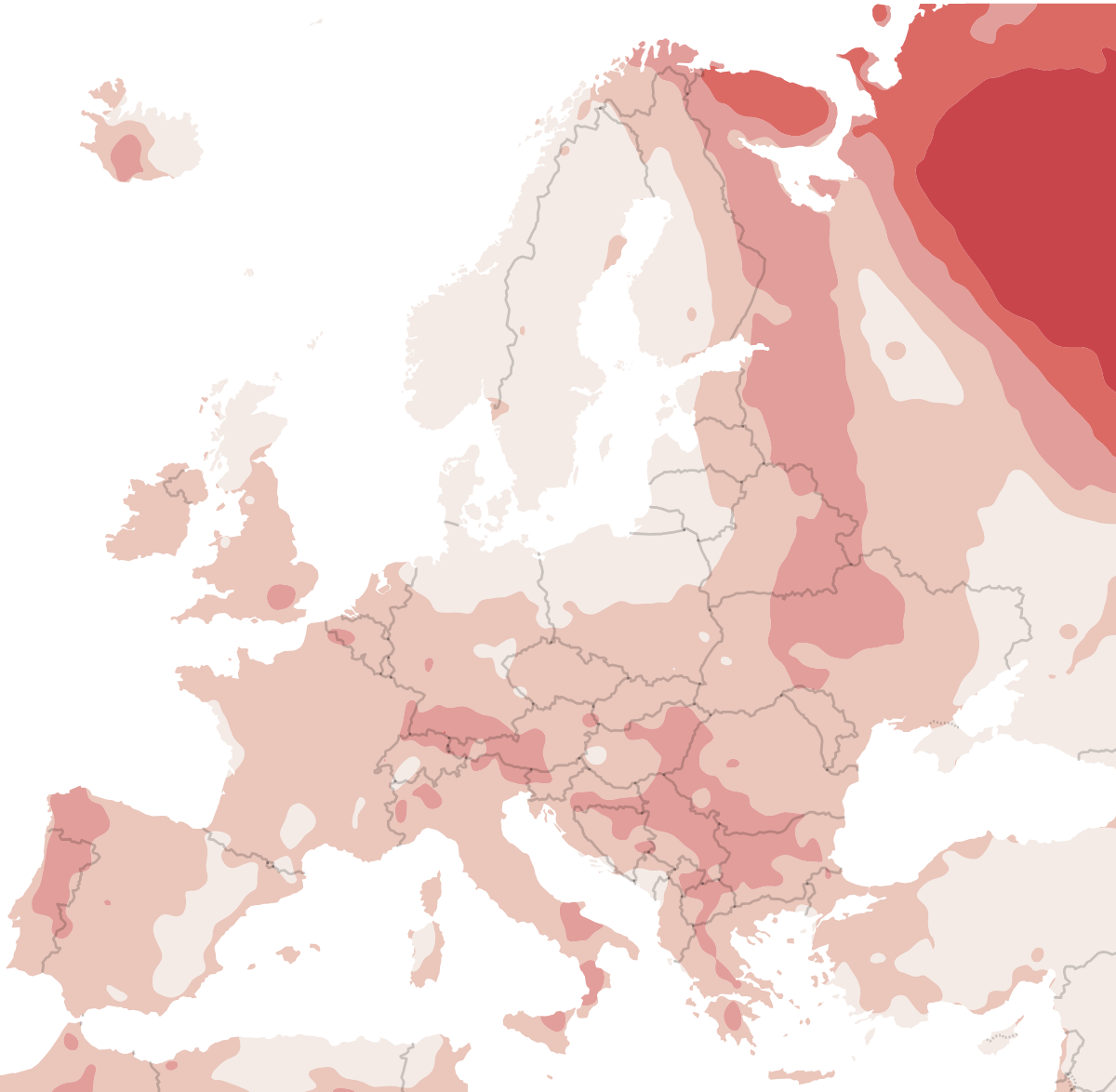
A new heat wave is expected to spread across large swaths of Europe this week, marking the continent’s fourth spell of extreme heat since May.
The relentless run of high temperatures has helped fuel deadly wildfires across parts of western and southern Europe, forcing hundreds of thousands of people to evacuate and destroying thousands of hectares of land.
The latest bout of heat is expected to begin on Monday. By midweek, parts of western Europe could see temperatures soar to 40 degrees Celsius (104 degrees Fahrenheit) or higher, forecasters said.
Months of repeated heat waves, combined with a lack of significant rainfall, have left vegetation tinder dry across much of the region, creating ideal conditions for fast-moving wildfires.
As of Sunday, more than 300,000 people had been forced to evacuate or shelter as hundreds of firefighters battled blazes near major cities in France and Spain.
In Italy, fires have raged in Sicily and Calabria, in the south of the country.
In Britain, residents in Scotland were allowed to return to their homes on Saturday, after more than 500 firefighters spent 10 days battling a wildfire in the Cairngorms National Park.
Here’s what to know.
The latest spell of heat in western Europe may not be as exceptional as the record-breaking high temperatures in June, but forecasters said it is expected to exacerbate an already dangerous wildfire situation.
According to the European Forest Fire Information System, parts of southwestern France and northern Spain are expected to remain under “very extreme fire conditions” — the highest category in its fire danger forecast — through at least Wednesday.
The extreme fire danger extends across much of the Iberian Peninsula, western and central France, northern Finland and parts of the western Balkans, while a very high danger warning covers areas of central Europe and parts of Turkey.
Météo-France, the French weather agency, said the fire danger eased slightly on Saturday after occasional severe thunderstorms swept across southern France. But forecasters warned that dry, gusty regional winds on Sunday and Monday would quickly elevate the risk, as another heat wave develops across the country and causes temperatures to soar to up to 40 degrees Celsius. One of the most affected areas will be Bordeaux, in the southwest, which is already facing a severe wildfire that has forced hundreds of thousands of people to evacuate.
In Spain, forecasters at AEMET, the national weather service, said the fire danger was expected to ease slightly on Sunday across much of the country. However, very high or extreme conditions were forecast to persist across eastern and southern Spain, with temperatures expected to climb above 40 degrees Celsius in the south during the coming week.
Portugal is expected to see temperatures rise to around 40 degrees Celsius beginning on Monday, especially in the southeast. The country’s weather service, IPMA, issued its highest fire danger warning for parts of southern Portugal, along with a broad swath of central and northern regions, through Wednesday.
Temperatures are forecast to climb in Britain. The Met Office, the country’s weather service, said the hottest conditions were expected across southeast England, where temperatures could reach 35 degrees Celsius (95 degrees Fahrenheit) by the middle of the week.
See temperatures as...
f° c°
High-temperature forecast
70
80
90
100
110
120
°F
Note: Data is as of Source: European Centre for Medium-Range Weather. William B. Davis and Bea Malsky/The New York Times
While the degree to which a single heat event is influenced by climate change requires specific attribution studies, scientists are certain that heat waves around the world are generally becoming hotter, more frequent and longer-lasting, and Europe is warming faster than any other continent.
In 2025, almost the entire continent was hotter than normal. Researchers estimate that in recent years, tens of thousands of heat-related deaths have occurred in Europe annually.
Many homes, schools and businesses across the continent were built for a cooler climate. In Britain, many were even built to retain heat, making cooling off during heat waves especially difficult. Air-conditioning is not a quick fix. In France, installing such systems has become a political flashpoint, while in Britain, high energy prices deter many.
Even in typically hotter Mediterranean cities, where old-fashioned courtyards, heavy shutters and white-stone facades are designed to keep homes cool, many newer buildings have been constructed using techniques that trap heat.
See temperatures as...
f° c°
Degrees above or below average for July 27
0 °F
+5 °F
+10 °F
+15 °F
Sources: University of Maine Climate Change Institute and the National Centers for Environmental Prediction Global Forecast System
Notes: Forecasts are for 8 p.m. Eastern on July 26, 2026, to 8 p.m. on July 27, 2026. Averages based on data from 1979 to 2000.
By Lazaro Gamio and Zach Levitt
Staying cool and hydrating often are the two most important things to do to avoid feeling sick and discomfort in extreme heat. Here are some other ways to keep cool:
Block out the windows in your home — especially those that get afternoon sun — with a blanket or a darker sheet during the day to keep the heat out. At night, keep windows open and run fans to circulate the air.
Spritz your skin with a mist of cool or room-temperature water or wipe your forehead with a cool cloth. Cold showers can also help you cool down.
If you need to be outdoors, put ice cubes in your water bottle and drink cool liquids. If you plan to exercise, douse your head in cold water. Swimming is also a great way to exercise and keep cool.
When exploring or sightseeing, seek out cooler attractions such as museums, cathedrals or even subterranean exhibitions. Some cities have created public spaces to cool down: Barcelona has climate shelters and Paris has drinking fountains, for example. London has a Cool Spaces map to find spots.
Watch out for signs of heat stroke. The Centers for Disease Control and Prevention lists some of them as dizziness, a rapid pulse, nausea, headache and fainting. But symptoms can vary.
……Read full article on The New York Times-World
Other

One-stop lifestyle app dedicated to making life in Singapore a breeze!




 English
 简体中文
简体中文
Comments
Leave a comment in Nestia App